
Ipsos Pride Report 2026
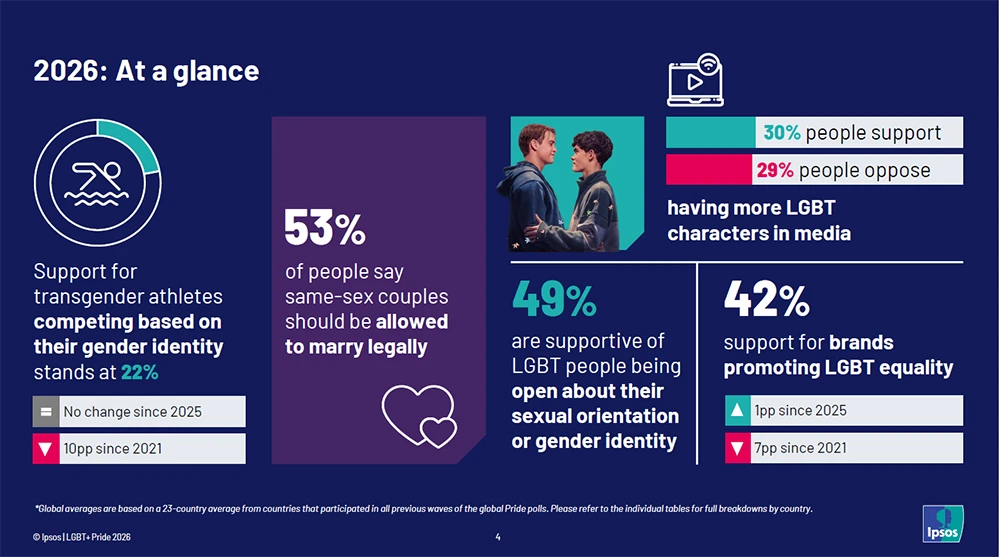
In recent years, we’ve seen evidence of a “wokelash” on many key metrics, and across a number of countries. This latest release reveals a more nuanced picture, with attitudes stabilising on a series of measures, continuing the trends observed in the 2025 Pride report.
Key headlines include:
- While there is general support for companies and brands promoting LGBT rights, it is not as widespread as it was five years ago. On average across 23 markets*, 42% of people support companies and brands actively promoting equality for LGBT people – that’s in line with the 41% recorded last year, but marks a notable dip from 49% in 2021, reflecting changing consumer expectations across a range of countries.
- We see widespread agreement that transgender individuals face discrimination, but divergence on policy-related matters such as access to single-sex facilities and participation in sports, highlighting ongoing societal debates. Support for trans athletes competing based on their gender identity has dropped from 32% in 2021 to 22% in 2026 across 23 countries*, with opposition the dominant view in almost all countries, including historically supportive ones.
- Levels of support for increased LGBT representation in TV, films and advertising range from 59% in Thailand to 14% in South Korea, highlighting persistent cultural hesitations toward inclusivity in mainstream media. The 23-country average* reflects this lack of consensus: 30% of people are in support of more LGBT representation in media, while 29% oppose this.
- Same-sex marriage – a cornerstone of acceptance – continues to have strong global support, though levels vary significantly by country. European countries such as the Netherlands (80%), Spain (74%) and Sweden (73%) display robust support. In contrast, countries showing lower support include Poland (33%) and Türkiye (16%), indicating regional variations in societal norms and legal standpoints.
Other Ipsos Pride LGBT+ Reports: 2026 | 2025 | 2024 | 2023 | 2021
About this study
These are the results of a 26-country survey conducted by Ipsos on its Global Advisor online platform between April 24, and May 8, 2026. For this survey, Ipsos interviewed a total of 19,019 adults aged 18-74 in Canada, Republic of Ireland, South Africa, Türkiye, and the United States, 20-74 in Thailand, 21-74 in Singapore, and 16-74 in all other countries. The “26-country average” reflects the average result for all the countries and markets where the survey was conducted. It has not been adjusted to the population size of each country or market and is not intended to suggest a total result.
* Change for 23-country average is based on the countries which were in prior editions of the Ipsos LGBT+ Pride report.