More people say they’re wearing masks to protect themselves from COVID-19 since March

There’s been an increase in the number of people wearing masks in many countries.

More people across 15 major countries say they are now wearing a face mask to protect themselves from the coronavirus pandemic.

In a survey of nearly 29,000 respondents conducted from April 9 to 12 in 15 countries, there’s been gradual increase in the number of people who say they are now wearing a face mask due to COVID-19 since mid-March.

Countries where most respondents are taking this personal action are Vietnam (91%), China (83%), Italy (81%), Japan (77%) and India (76%). Meanwhile, those in developed nations are least likely to do this including the United Kingdom (16%), Germany (20%), Australia (21%), Canada (28%) and France (34%).
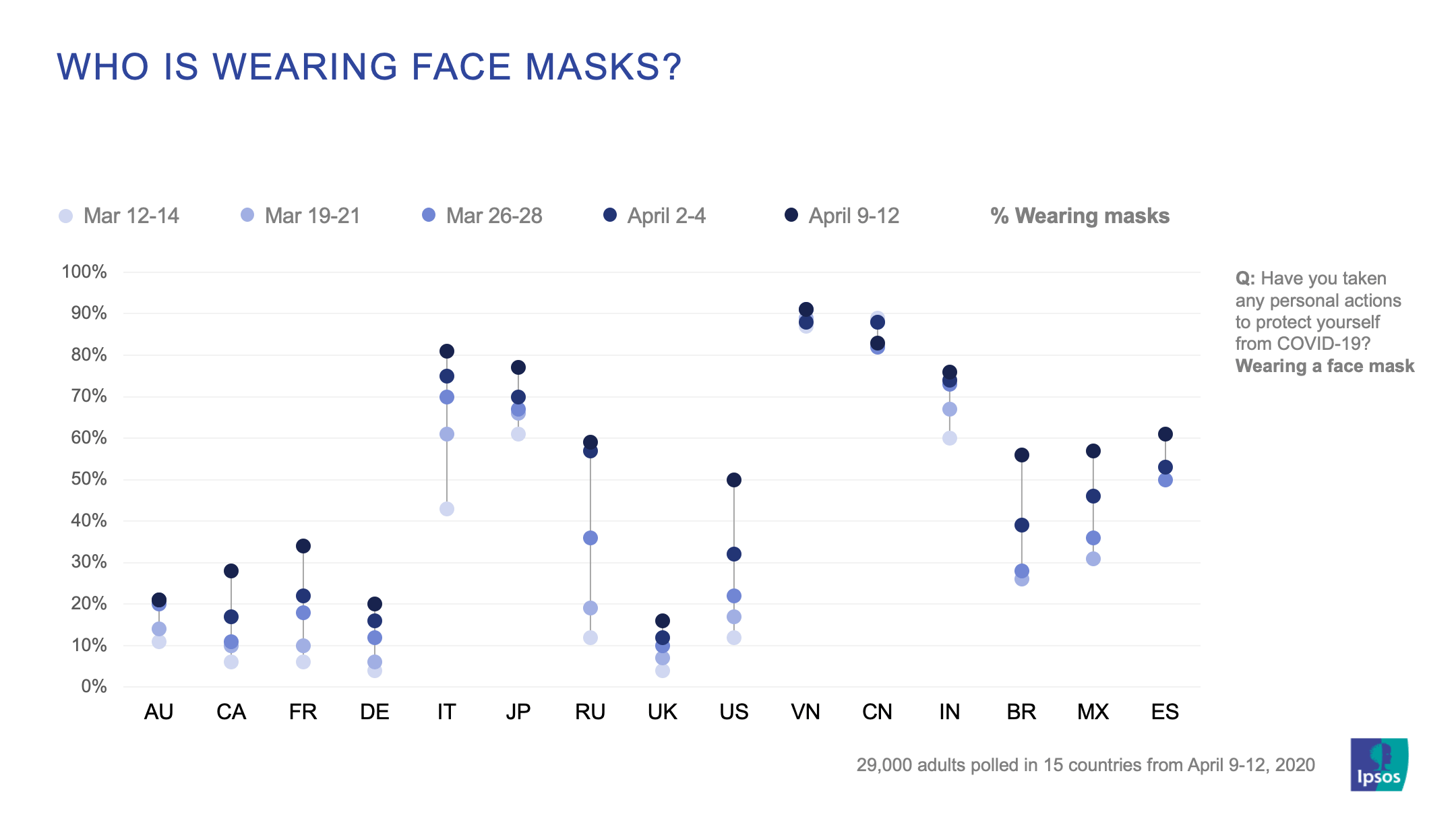
Who is wearing face masks? | Coronavirus pandemic | Global Advisor | Ipsos

Since March, Russia (+47 percentage points), the United States and Italy (+38) have seen the biggest jumps in the number of people who now say they are wearing a mask, followed by significant increases in Brazil (+30), France (+28) and Mexico (+26). China remains high with only a small decline (-6) on this measure since March 12 to 14.

A perceived draw back in wearing face masks in many countries is getting access to one. Nearly three in five people (57%) in Japan say they have heard masks are not available or are too expensive even if they wanted to wear one. This sentiment is also high in France (49%), Germany and Spain (45%).

In terms of expectations, people in Japan (58%) and Vietnam (55%) and hard-hit Italy (53%) expect others to wear a mask around them so they don’t get sick.

Meanwhile, respondents in Australia (46%) and the U.K. (41%) were most likely to say they did not see the value in wearing a face mask if they are not sick. This sentiment was lowest in Vietnam (7%), China and Spain (9%).
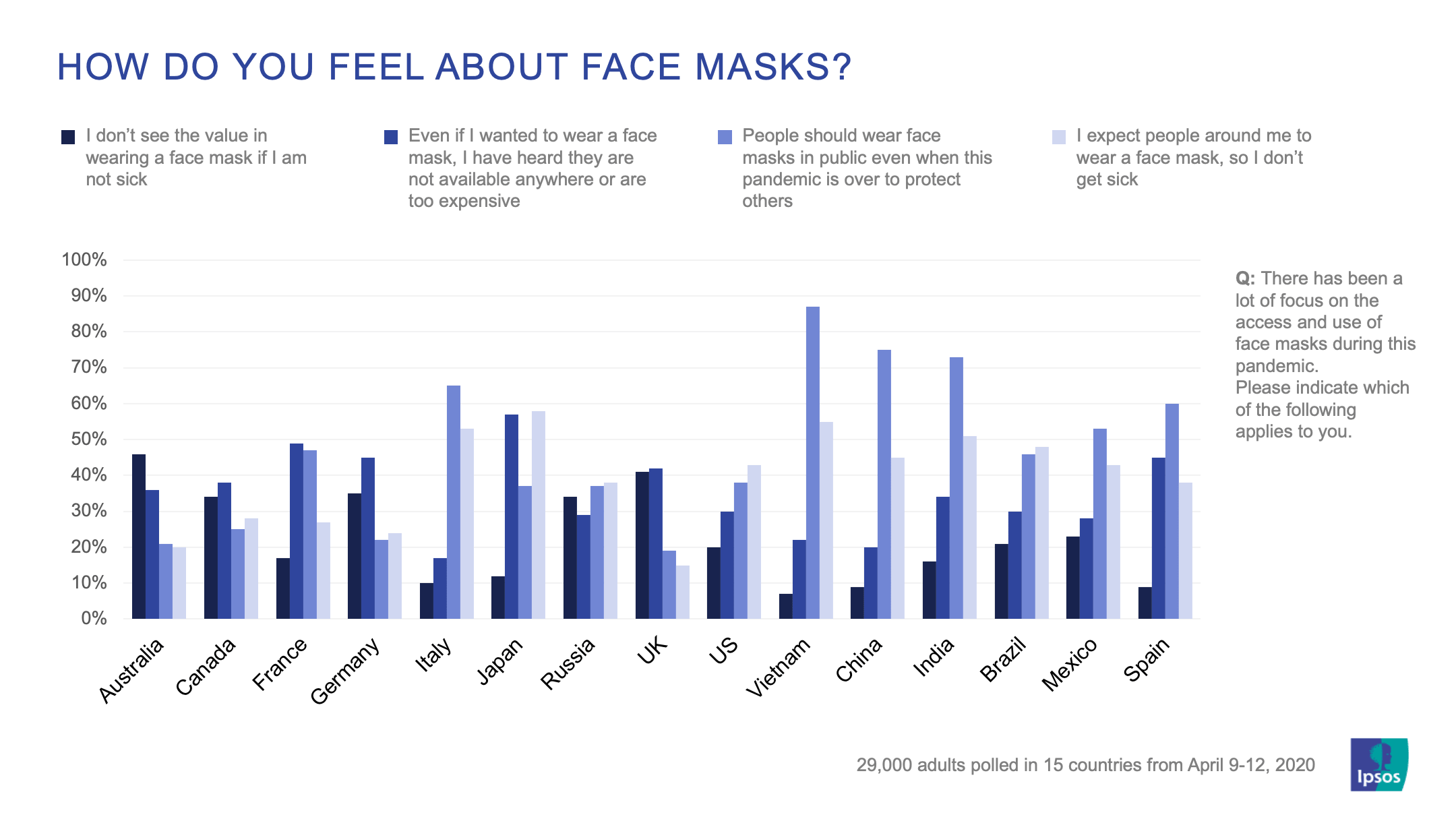
How do you feel about face masks? | Covid-19 | Global Advisor | Ipsos

These are the results of an Ipsos survey conducted April 9th to 12th , 2020 on the Global Advisor online platform among 28,000 adults aged 18-74 in Canada and the United States and 16-74 in Australia, Brazil, China, France, Germany, Italy, India, Japan, Mexico, Russia, Vietnam and the United Kingdom. Where available, tracking results from previous studies, conducted through March and selected results from February are referenced by date.

Related news

  • Ipsos Health Service Report 2026
    Healthcare Survey

    Ipsos Health Service Report 2026

    Since 2018, Ipsos has been tracking perceptions of the quality of healthcare systems, the biggest health issues and the biggest public health problems.
  • Ipsos Global Trustworthiness Index 2026

    Ipsos Global Trustworthiness Index 2026

    In the seventh edition of the Ipsos Global Trustworthiness Index, AI chatbots, tech entrepreneurs and personal trainers are added to the Index.
  • enseignement ipsos belgique
    Education Press release

    L'enseignement, un levier pour l'avenir ? Les Wallons en doutent de plus en plus

    Alors que 34 % des Flamands portent un regard positif sur l’enseignement, ce n’est le cas que pour 16 % des Wallons. Chez ces derniers, 51 % le jugent même explicitement mauvais. Le même sondage réalisé par Ipsos révèle également que les différences entre les deux régions vont au-delà de la simple perception de la qualité. La confiance dans l’enseignement en tant que moteur d’opportunités de carrière et de la mobilité sociale est également nettement plus faible en Wallonie.