
More suffering from under exercising, anxiety than other health concerns due to COVID-19: Poll
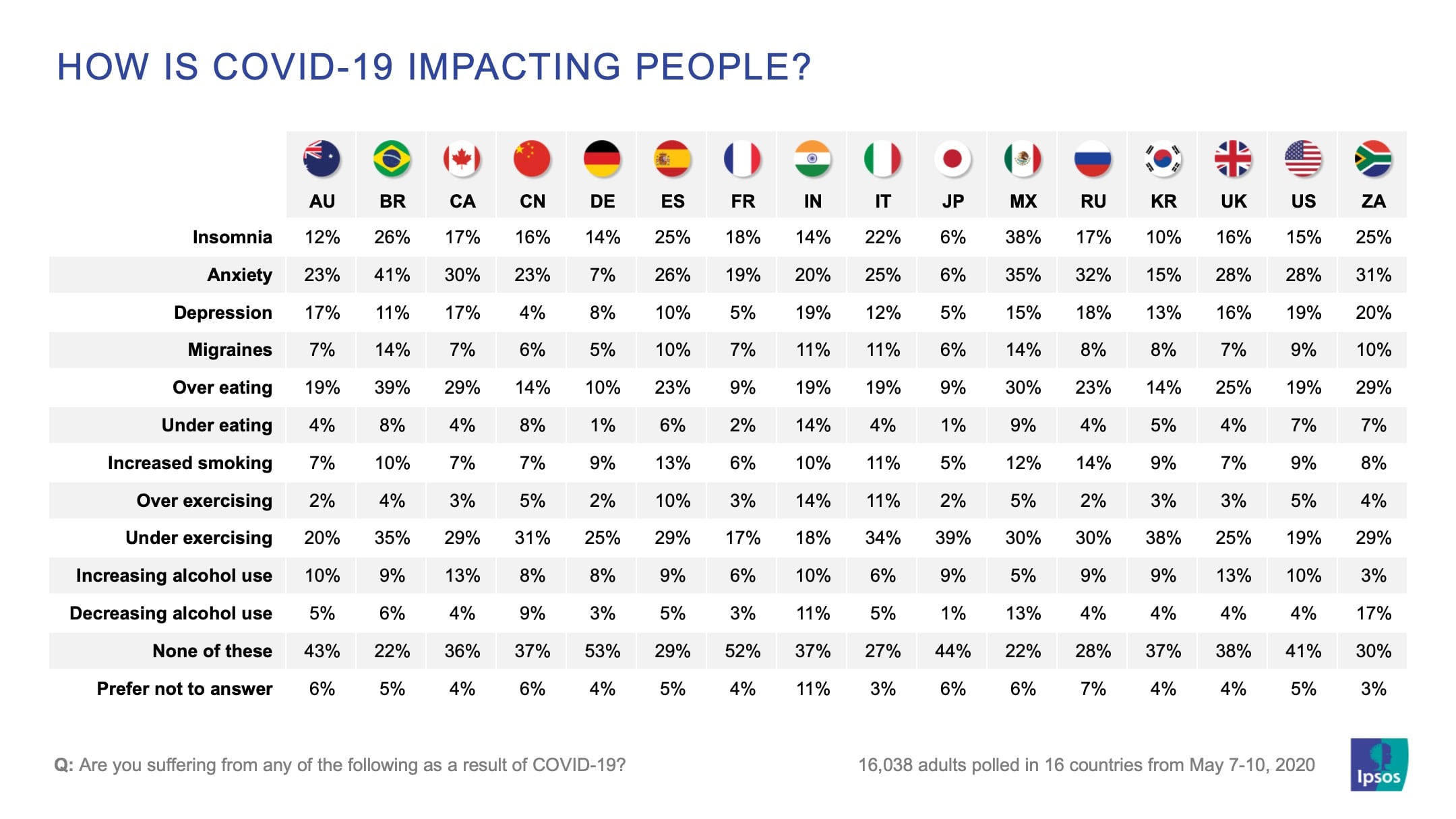
More people across 16 major countries say they are suffering from not exercising enough and anxiety out of 11 possible ailments as a result of the coronavirus pandemic, according to the latest Ipsos survey.
In a global poll of more than 16,000 people conducted from May 7 to 10, about one third of the respondents in 10 countries say they are under exercising because of COVID-19 with this sentiment highest in Japan (38%), South Korea (37%), Italy (33%), China (31%), Mexico and Russia (30%).
The second most cited health concern on the list is anxiety with at least about a quarter of people in 11 countries saying they are suffering from this because of the pandemic. Respondents in Brazil (41%), Mexico (35%), Russia and South Africa (32%) and Canada (29%) are more likely to say this.
Stewart Shankman, Chief of Psychology at Northwestern University’s Feinberg School of Medicine in Chicago, said the pandemic is fraught with uncertainty ̶ about how long it will last, who will catch it, etc., and uncertainty is one of the biggest precipitants of anxiety.
“We also know that physical activity has important cardiovascular and health benefits, including supporting our body's natural immune system,” said Prof. Shankman. “Thus, the high rate of under exercising will actually hinder our ability to fight any virus it comes in contact with.”
Added to this, overeating and insomnia were the next two highest conditions people said they are suffering from as a result of COVID-19. Respondents in Brazil (39%) were most likely to say they’re overeating, followed by South Africa and Mexico (29%), Canada (28%) and the United Kingdom (25%). Those in Mexico (38%), Brazil (26%), Spain and South Africa (25%) were most likely to say they’re suffering from insomnia.
Dr. William Schaffner, Professor of Preventive Medicine and Infectious Diseases at Vanderbilt University Medical Centre in Nashville, said if you’re home with food, and feeling sad and lonely from being isolated, there is a greater tendency to snack.
“You will reduce your physical fitness and there is a tendency to gain some weight,” said Prof. Schaffner.
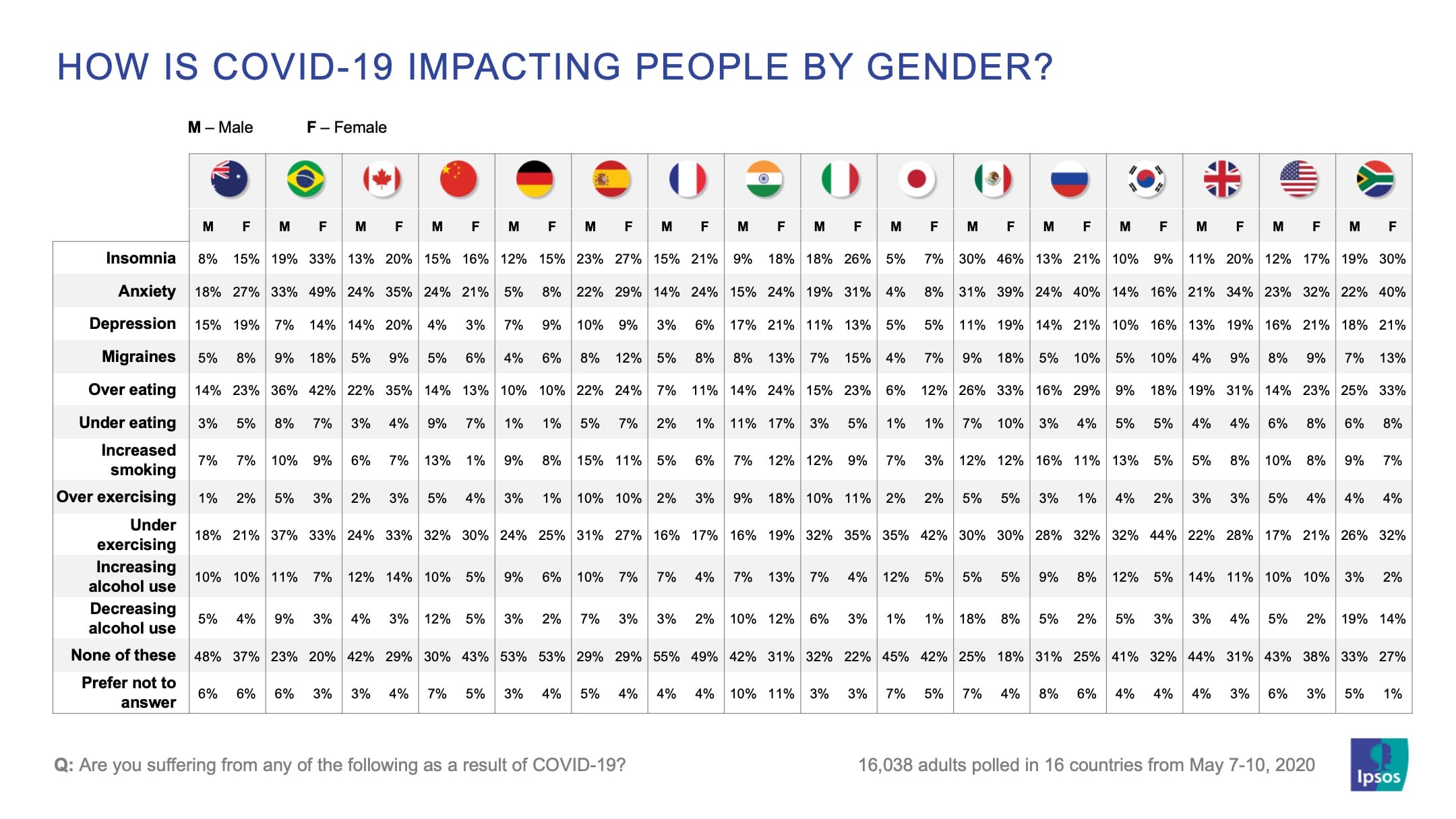
Meanwhile, women are more likely than men to say they are impacted in all of the categories except for alcohol consumption and increased smoking. The percentage of younger women - those aged 34 and under – were also more likely to cite insomnia, anxiety and depression as result of the outbreak.
Overall though, more people across the 16 countries said they were not affected by any of these conditions because of the pandemic. This sentiment was in the majority in Germany (53%) and France (52%), followed by higher numbers in Japan (44%), Australia (43%) and the United States (41%).
Prof. Shankman said these results highlight people’s resilience and something we’ve seen in response to numerous other natural disasters and traumas in the past.
Still, Prof. Schaffer advises people to move around as much as they can while keeping a social distance.
“Try to get out there and try to restore some of the normal rhythms of your life and make that associated with physical activity to keep moving,” he said.


