
It’s a fact, scientists are the most trusted people in world
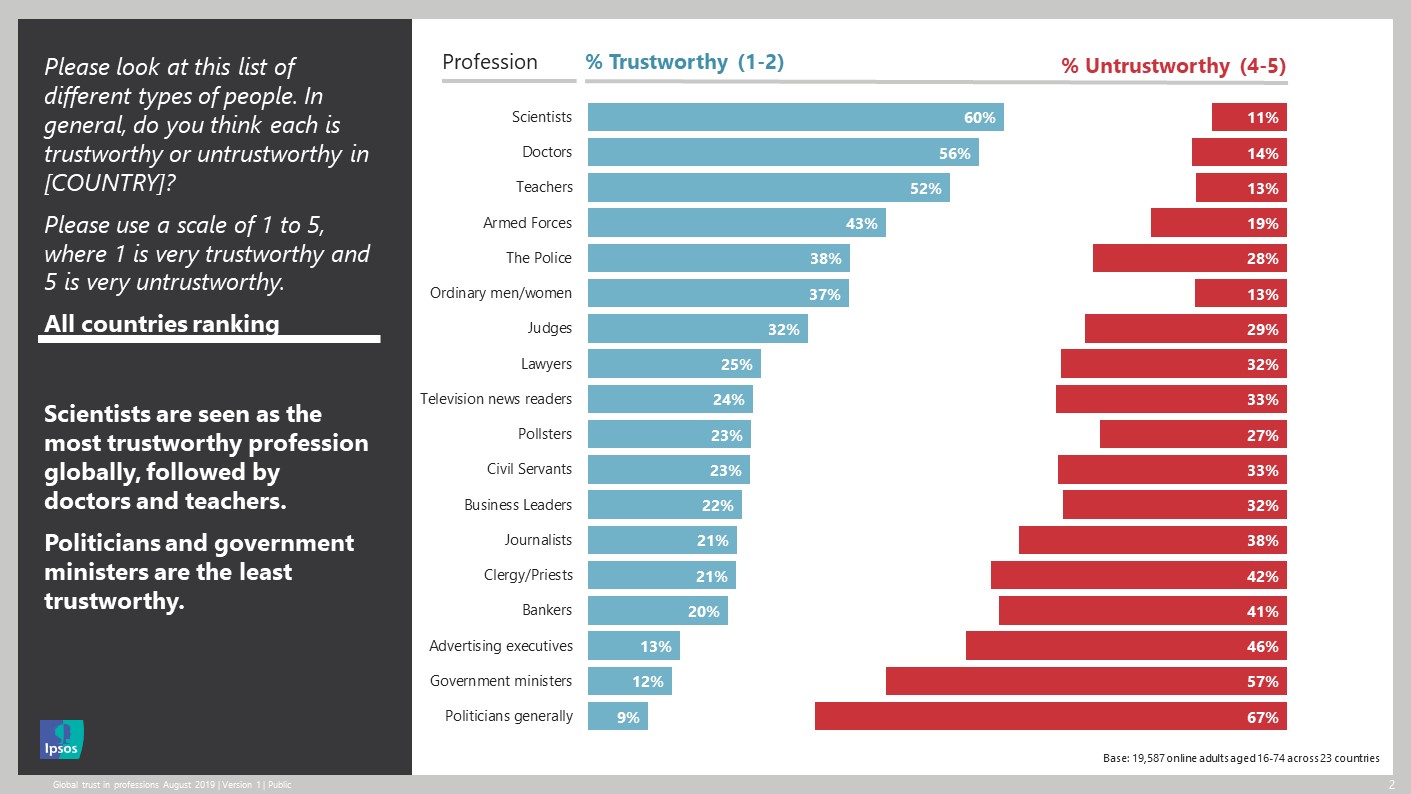
A new Ipsos poll reveals that scientists are considered the most trustworthy profession in the world, followed closely by doctors. Six in ten of the global public rate scientists as trustworthy and just one in ten consider them untrustworthy. The next most-trustworthy profession is doctors (56% trustworthy), followed by teachers (52%). Politicians are the least trusted group globally.
The survey, completed online by adults aged 16-64 in 22 countries, showed that while the most trustworthy profession varies across the countries covered, there is greater agreement on the professions considered to be untrustworthy. In all countries polled, politicians are seen as the most untrustworthy profession – globally, two thirds of the public consider politicians generally to be untrustworthy (67%) and almost six in ten say the same about Government Ministers (57%).
The index also shows that:
- Scientists are the most trustworthy profession in Argentina, Germany, Hungary, Italy, Japan, South Korea, Saudi Arabia, Mexico, Poland, Russia, Sweden and Turkey
- Doctors are the most trustworthy for citizens of Australia, Belgium, Canada, France, Great Britain, South Africa, Spain and Sweden (where they are tied with scientists)
- Teachers are the most trustworthy profession for Brazilians and Americans.
- Indians see armed forces members as the most trustworthy profession, while in China it is the police.
- Members of the armed forces are the fourth most trustworthy profession overall, seen as trustworthy by 43 per cent. Perceptions of the trustworthiness of servicemen and women are highest in China (72%), India (70%) and the US (60%), while they are particularly low in Germany (24%) and South Korea (18%).
- Trust in the police – overall the fifth-most trusted profession on 38 per cent – ranges widely from 80 per cent in China to 11 per cent in Mexico. In addition to China, a majority of the public consider the police to be trustworthy in Australia (56%), France (53%), Canada (52%) and Italy (50%).
The Global Trustworthiness Index
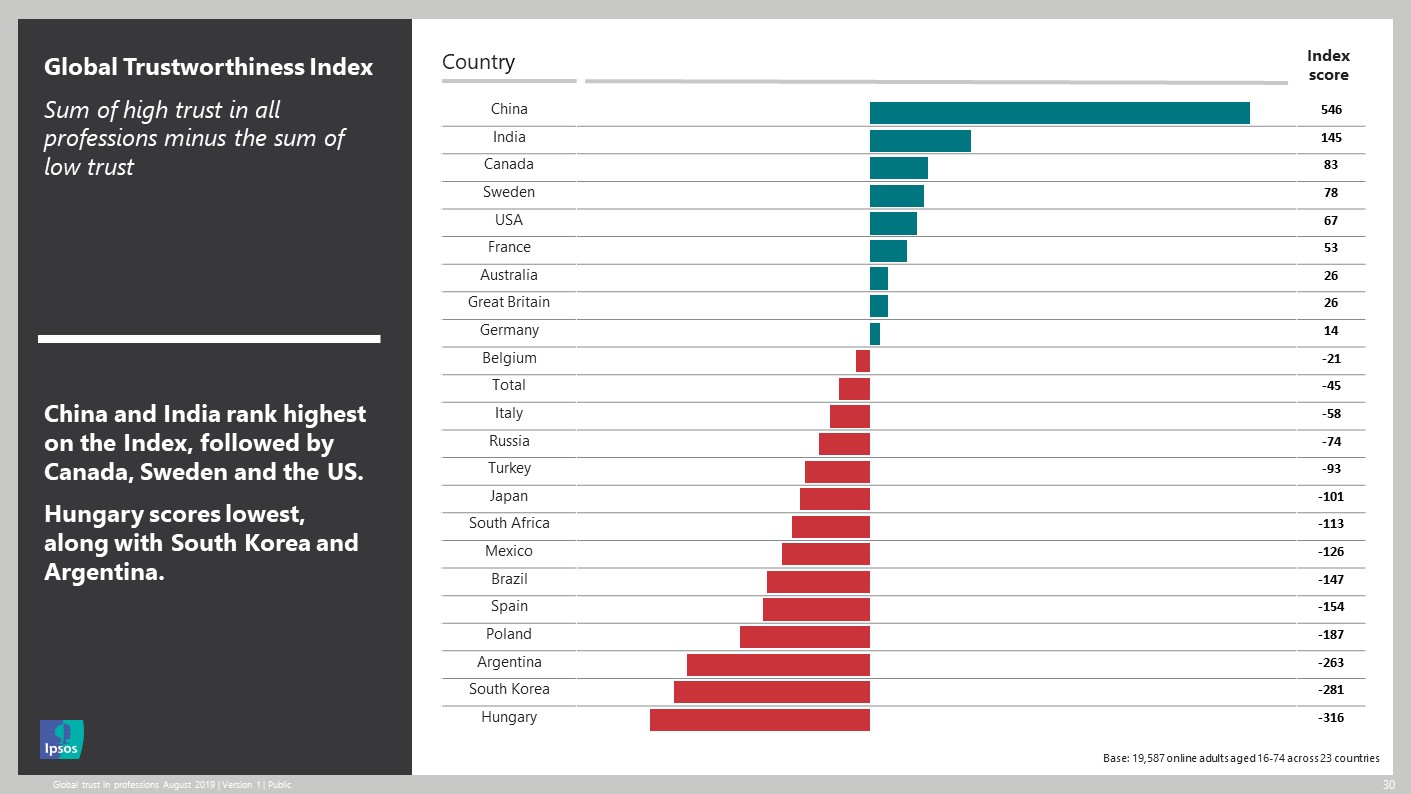
Comparing net trust scores across nations shows which countries are marked by low trust in professions, and which show higher levels of trust.
In all, nine of 22 countries in the index have positive scores. This means that most of the professions listed have net positive scores – more people consider them to be trustworthy rather than untrustworthy. The remaining thirteen countries have negative scores, which indicates higher levels of distrust with most professions. The overall figure for all 22 countries also negative.
- China scores highest on the Index, followed by India, with Canada in third.
- Sweden, the US, France, Australia, Great Britain and Germany also show positive scores, meaning citizens of these countries are more trusting of most professions covered in the poll
- Argentina, South Korea and Hungary are the bottom three countries on the index, indicating high levels of distrust with professions. These three countries are notably more negative than the rest of the countries in the poll, which also have negative scores overall.
An Ipsos spokesperson, says:
It has been said that we no longer trust experts. This study shows that in fact, scientists are held in high esteem all over the world. Many professions have high levels of trust. As our new report, Trust: the Truth shows, trust is not in a new acute crisis.
Read the publication on Ipsos Thinks called Trust: the Truth, that explores the theory and arguments surrounding the complicated concept of trust.


