61% globally think the war in Ukraine poses a significant risk to their country
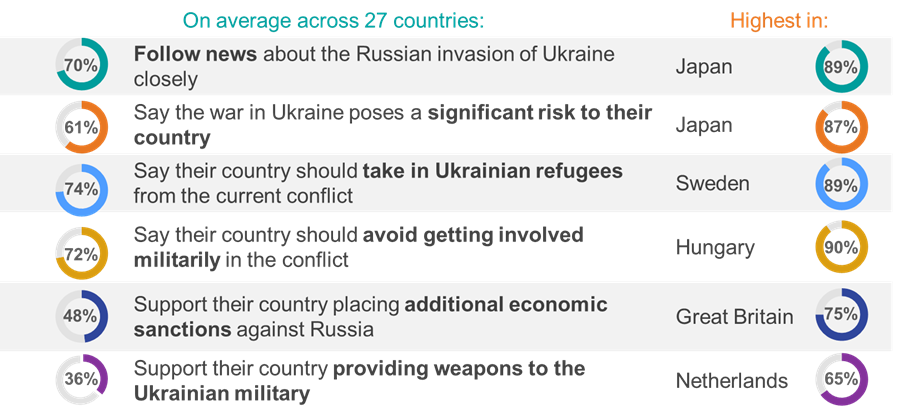
A new Ipsos survey finds that, on average across 27 countries, 70% of adults report closely following the news about Russia’s invasion of Ukraine and 61% think it poses a significant risk to their country. Majorities in every one of the countries surveyed support taking in Ukrainian refugees and oppose getting involved militarily in the conflict. However, opinions on economic sanctions and providing weapons to the Ukrainian military differ widely across countries.
The survey was conducted among 19,000 adults under the age of 75 between March 25 and April 3 on Ipsos’s Global Advisor online survey platform.
The world is watching
Those who follow the news about the war in Ukraine represent between 57% and 77% of those surveyed in all but three of the 27 countries. The only exceptions are Japan (89%) and Sweden (83%) at one end of the spectrum and Malaysia (49%) at the other end.
Globally, those over the age of 50 (78%), business decision-makers (76%), and those with a university-level education (73%) are especially likely to pay close attention to the events in Ukraine.
A great risk for the world
A 27-country average of 82% say that the war in Ukraine poses a great deal or a fair amount of risk to the world as a whole; 61% say that it does to their country. The perception that one’s own country is facing a significant risk is most prevalent in Japan (87%), Poland (77%), South Korea (77%), and Sweden (75%).
Globally, about one-third say it poses at least a fair amount of risk to them personally (36%), their family (34%), and their job or business (37%). Countries whose citizens most tend to feel personally exposed by the war in Ukraine are India (56%), Poland (50%), Japan (53%), and Italy (48%).
Widespread support for Ukrainians
Globally, three-quarters (74%) agree their country should take in Ukrainian refugees, but six in ten (61%) say it cannot afford financial support to Ukraine.
In each of the 27 nations, most citizens surveyed agree that their country should take in Ukrainian refugees from the current conflict. Agreement is especially high in Poland (84%), the country that has taken in the largest number of Ukrainian refugees so far. It is highest in Sweden (89%), the Netherlands (86%), and Spain (85%). It is lowest in Turkey (53%), which already hosts four million refugees, mostly from Syria.
Large majorities in all emerging economies agree that, given the current economic crisis, their country cannot afford to lend financial support to Ukraine. However, more than half in several high-income nations, including Sweden (67%), the Netherlands (63%), and France (55%) disagree.
No consensus on supporting Ukraine’s military response
On average globally, majorities say that their country must support sovereign countries when attacked (70%) and that doing nothing in Ukraine will encourage Russia to take further military action elsewhere (68%). At the same time, majorities also say that their country should avoid getting involved militarily (72%) and that military action in Ukraine will encourage attacks on other countries (68%). In addition to being ambivalent and cautious, global public opinion on how to respond to Russian aggression in Ukraine is also divided:
- In Saudi Arabia, Hungary, Malaysia, and India, the opinion that “the problems of Ukraine are none of our business and we should not interfere” prevails. It is also shared by half of those surveyed in Mexico, Israel, and Argentina. In contrast, except for Hungary, between 65% and 80% in all eight other European Union member countries surveyed, as well as in Great Britain, the United States, Canada, Australia, Japan, and South Korea disagree.
- While more than four in five in Poland, Sweden, Great Britain, and India agree that their country should support sovereign countries when attacked, only about half in Mexico, Hungary and Brazil do.
- More than three in four in Great Britain, Japan, the U.S., Australia, and Poland believe that inaction in Ukraine will encourage Russia to attack other countries vs. less than half in Hungary and Israel.
Differences are starker when it comes to providing military support or sending troops to Ukraine. On average globally, about one-third support their country providing weapons – such as guns and anti-tank weapons – to the Ukrainian military (36%), providing funding to the Ukrainian military (33%), and sending troops to NATO countries neighboring Ukraine (32%). However, each of one these propositions rallies majority support in several countries:
- The Netherlands, Great Britain, Sweden, the U.S., Canada, Poland, Germany, France, and Australia for supplying the Ukrainian military with weapons;
- Great Britain, Germany, Canada, and the U.S. for providing financial assistance to the Ukrainian military; and
- The Netherlands, Great Britain, Canada, France, and Belgium for sending troops to NATO countries neighboring Ukraine.
However, those who support sending their own troops to Ukraine are a minority in each one of the 27 countries, averaging 17%.
Diverging opinions about economic sanctions
On average globally, two-thirds agree that “the economic sanctions placed on Russia by many countries are an effective tactic to help stop the war” – from 50% in Hungary to 78% in South Korea. However, support for sanctions and other economic action varies more widely across countries.
Just over half on average across all 27 countries (54%) agree that paying more for fuel and gas because of sanctions against Russia is worthwhile to defend another sovereign country. However, while more than 75% in South Korea and Poland agree, fewer than 40% in Mexico, Peru, Hungary, Brazil, and Argentina do so.
Furthermore, only 40% on average globally support banning imports of oil and gas from Russia to their country even if this leads to further price increases. While more than 50% in Great Britain, Canada, Sweden, Poland, Australia, the U.S., and France support such a ban, it is the case of fewer than 20% in Hungary and Turkey. In Germany, which is highly dependent on Russian natural gas, 45% support such a ban, 30% oppose it, and 25% are not sure.
Support for putting in place additional sanctions against Russia averages at 48% globally. Again, majority support is found in all EU countries surveyed excluding Hungary, as well as in Great Britain (by as many as 75%), Canada, the U.S., Australia, Japan, and South Korea. Elsewhere, it ranges from 23% (in Turkey) to 40% in South Africa and India. Opinions on whether to seize the assets of Russian oligarchs affiliated with Russian President Vladimir Putin show a nearly identical pattern with majority support in the same countries as for additional sanctions against Russia.
To talk or not to talk
Opinions on whether one’s country should continue its diplomatic ties to Russia vary widely. Globally, 38% on average support it, 29% oppose it and 33% are not sure. Support ranges from 63% in Turkey to just 19% in Poland. Countries where support for continued diplomatic engagement is highest include not only some of those where majorities think that the problems of Ukraine are “none of our business” (Saudi Arabia, India, Israel) and/or where the appetite for supporting the Ukrainian military is low (Turkey), but also the three largest EU countries (Germany, France, and Italy).
Methodology: Ipsos interviewed a representative sample of 19,000 online adults under the age of 75 across 27 countries.
The “Global Country Average” reflects the average result for all the countries and markets where the survey was conducted. It has not been adjusted to the population size of each country or market and is not intended to suggest a total result. The samples in Brazil, Chile, Colombia, India, Israel, Malaysia, Mexico, Peru, Saudi Arabia, South Africa, and Turkey are more urban, more educated, and/or more affluent than the general population.