Australians overwhelmingly support Government commitments to emissions reductions
The majority (71%) of Australians support the Government’s commitment to targets for the Paris climate agreement and 69% support a commitment to net zero emissions by 2050, according to the Ipsos Climate Change Report 2020.
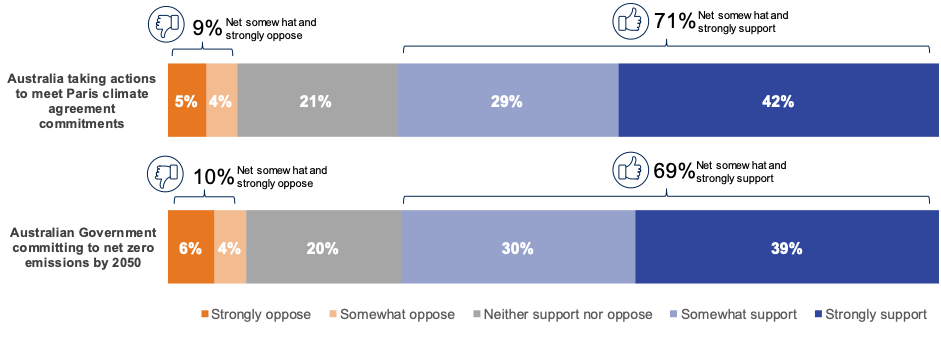
Data collected in January 2020 that showed that half of Australians (56%) agree that the nation will be better off in the long run if Australia meets the Paris agreement targets, indicating that many see long-term benefits to involvement in international efforts to reduce emissions. More than half (54%) also agree that Australia should transition to a carbon neutral economy as soon as possible.
There is also strong support among Australians for our country to take a global leadership role on climate change, with 60% agreeing that Australia should be a global leader in emissions reduction with the aim of encouraging other countries to take similar actions. Just under a third (30%) of people agree that Australia should only take action on climate change if other countries are contributing a fair share.
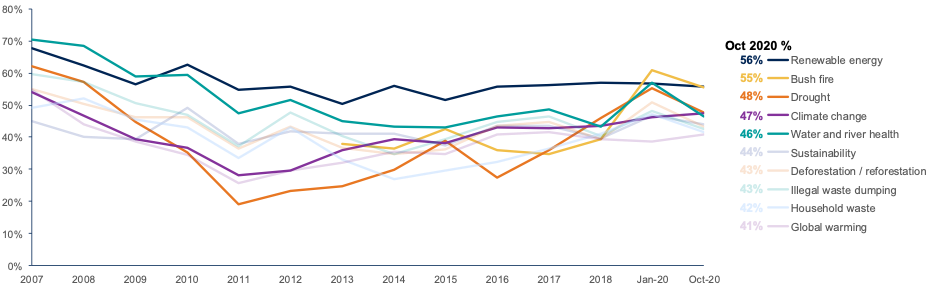
Australia’s devastating bushfires earlier in the year are still on the minds of the population, with 55% of Australians nominating bushfires an environmental issue they would take action on in October 2020. When data was collected in January during the peak of the fire season, bushfires topped the list at 61%.
There continues to be a high level of support among Australians for renewable energy, which has again topped the list in the latest data as the top environmental issue, at 56%. Other key issues were drought (48%), climate change (47%) and water and river health (46%).
The COVID-19 pandemic has, however, impacted the relative importance of the environment among Australians. The Ipsos Issues Monitor has been tracking public sentiment by asking a representative sample of 1,000 Australians to select the top three issues facing the nation. At the beginning of 2020, in the wake of the unprecedented summer bushfire season, the environment was the top issue facing Australia for the first time, with more than 40% of Australians rating it in their top three.
In the latest data, the economy (56%) and unemployment (44%) are now the top two issues facing the nation by a comfortable margin. Concern about healthcare peaked in April and again in August, following the rollercoaster of new outbreaks and extended lockdowns. This has left the environment as the fifth most pressing issue in the eyes of Australians. The proportion of people rating it in their top three has halved to 20% between January and September.
However, data collected for the Ipsos Climate Change Report shows that support for general action on climate change has continued to trend upwards through the pandemic, with 47% saying they would take action on the issue. This contrasts with the downward trend during and following the global financial crisis in 2008-2009. Support for action on climate change reached its lowest point in 2011 (28%) and has been on the rise since then.
Those with the most power to influence climate change are seen as performing poorly by Australians, including our own government and those of other countries, multinational businesses, Australian state and territory governments and large Australian businesses.
Solar panels, more energy efficient features in homes, purchasing household energy from renewable sources and voting for candidates who have policies to address climate change are seen as the most effective paths to individual climate action.
Ipsos Director, Stuart Clark, said: “Public support for action on climate change, particularly from government, is high despite the economic challenges that have come with COVID-19. This stands in contrast to the falling support for climate action we saw for several years following the GFC.
“It highlights the degree to which Australians are taking on board the idea of a green recovery led by government. It’s very different from the situation in 2010 and 2011. At that time, support for climate action dropped away as people prioritised the economic recovery.”
Click here to access the Ipsos Climate Change Report 2020
Click here to access previous Climate Change Reports