Interest in national Indigenous issues at lowest level since 2021
Australians’ interest in Indigenous issues has declined to its lowest level since 2021, with many showing decreased support for the closing-the-gap initiatives, the Ipsos Indigenous Issues 2024 report has revealed.
Download the 2024 Ipsos Indigenous Issues Report
The report, released during National Reconciliation Week (May 27 – June 3), measures Australians’ perceptions of First Nations issues, including Indigenous recognition and the role of Government in acting for First Nations Peoples.
The survey was conducted in late April 2024 and found a downward trend in perceived importance of Treaty and Voice to Parliament as a way forward for reconciliation. Non-Indigenous Australians who don't consider Treaty important for reconciliation believe their perspective is widely shared.
A majority of non-Indigenous Australians said they had heard racial slurs or jokes in public (70%) or on social media (69%) in 2024, and perceptions of how these jokes might upset people has increased.
Despite the figures, young Australians still show a deep empathy for Indigenous issues, with 59% saying they were interested in Indigenous issues and 64% saying they were confident in their knowledge of local Country. They were also more likely to support reconciliation activities and show more cultural sensitivity.
Key findings
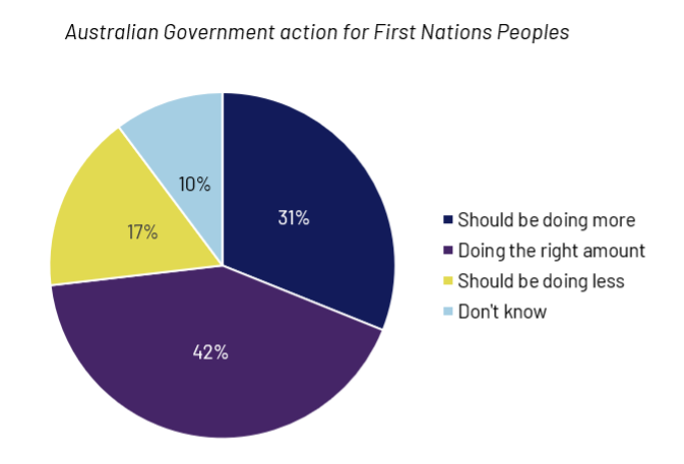
- Mixed reviews on Government role: Opinions vary on the government’s role in acting for First Nations people. 1 in 3 Australians think the Government should be doing more for Indigenous people (31%) – and this is higher for young people and those living in metro areas. However, 2 in 5 Australians think the Government is doing the right amount (42%).
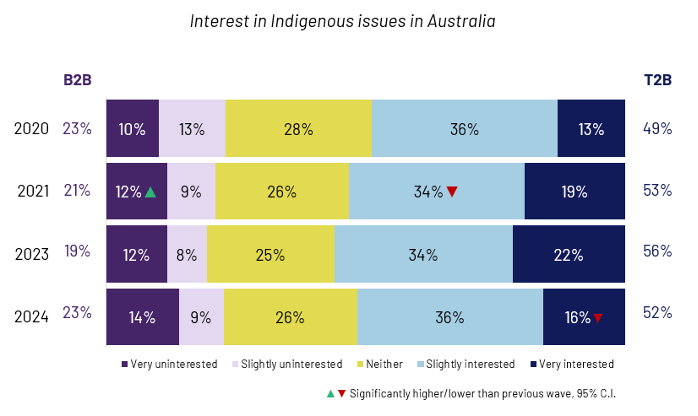
- Interest in Indigenous issues has declined: just 16% of Australians said they were “very interested” in Indigenous issues, compared to 22% in 2023 and 19% in 2021. Decreasing interest was noted among women (49% in 2024, compared to 55% in 2023) and regional Australians (44%, compared to 57% in 2023).
- Support for closing-the-gap declined: The Voice and surrounding debate appears to have damaged consensus on closing-the-gap initiatives, and that damage appears sustained. There was a decline across the board for closing-the-gap initiatives, with support dropping below 2021 figures. Support was highest for the re-telling of Australia’s history from Indigenous perspectives (57%).
- Claimed knowledge of traditional owners remains stable: Australians’ confidence in their knowledge of local Aboriginal and Torres Strait Islander country dropped slightly in 2024 - 11% compared to 13% in 2023. Men (54%, compared to 47% of women) and younger Australians were most confident in their knowledge.
- Downward trend in importance of Voice to Parliament and Treaty: Fewer Australians thought the Voice to Parliament and Treaty were important as a way forward to reconciliation in 2024 (32%, compared to 41% in 2023; and 36%, compared to 38% in 2023, respectively).
- Indigenous laws and issues: despite the softening of support, most Australians still believe Indigenous Australians should have a say in the laws and political decisions that affect them (78%), but the figure has dropped from 2021 (85%).
- Deaths in custody: 4 in 5 Australians believe Aboriginal deaths in custody are a serious issue that needs to be addressed by politicians and the criminal justice system.
- Changing Australia Day still unpopular: changing the date of Australia Day still seems to be unpopular among Australians – 6 in 10 don’t want it to change. Interestingly, while younger Australians are still more likely to support a different date (50% agree to change), older Australians attitude towards change is on the rise (30% agree to change in 2024, compared to 25% in 2023).
- Millennial and Gen Z back Indigenous issues: younger Australians demonstrate a deeper empathy towards Indigenous issues, showing considerable support for reconciliation initiatives, greater racial sensitivity and advocating for more government action.
- Racial slurs still prevalent: racial slurs and jokes are more common in public and on social media, than at work or school. 70% of non-Indigenous Australians said they had heard slurs in public in 2024, while 69% said they’d heard them on social media. The figures are similar to 2023 data.
- Greater perception of upset: Australians showed a greater understanding around the potential for slurs/jokes to upset other people in 2024; 19% of those surveyed said slurs would upset other people, compared to 13% in 2021. Younger Australians (32%, compared to 15% of people over 50) and those living in metro areas (21%, compared to 14% of regional) were more likely to see slurs as causing upset.
Ipsos Australia Public Affairs Associate Research Director, Nonie Finlayson, said: “Australians’ knowledge and attitudes towards First Nations’ peoples appear to have stalled in the shadow of the 2023 Voice to Parliament vote. The Indigenous Issues report comes amid a time of turbulence in Australian Indigenous affairs. Many people are feeling significant fatigue post the divisive Voice to Parliament campaign and are also feeling deflated after the vote’s rejection. The debate surrounding the Voice appears to have caused long-term damage to interest in and support for Indigenous issues, particularly around consensus on important closing-the-gap initiatives.
“I think it's clear that more needs to be done to eliminate racism and determine what level of government action is appropriate to support Indigenous issues. The release of the report during National Reconciliation Week is a timely reminder of the ongoing importance of Indigenous issues and affairs. This year’s Reconciliation Week theme is ‘Now More Than Ever’ – a reminder that the quest for justice and the rights of Aboriginal and Torres Strait Islander people will, and must, continue.”
About the Study
This study did not have any external sponsors or partners. It was initiated and run by Ipsos, because we are curious about the world we live in and how citizens around the globe think and feel about their world.
The study was conducted via Ipsos’ online research panel, between 22 – 26 April, with 1,000 people representing the adult Australian population.
The precision of Ipsos online polls is calculated using a credibility interval with a poll of 1,000 accurate to +/- 3.5 percentage points and of 500 accurate to +/- 5.0 percentage points. For more information on the Ipsos use of credibility intervals, please visit the Ipsos website.
Where results do not sum to 100 or the ‘difference’ appears to be +/-1 more/less than the actual, this may be due to rounding, multiple responses, or the exclusion of don't knows or not stated responses
The publication of these findings abides by local rules and regulations.