Seven in 10 Australians say our healthcare system is overstretched
Our 34-country survey explores the public view on the biggest health challenges facing people today and how well-equipped our country’s healthcare services are to tackle them. It shows that Australians continue to see Coronavirus and Mental Health as the biggest health concerns facing the nation, and an increasing proportion see our healthcare system as overstretched.
The Key Australian Findings
In Australia, the key findings were as follows:
- Seven in 10 of Australians (72%) say that the country’s healthcare system is overstretched, up from 58% in 2021. This is above the global average of 61%.
- Not enough staff was seen by Australian participants to be the main challenge for healthcare services (58%), followed by long waiting times (37%) and ageing population (27%).
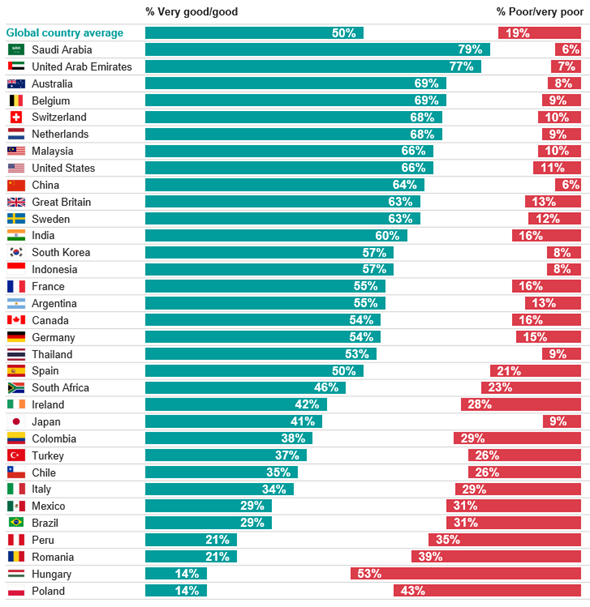
- Despite these concerns, 69% of Australians said their system is very good or good overall. This places Australia third on this measure, after Saudi Arabia (79%) and the UAE (77%).
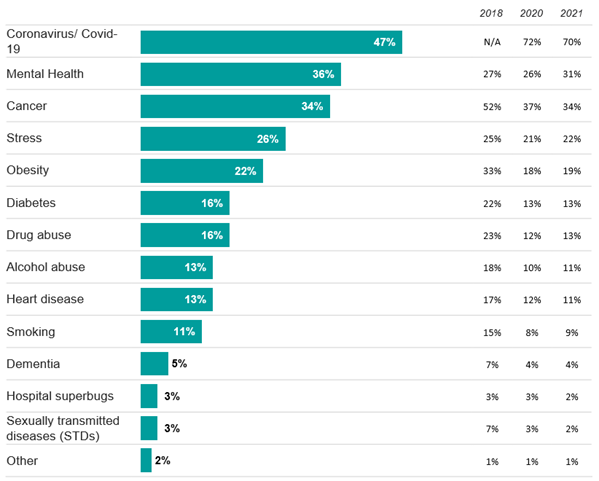
- Australian participants were more likely to cite Coronavirus as the biggest health problem facing the nation than the global average: 62% said it was a big health problem compared to only 47% globally.
- Australians were more likely than the global average to be concerned about mental health 44% see it as a big health problem, compared to 36% globally.
- Globally, concern about mental health has increased since 2021, while concern about Coronavirus has decreased.
- The proportion of Australians who think vaccinating against serious infections diseases should be compulsory is lower in 2022 (61%) than it was in 2018, pre-Coronavirus pandemic (72%).
Ipsos Australia Director, Julia Knapp, said: Australians continue to exhibit a great deal of pride in our healthcare system, we’re among the most likely to view our system positively overall among the 34 countries we surveyed. However, there is a growing sense that our strong system is beginning to fray; almost three quarters of us see the system as overstretched.
Global Findings in detail
Q: Thinking generally, which of the following, if any, do you see as the biggest health problems facing people in your country today?
Healthcare Perceptions
Though the pandemic still lingers, in most of the countries covered in the survey, more than half rate their healthcare system’s quality as “good” - most commonly in Saudi Arabia, the UAE and Australia. There are some outliers in Latin America and Central Europe, with Brazil (31%), Mexico (31%), and Peru (35%) describing their healthcare as poor. Similarly, Hungary and Poland stand out, with significant proportions thinking their healthcare service is poor (53% and 43% respectively).
Q: How would you rate the quality of healthcare that you and your family have access to in your country?
When asked to look into the future, the outlook is not entirely optimistic. A third (33%) think the quality of healthcare in the coming years will improve and 20% see it getting worse. Contrary to their current pessimism, people in Latin America are more optimistic about their future in relation to the rest of the world. Colombia (71%), Brazil (62%), and Peru (59%) all see quality improving. Meanwhile, nearly half (45%) of Hungarians think it will get worse. France (43%) and Great Britain (39%) are also negative in their forecasts.
There is widespread agreement about the pressures on individual countries’ healthcare capacity. Three in five (61%) globally agree their system is overstretched. Newcomer Portugal ranks first at 87%, followed by Great Britain (83%) whose sense of concern has been consistent over the years.
Healthcare Challenges
In conjunction with this mood that systems are overstretched, we see that access to treatment/waiting times emerge as the main perceived problems their country’s healthcare system faces – selected by a global country average of four in ten. Not enough staff is joint first for the first time since we started asking these questions in 2018. Cost of accessing treatment is the third most selected issue globally (31%). While no country has bureaucracy as their top healthcare challenge, it is widely recognised among the main issues.
Q: Overall, which of the following, if any, do you see as the biggest problems facing the healthcare system in your country?
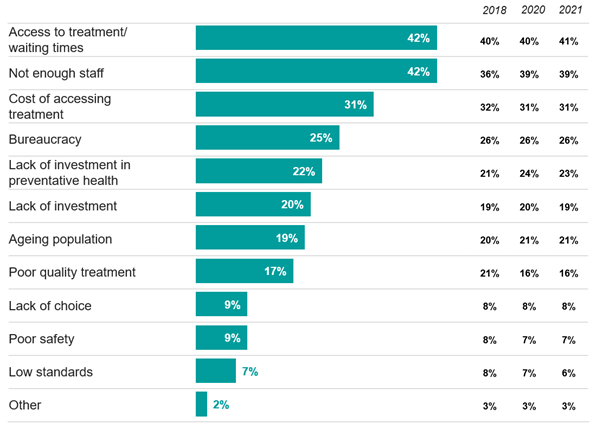
Waiting times are a particularly prominent concern in Hungary, Chile, and Portugal (in each country 65% single it out as a challenge). However, this pattern does not follow when we look at where not having enough staff is a particular challenge. Here Sweden (76%), France (69%), and Netherlands (67%) as the top countries.
Although slightly further down the list, bureaucracy is still a challenge for a quarter of respondents (25%). Argentina has it as their joint second highest challenge at 43%, only just behind lack of investment (44%). Other LATAM countries struggling are Mexico (41%) and Peru (39%).
Outside the top issues, we see that lack of investment in preventative health (22%) and lack of investment (20%) in general rank next highest. Ageing population is seen as a challenge in some of the Asian countries: Japan (52%), South Korea (51%), and China (46%).
About the Study
This study did not have any external sponsors or partners. It was initiated and run by Ipsos, because we are curious about the world we live in and how citizens around the globe think and feel about their world.
These are the results of a 34-market survey conducted by Ipsos on its Global Advisor online platform. Ipsos interviewed a total of 23,507 adults aged 18-74 in the United States, Canada, Malaysia, South Africa, and Turkey, 20-74 in Thailand, 21-74 in Indonesia, and 16-74 in 27 other markets between Friday, July 22 and Friday, August 5, 2022.
The sample consists of approximately 1,000 individuals in each of Australia, Brazil, Canada, mainland China, France, Germany, Great Britain, Italy, Japan, Spain, and the U.S., and 500 individuals in each of Argentina, Belgium, Chile, Colombia, Hungary, India, Indonesia, Ireland, Malaysia, Mexico, the Netherlands, Peru, Poland, Portugal, Romania, Saudi Arabia, South Africa, South Korea, Sweden, Switzerland, Thailand, Turkey, and the United Arab Emirates.
The samples in Argentina, Australia, Belgium, Canada, France, Germany, Great Britain, Hungary, Italy, Japan, the Netherlands, Poland, Portugal, Romania, South Korea, Spain, Sweden, Switzerland, and the U.S. can be taken as representative of their general adult population under the age of 75.
The samples in Brazil, Chile, mainland China, Colombia, India, Indonesia, Ireland, Malaysia, Mexico, Peru, Saudi Arabia, South Africa, Thailand, Turkey, and United Arab Emirates are more urban, more educated, and/or more affluent than the general population. The survey results for these countries should be viewed as reflecting the views of the more “connected” segment of their population.
The data is weighted so that each country’s sample composition best reflects the demographic profile of the adult population according to the most recent census data.
Where results do not sum to 100 or the ‘difference’ appears to be +/-1 more/less than the actual, this may be due to rounding, multiple responses, or the exclusion of “don’t know” or not stated responses.
Sample surveys and polls may be subject to sources of error, including, but not limited to coverage error, and measurement error. The precision of the online surveys conducted is measured using a Bayesian Credibility Interval. Here, the Australian results have a credibility interval of +/-3.5 percentage points. For more information on the Ipsos use of credibility intervals, please go to: https://www.ipsos.com/sites/default/files/2017-03/IpsosPA_CredibilityIntervals.pdf
As a foundation member of the Australian Polling Council Ipsos complies with the Council’s Code of Conduct. The purpose of the Code is to provide journalists and the public with greater confidence and trust in publicly released polling and survey data. We strongly encourage the inclusion of methodological details in any reference to published Ipsos results.
This study is compliant with the Australian Polling Council Code of Conduct. The Long Methodology Disclosure Statement for the study will be available at https://www.ipsos.com/en-au/disclosure_statements within two business days.