
Australians divided on Acknowledgements of Country at major events but oppose disrupting ceremonies
Australians' interest in Indigenous issues has continued to decline in the past year to their lowest levels since 2020, as more pressing issues such as cost of living, housing and economic concerns compete for public attention.
Support for key reconciliation measures appears to have stabilised following the sharp shifts seen after the 2023 Voice referendum and while Australians remain supportive of many reconciliation initiatives, symbolic measures continue to attract greater scrutiny.
The report measures Australians' perceptions of First Nations issues, reconciliation initiatives and the role of government in Indigenous affairs..
Key findings
- Acknowledgement debate does not equal hostility: Despite public debate around Acknowledgements of Country, opposition does not translate into support for disruptive behaviour. Among Australians who oppose Acknowledgements of Country at major events (39%), almost three-quarters (73%) oppose booing or disrupting such ceremonies.
- Australia Day attitudes remain unchanged: Opposition to changing the date of Australia Day remains more than twice as high as support (46% versus 21%).
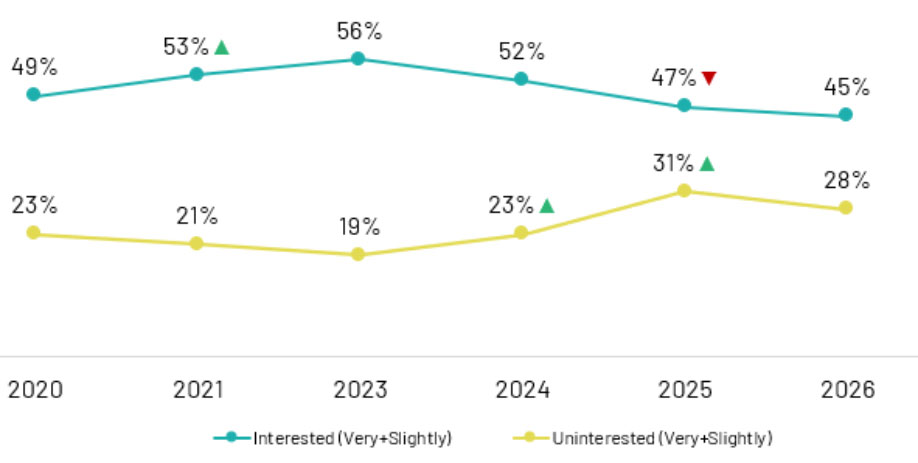
- Indigenous issues continue to lose prominence: Interest in Indigenous issues among non-Indigenous Australians has fallen to 45%, down from its peak around the 2023 Voice referendum and the lowest level recorded since 2020.
Interest in Indigenous Issues
What is your level of interest in Indigenous issues in Australia
- Exposure to racial slurs remains common: Seven in 10 Australians report hearing racial slurs or jokes about Aboriginal and Torres Strait Islander peoples in public settings (68%) or on social media (70%).
- Modern racism indicators largely unchanged: Attitudes associated with modern racism remain broadly stable, suggesting that these views remain entrenched among a minority of Australians.
- Knowledge and support remain stable: Almost half of Australians (48%) are confident they know the Traditional Owners where they live, while understanding of Treaty remains largely unchanged. Support for Treaty as a pathway to reconciliation remains steady at 59%, while support for the Voice to Parliament remains steady at 50% following declines in previous years.
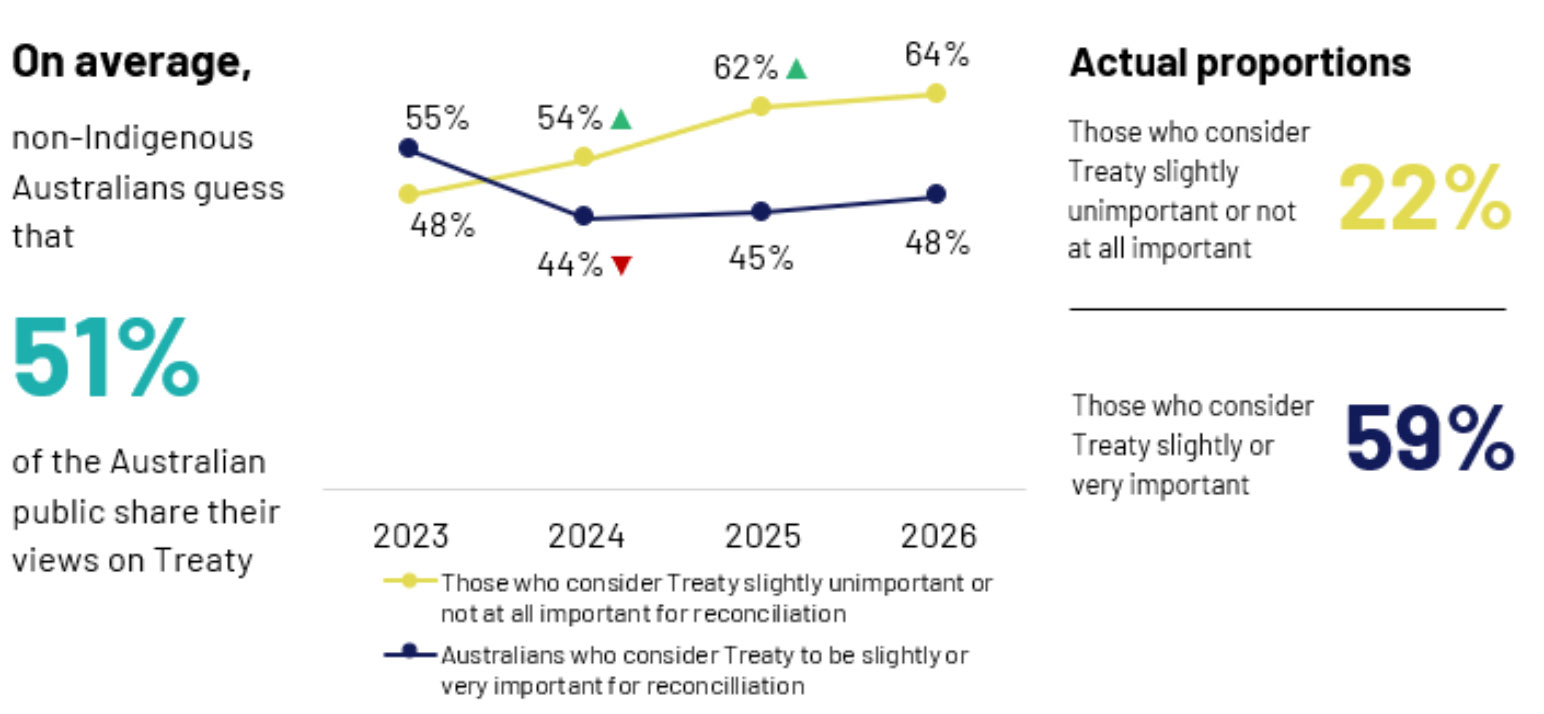
- False consensus remains a challenge: Australians who oppose Treaty continue to substantially overestimate how many people share their views. Although only 22% consider Treaty unimportant, they estimate that 59% of Australians agree with them, underscoring how minority viewpoints can appear more widespread than they actually are.
Perceptions of consensus on Treaty
How much of the Australian public would you guess holds your views on Treaty?
- Closing the Gap initiatives holding steady: Support continues to be strongest for initiatives focused on education and historical understanding, including retelling Australia's history from Indigenous perspectives (58%).
- Government action still expected: Nearly one-third of Australians (31%) believe the Government should be doing more for First Nations peoples, while 18% believe it should be doing less.
- Generational divide persists: Younger Australians continue to demonstrate stronger engagement with Indigenous issues than older generations, showing greater support for Treaty (18-29: 73%, 50+: 49%), stronger knowledge of Traditional Owners (18-29: 62%, 50+: 42%) and greater belief that the Government should be doing more for First Nations peoples (18-29: 38%, 50+: 26%).
Ipsos Australia Public Affairs Research Director, Nonie Finlayson, said: “Recent public debates around Acknowledgements of Country have highlighted that disagreement with particular practices should not be mistaken for hostility. Even among those who oppose acknowledgements, there is overwhelming rejection of disrespectful behaviour such as booing. “And while Australians have not turned away from reconciliation, Indigenous issues are increasingly competing with other national concerns for attention. The challenge for reconciliation advocates and policymakers will be maintaining public attention and engagement at a time when cost of living pressures and broader economic concerns dominate the national conversation.”
