

Widespread nostalgia for the old days, with many saying things were better back in 1975
Ipsos announces the release of a new 30-country research study. Halfway through the decade, and a quarter of the way through the 21st century, we asked people to assess how life today compares with 50 years ago.
Key findings of the Is Life Getting Better? report include:
- Given the choice, people would prefer to have been born in 1975 rather than 2025 by a margin of almost two to one. This is despite 72% of people in our 30 countries having been born since 1975. An average of 44% say they would rather have been born then, far ahead of the 24% who favour today’s times.
- South Korea stands alone in embracing the future. It’s the only country where more would choose to be born today rather than 50 years ago. Meanwhile, France leads in the nostalgia stakes, with 57% preferring 1975. Belgium, Mexico (both 53%), Great Britain and New Zealand (both 52%) are close behind.
- There’s a prevailing sense that people were happier in the old days. An average of 55% say their country was a happier place in 1975, with just 16% feeling the mood is better right now. It’s worth noting that our survey finds people don’t always have a detailed grasp of what’s changed over this period: respondents tend to overestimate life expectancy in their country 50 years ago and to underestimate longevity in today’s world, one where many of us can expect to live to age 75 years or more.
- Concerns about the environment are front and centre. An average of 61% (and majorities in 26 out of 30 countries) say things were in better shape back in 1975. People are also inclined to say things were better 50 years ago when it comes to living free from war/conflict and feeling safe on the streets. It’s not all bad news though: 55% say healthcare is in better shape now, while perceptions on whether education has improved vary hugely from country to country.
- When it comes to our standard of living, where you were born really matters. In South Korea, 80% say things are better today, a view shared by 70% in Singapore and 66% in Poland. At the other end of the spectrum are France, Türkiye and Canada: each registering majorities saying standards of living were better in 1975 (59%, 52% and 52%, respectively).
- Generation Z breaks the pattern (just). It’s the only age group where there’s a preference for being born in the 2020s. But even among this youngest section of the population, the margin is razor-thin, reflecting the depth of unease about both our present and our future.
Key Findings - At a Glance
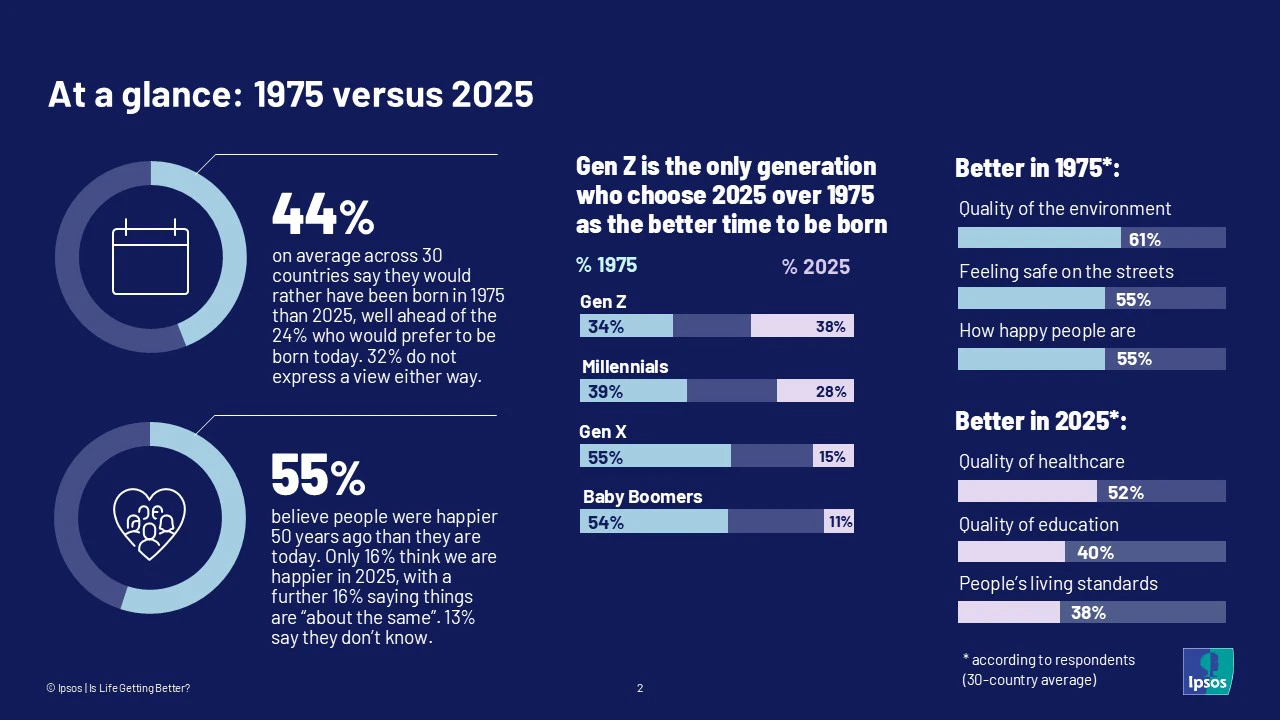
Comparing 1975 with 2025
1975 versus 2025: Life Expectancy
What do you think life expectancy is/was in your country in 1975/2025
Difference in years - guess versus actual
*The “30-country average” reflects the average result for all the countries and markets where the survey was conducted. It has not been adjusted to the population size of each country or market and is not intended to suggest a total result.
Technical note: Ipsos interviewed a total of 23,772 adults aged 18 years and older in India, 18-74 in Canada, Republic of Ireland, Malaysia, South Africa, Türkiye, and the United States, 20-74 in Thailand, 21-74 in Indonesia and Singapore, and 16-74 in all other countries. Fieldwork dates: August 22 – September 5, 2025
The sample consists of approximately 1,000 individuals each in Australia, Belgium, Brazil, Canada, France, Germany, Great Britain, Indonesia, Italy, Japan, Spain, Türkiye, and the U.S., and 500 individuals each in Argentina, Chile, Colombia, Hungary, Ireland, Malaysia, Mexico, the Netherlands, Peru, Poland, Romania, Singapore, South Africa, South Korea, Sweden, and Thailand. The sample in India consists of approximately 2,200 individuals, of whom approximately 1,800 were interviewed face-to-face and 400 were interviewed online.


