
Loneliness on the increase worldwide, but an increase in local community support
A new global survey from Ipsos shows how the COVID-19 pandemic has affected mental wellbeing, community support and loneliness around the world.
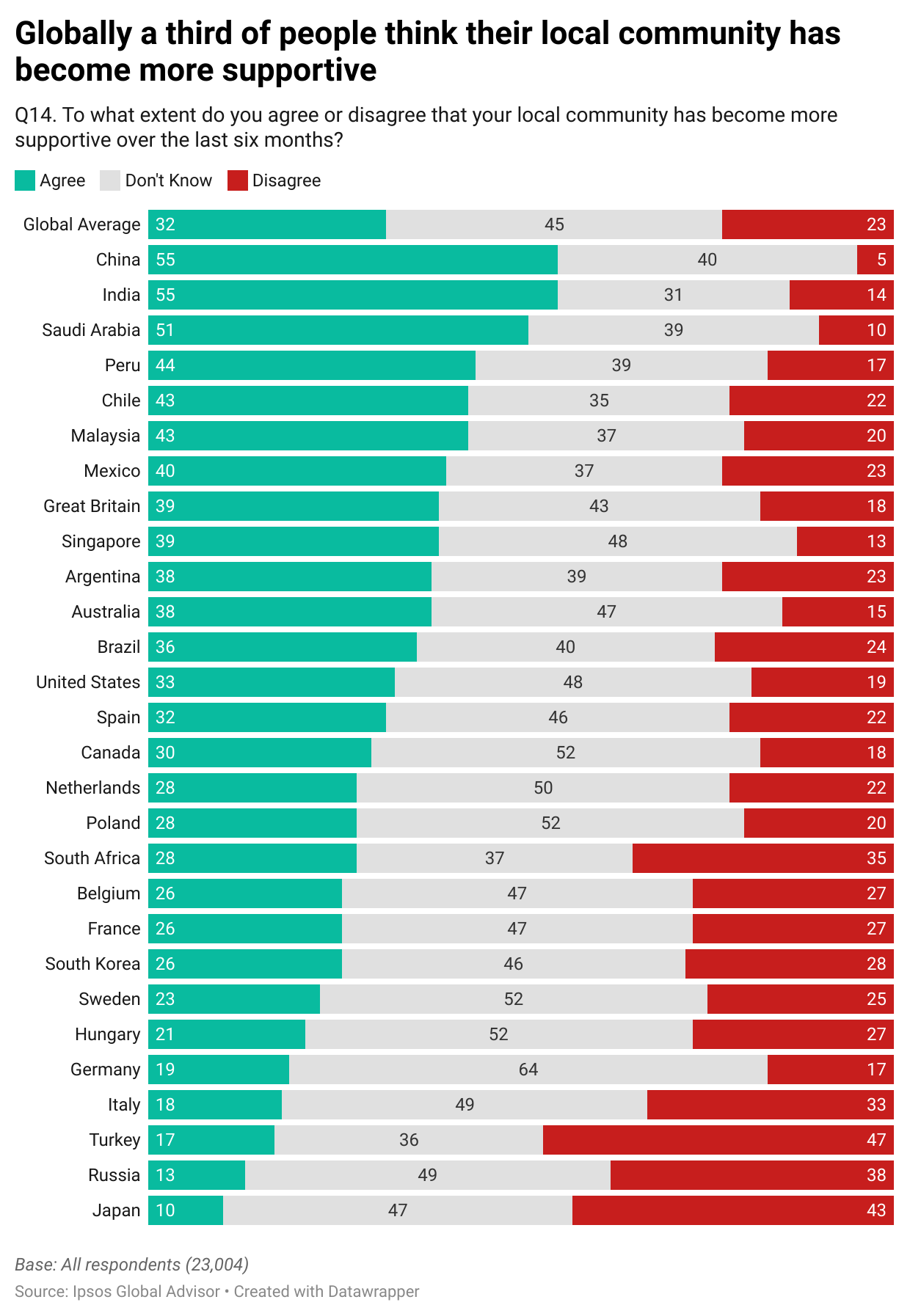
Globally a third of people think their local community has become more supportive.
- Around the world, a third of people agree their local community has become more supportive over the last six months (32%).
- Great Britain is the only European country to feature in the top 10 countries who are most likely to agree their local community has become more supportive: Top are China and India (both 55%), followed by Saudi Arabia (51%), Peru (44%), Chile (43%), Malaysia (43%), Mexico (40%) and GB (39%), Singapore (39%) and Argentina (38%).
- The country with the highest proportion disagreeing that their local community has become more supportive is Turkey, with almost half of people agreeing this is the case (47%). Other countries unlikely to say their community has become more supportive over the last six months are Turkey (17%), Russia (13%) and Japan (10%).
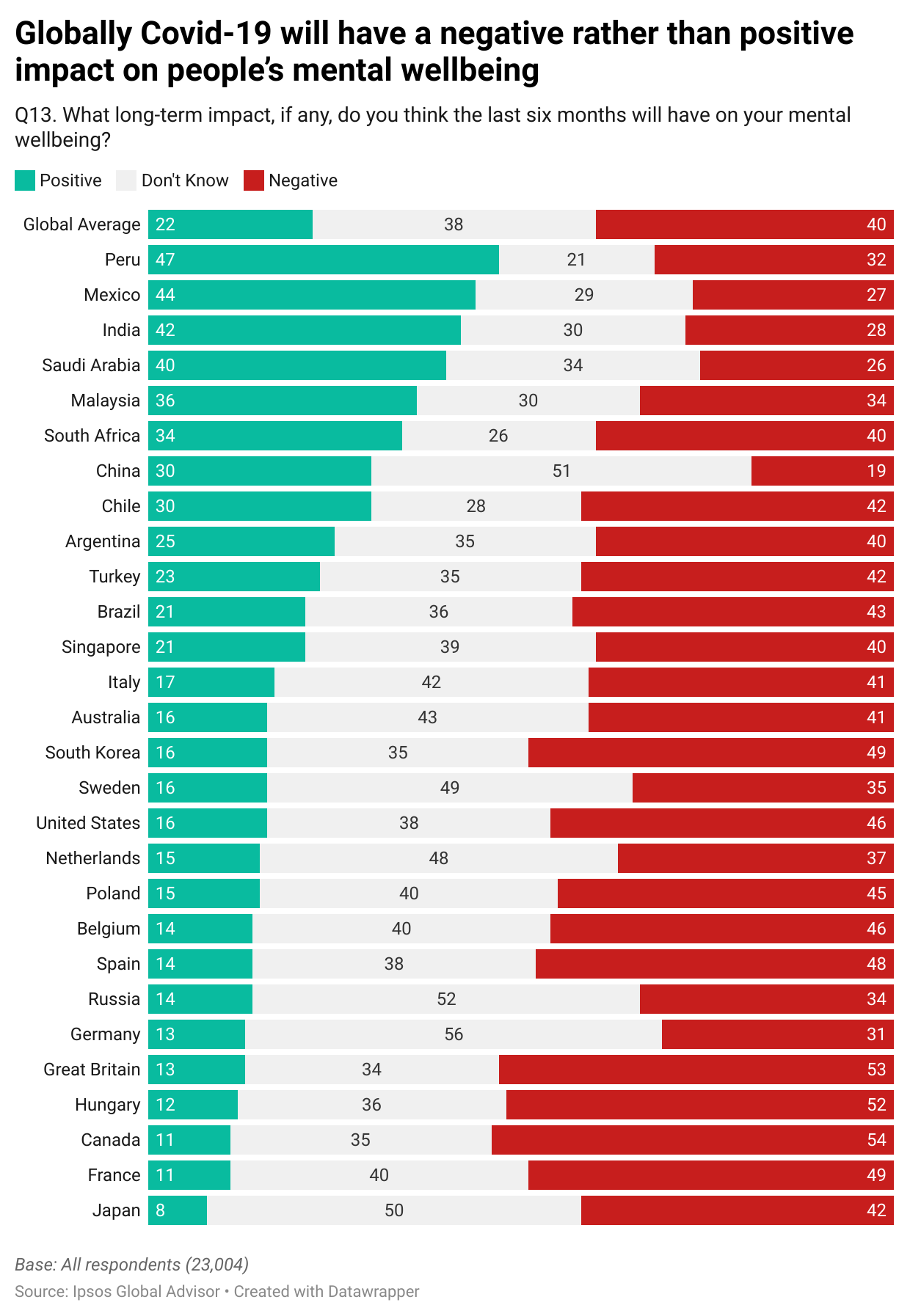
Globally Covid-19 will have a negative impact on people's mental wellbeing
- Globally, people are more likely to say Covid-19 will have a negative impact on their mental wellbeing than a positive impact (40% compared with 22%).
- There are wide differences between countries. Countries where people are most likely to say the pandemic will have a positive impact on their mental wellbeing are: Peru (47%), Mexico (44%), India (42%), Saudi Arabia (40%) and Malaysia (36%).
- This contrasts with the following countries where the smallest proportions believe it will have a positive impact: GB (13%), Hungary (12%), Canada (11%), France (11%) and Japan (8%).
Loneliness has increased across the world
- Globally, two in five people (41%) report becoming lonelier over the last 6 months, while one in five (19%) have become less lonely.
- Countries where the highest proportions of people have become lonelier include: Turkey (54%), Brazil (52%), Belgium (51%), Canada (50%) and Great Britain (49%).
- People in Turkey were also the most likely to disagree their local community has become more supportive over the last 6 months (47%).
- Countries where the smallest proportions of people say they've become lonelier include Malaysia (35%), Poland (34%), Russia (28%), China (26%) and Japan (23%).
Technical details
These are the results of a 28-market survey conducted by Ipsos on its Global Advisor online platform. Ipsos interviewed a total of 23,004 adults aged 18-74 in Singapore, 18-74 in the United States, Canada, Malaysia, South Africa and Turkey, 21-74 in Singapore and 16-74 in 22 other markets between 23 December 2020 and 8 January 2021.
The sample consists of approximately 1,000 individuals in each of Australia, Belgium, Brazil, Canada, mainland China, France, Germany, Great Britain, Italy, Japan, Spain and the U.S., and 500 individuals in each of Argentina, Chile, Hungary, India, Malaysia, Mexico, the Netherlands, Peru, Poland, Russia, Saudi Arabia, Singapore, South Africa, South Korea, Sweden, and Turkey.
The samples in Argentina, Australia, Belgium, Canada, France, Germany, Great Britain, Hungary, Italy, Japan, the Netherlands, Poland, South Korea, Spain, Sweden and the U.S. can be taken as representative of their general adult population under the age of 75.
The samples in Brazil, Chile, mainland China, India, Israel, Malaysia, Mexico, Peru, Russia, Saudi Arabia, Singapore, South Africa, and Turkey are more urban, more educated, and/or more affluent than the general population. The survey results for these markets should be viewed as reflecting the views of the more "connected" segment of their population.
The data is weighted so that each country's sample composition best reflects the demographic profile of the adult population according to the most recent census data.
Where results do not sum to 100 or the 'difference' appears to be +/-1 more/less than the actual, this may be due to rounding, multiple responses, or the exclusion of "don't know" or not stated responses.
The precision of Ipsos online polls is calculated using a credibility interval with a poll of 1,000 accurate to +/- 3.5 percentage points and of 500 accurate to +/- 5.0 percentage points. For more information on Ipsos' use of credibility intervals, please visit the Ipsos website. The publication of these findings abides by local rules and regulations.


