More think opening businesses puts too many people at risk of COVID-19 and we need to wait

A majority of people in some hard-hit countries think jobs lost will not be recovered.

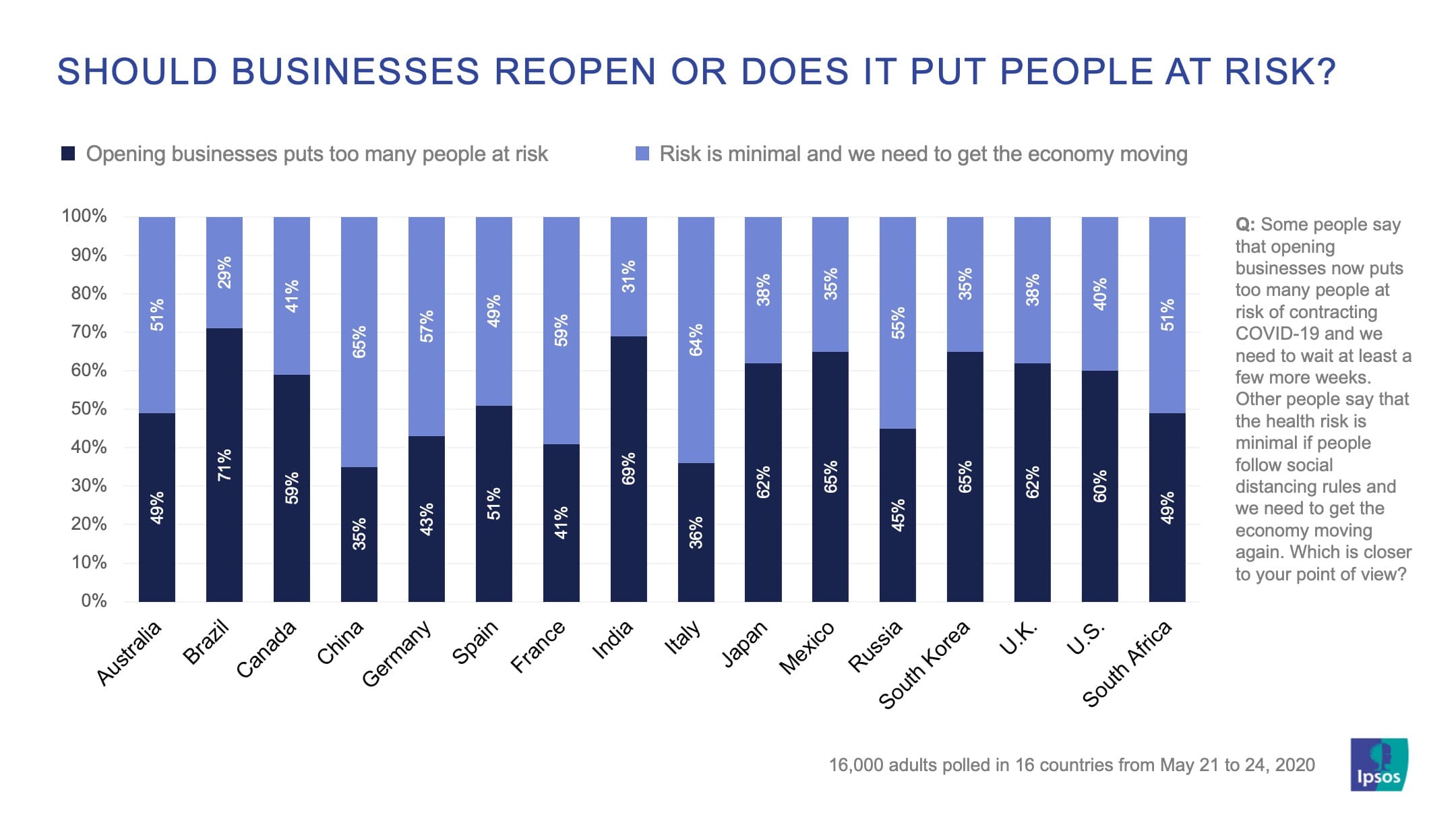
A majority of people in nine out of 16 countries think opening businesses now puts too many people at risk of contracting COVID-19, according to the latest Ipsos suvey.

More people also say most jobs lost during the lockdown will not return, suggesting those that support reopening are doing so in spite of the risk rather than believing the risk is low.  

In a poll of 16,000 people in 16 major countries conducted from May 21 to 24, people in Brazil (71%), India (69%), Mexico and South Korea (65%), Japan and the United Kingdom (62%) and the United States (60%) are most likely to say we need to wait at least a few more weeks before opening businesses, because opening now would put too many people at risk of contracting COVID-19.

But on the opposite end, those in hard hit countries of China (65%), Italy (64%), France (59%), Germany (57%) and Russia (55%) are most likely to say the health risk is minimal if people follow social distancing rules, and we need to get the economy moving again.

People most divided on taking this action are in Spain, Australia and South Africa with only 2 percentage points between those who think opening businesses now puts too many people at risk versus those who say the risk is minimal.
Should businesses reopen or does it put people at risk? | Ipsos | Essentials | Coronavirus tracker

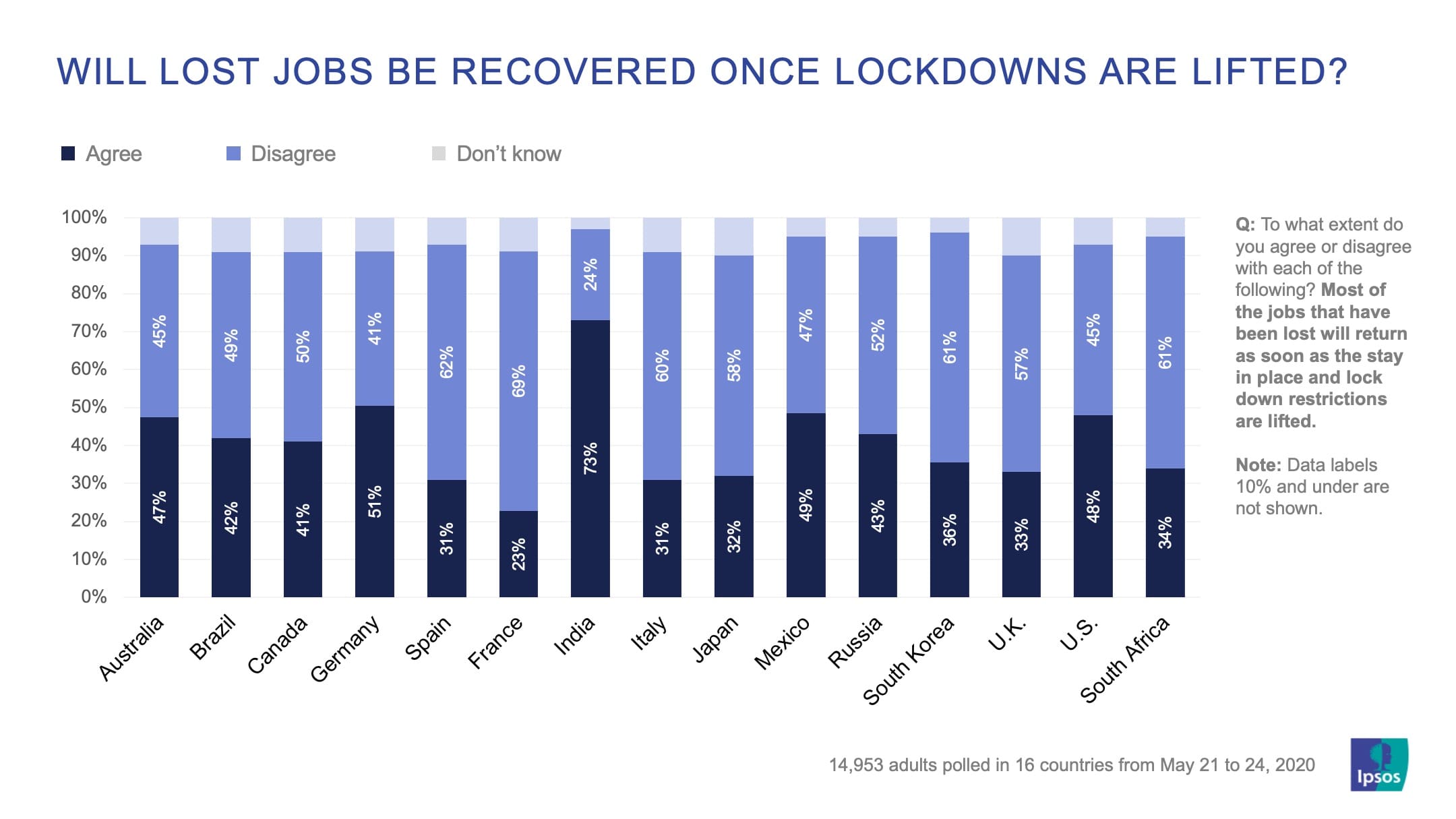
Added to this, a majority of people in France (69%), Spain (62%), South Korea and South Africa (61%), Italy (60%), Japan (58%), the U.K. (57%), and Russia (52%) don’t think most jobs lost during the pandemic will return as soon as the stay in place and lockdown restrictions are lifted.

A majority of respondents in India (73%) and Germany (51%) are the only ones out of 15 countries to believe most lost jobs will return once restrictions are eased.

A number of countries are divided on this question with only 2 points separating those who agree and disagree on whether jobs will be recovered in Australia and Mexico, followed by the U.S. (3), Brazil (7), Canada (9) and Germany (10).
Will lost jobs be recovered once lockdowns are lifted? | Ipsos | Essentials | Coronavirus tracker

These are the results from Essentials, an Ipsos weekly global syndicated study examing the opinions and behaviours as countries move through the pandemic. These results were collected May 21st to 24th, 2020 using an online methodology 16,000 adults aged 18-74 in Canada and the United States and 16-74 in Australia, Brazil, China, France, Germany, Italy, Spain, India, Japan, Mexico, Russia, South Africa, South Korea and the United Kingdom.

Related news

  • enseignement ipsos belgique
    Education Press release

    L'enseignement, un levier pour l'avenir ? Les Wallons en doutent de plus en plus

    Alors que 34 % des Flamands portent un regard positif sur l’enseignement, ce n’est le cas que pour 16 % des Wallons. Chez ces derniers, 51 % le jugent même explicitement mauvais. Le même sondage réalisé par Ipsos révèle également que les différences entre les deux régions vont au-delà de la simple perception de la qualité. La confiance dans l’enseignement en tant que moteur d’opportunités de carrière et de la mobilité sociale est également nettement plus faible en Wallonie.
  • Ipsos Belgie - onderwijs
    Education Press release

    Onderwijs als hefboom voor de toekomst? Vlamingen en Walen denken daar anders over

    Terwijl 34% van de Vlamingen het onderwijs positief beoordeelt, geldt dat slechts voor 17% van de Walen. Daar beoordeelt zelfs 51% het expliciet als slecht. Uit dezelfde bevraging van Ipsos blijkt eveneens dat de verschillen tussen de landsdelen verder gaan dan de perceptie van kwaliteit alleen. Ook het geloof in onderwijs als motor voor carrièrekansen en sociale mobiliteit ligt in Wallonië beduidend lager.
  • Ipsos Pride Report 2026
    Sexuality Survey

    Ipsos Pride Report 2026

    Our 2026 edition of the Ipsos LGBT+ Pride report shows attitudes stabilising across 26 countries on several key measures, including trans athletes and LGBT media representation.