
Social media: Should governments shut it down in times of crisis?
- One in six say it’s acceptable to shut down social media during a crisis to stop the spread of fake news
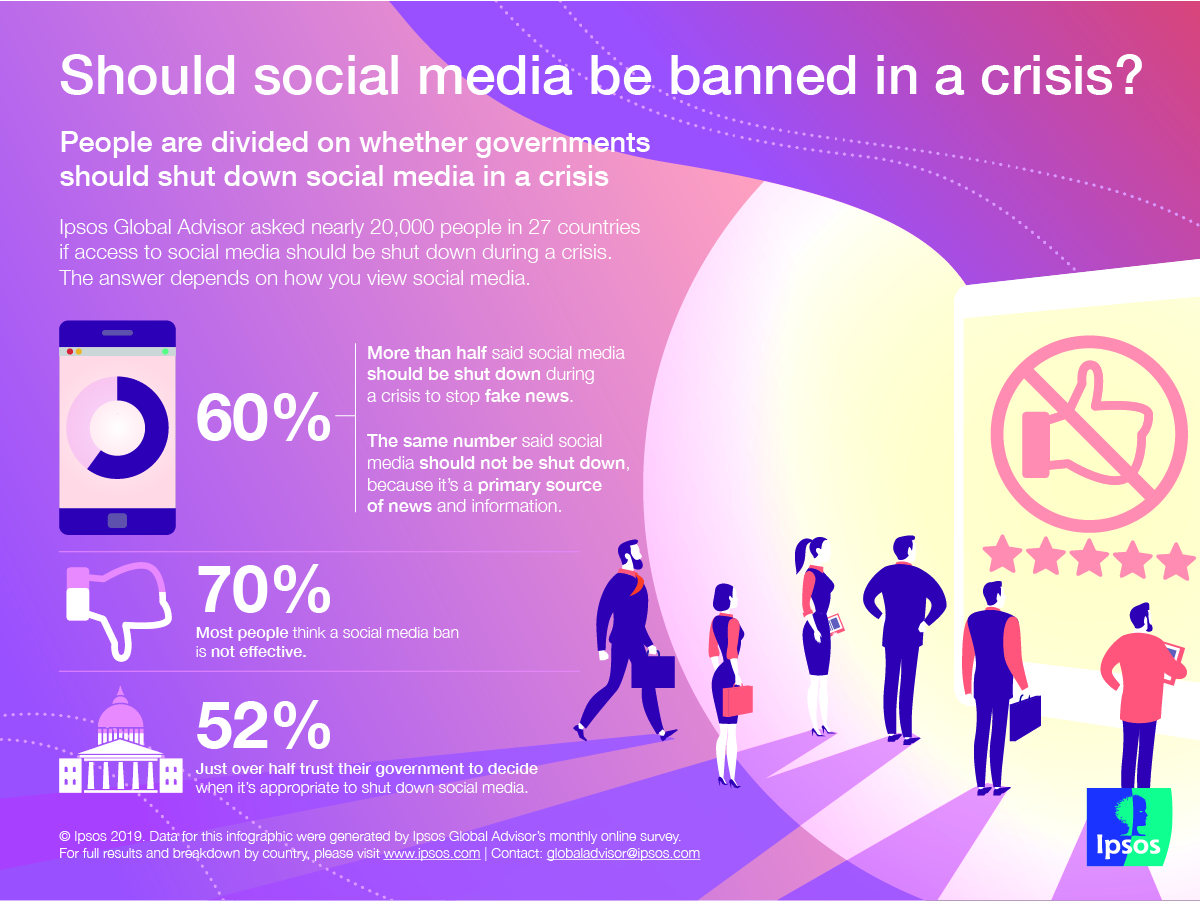
- 60% say cutting off social media is unacceptable because it’s a primary news source
- Majority of people (70%) don’t believe a social media ban is effective
People around the world are divided on whether governments should shut down access to social media during a crisis depending on if they see the platforms as a valuable news source, or a supplier of fake news.
In the wake of the fatal terrorist attack in Sri Lanka on Easter Sunday in April, the government temporarily shut down access to social media to stop the spread of fake news.
An Ipsos Global Advisor survey conducted more than a month later finds that more than half (60%) of nearly 20,000 people across 27 countries think cutting off social media access during a crisis is acceptable.
But, the same proportion of people (60%) also said that it is not acceptable to shut down social media in a crisis, because the platforms are a primary source of news and information for many.
Darrell Bricker, CEO, Ipsos Public Affairs and author of the report, said the findings show that while people are concerned that fake news further inflames an already tense situation, losing access to social media also brings up red flags.
“People are somewhat confused on what the appropriate response should be,” said Bricker.
“While the idea of being denied access to social media is likely seen as draconian, there’s also a view that it shouldn’t be used to make a difficult situation worse.”
Countries where most say social media should be banned to stop fake news:
- India (88%)
- Malaysia (75%)
- Saudi Arabia (73%)
- China (72%)
- Great Britain (69%)
Countries where most say social media shouldn’t be banned because it’s a news source:
- Peru, Turkey (74%)
- Mexico (71%)
- China, Saudi Arabia (70%)
- Serbia (67%)
Overall, most of the respondents (71%) felt that a temporary ban on social media by the government is not an effective measure, because there are many ways to work around them.
Added to that, more than half (54%) think people are capable of separating fact from fiction, which is why they would not support a temporary ban to stop the flow of fake news.
“The public is learning that anything posted online, especially on social media, lives forever,” said Bricker. “Banning it temporarily won’t remove it from existence.”
Trust in government and social media
A big driver of whether people thought governments should or shouldn’t ban social media in a crisis came down to how much people trusted their elected officials and social media networks.
Slightly more than half (52%) said they trust their government to decide when and if it’s appropriate to shut down social media access in times of crisis.
People in India (80%), Saudi Arabia (75%), and Malaysia (74%) had the most trust in their governments to do this, while those in Argentina (35%), South Africa (38%), and Hungary (41%) had the least trust.
At the same time, more than half said they did not trust (51%) social media companies to ensure that information shared on their platforms during a crisis is factual.
Education levels also are a factor when it comes to trusting social media, with those most educated the least likely (42%) to think of social media as the most accurate source of news and information.
Bricker added that it is likely that those with higher education have been more exposed to the complexities of freedom of speech issues, particularly related to bans on public communication.
Other findings:
- More than half (59%) support a social media ban in the event of a massive terrorist attack
- Only 45% think social media is the best or most accurate source of news
- Those with lower education levels are more likely to support a social media ban (62%)
Click here for the entire report.


