Many think it’s unlikely the economy will recover quickly once COVID-19 lockdown is over

Most negative about an economic recovery in hard-hit countries except China.

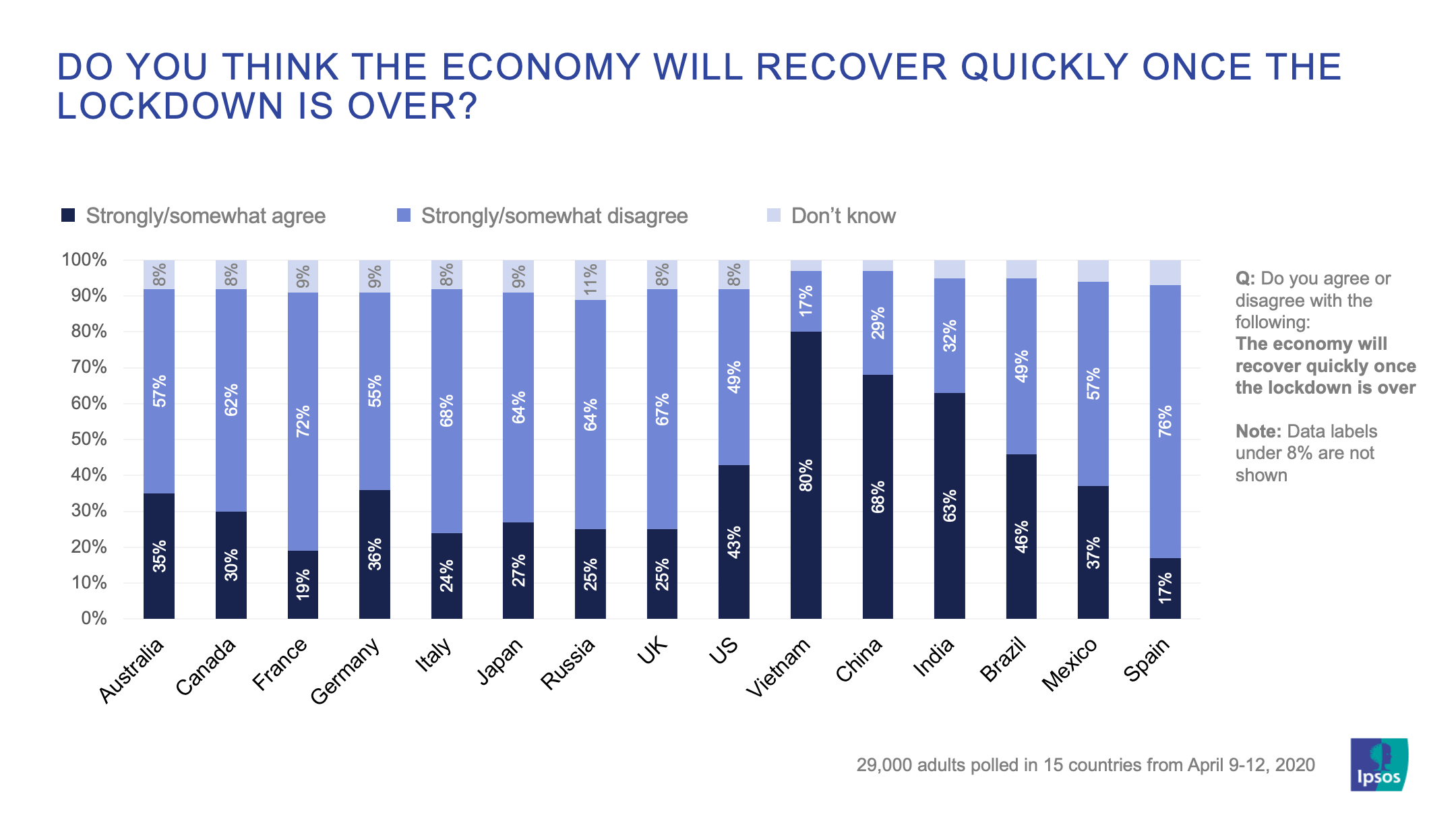
A majority of people in 10 of the 15 countries polled by Ipsos disagree that the economy will recover quickly once the lockdown from the coronavirus pandemic is over – suggesting a lasting impact.

People in Spain (76%), France (72%), Italy (68%), the United Kingdom (67%), Russia and Japan (64%), and Canada (62%) feel most strongly against a quick economic recovery in a survey of nearly 29,000 respondents conducted from April 9 to 12. Those in Vietnam (80%), China (68%) and India (63%) are most likely to say a quick recovery will take place.

At the same time, one of the countries most divided on this question is the world’s largest economy – the United States - with nearly half of those surveyed (49%) disagreeing on a quick recovery, while 43% think it will happen.
Do you think the economy will recover quickly once the lockdown is over? | Coronavirus | Global Advisor | Ipsos

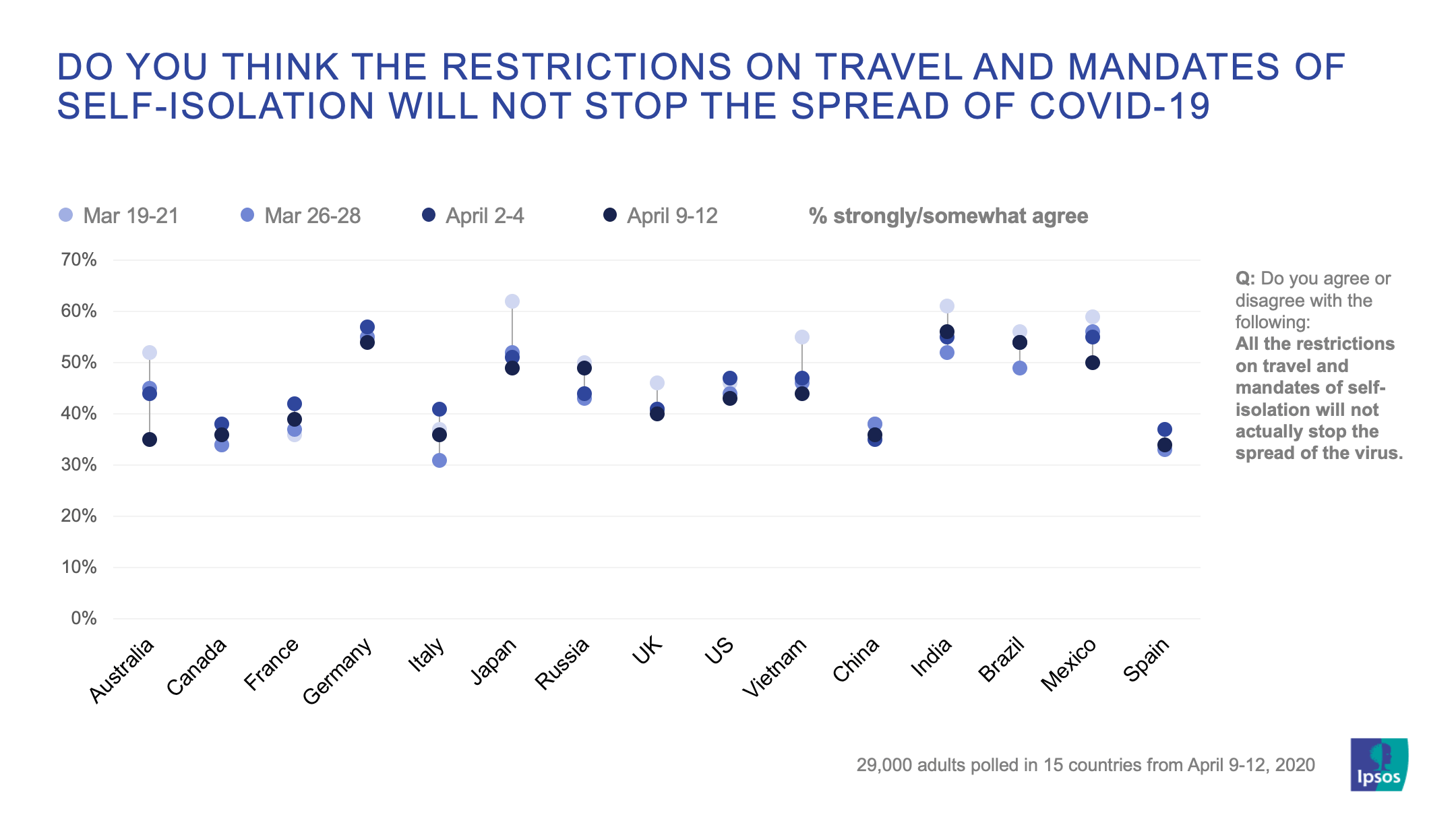
In terms of actions taken, majorities in India (56%), Brazil and Germany (54%) say all of the restrictions on travel and mandates for self-isolation will not stop the spread of COVID-19. That compares with majorities in China (63%), Australia (59%), Italy and Canada (58%), Spain (57%), the U.K., and Vietnam (54%) and France (51%) who think the restrictions do work.

Countries that have the seen the most significant change on this measure since mid-March are the ones where optimism has increased. Australia saw a drop of 17 percentage points in the number of those that agree the measures will not stop the spread of the pandemic, while the number of respondents in Japan fell by 13 points.
Do you think the restrictions on travel and mandates of self-isolation will not stop the spread of COVID-19? | Global Advisor | Ipsos

These are the results of an Ipsos survey conducted April 9th to 12th, 2020 on the Global Advisor online platform among 28,000 adults aged 18-74 in Canada and the United States and 16-74 in Australia, Brazil, China, France, Germany, Italy, India, Japan, Mexico, Russia, Vietnam and the United Kingdom. Where available, tracking results from previous studies, conducted through March and selected results from February are referenced by date.

Related news

  • enseignement ipsos belgique
    Education Press release

    L'enseignement, un levier pour l'avenir ? Les Wallons en doutent de plus en plus

    Alors que 34 % des Flamands portent un regard positif sur l’enseignement, ce n’est le cas que pour 16 % des Wallons. Chez ces derniers, 51 % le jugent même explicitement mauvais. Le même sondage réalisé par Ipsos révèle également que les différences entre les deux régions vont au-delà de la simple perception de la qualité. La confiance dans l’enseignement en tant que moteur d’opportunités de carrière et de la mobilité sociale est également nettement plus faible en Wallonie.
  • Ipsos Belgie - onderwijs
    Education Press release

    Onderwijs als hefboom voor de toekomst? Vlamingen en Walen denken daar anders over

    Terwijl 34% van de Vlamingen het onderwijs positief beoordeelt, geldt dat slechts voor 17% van de Walen. Daar beoordeelt zelfs 51% het expliciet als slecht. Uit dezelfde bevraging van Ipsos blijkt eveneens dat de verschillen tussen de landsdelen verder gaan dan de perceptie van kwaliteit alleen. Ook het geloof in onderwijs als motor voor carrièrekansen en sociale mobiliteit ligt in Wallonië beduidend lager.
  • Ipsos Pride Report 2026
    Sexuality Survey

    Ipsos Pride Report 2026

    Our 2026 edition of the Ipsos LGBT+ Pride report shows attitudes stabilising across 26 countries on several key measures, including trans athletes and LGBT media representation.