
Populist, anti-elite and nativist views linked to globally widespread broken-system sentiment
Majorities of citizens in most of 25 countries surveyed by Ipsos express feelings of alienation when thinking about their country. The survey of more than 19,000 adults finds perceptions of a broken political and economic system prevailing in most countries, often accompanied by populist and anti-elite sentiment and nativist views.
Broken-System Sentiment
On average, 56% agree their country’s society is broken and 57% agree that their country is in decline. To fully grasp the prevalence of social and political disaffection, Ipsos designed the “System Is Broken” Index, based on the level of agreement with five statements:
- “The economy is rigged to favor the rich and powerful” (averaging 71% agree in the 25 countries surveyed)
- “Traditional parties and politicians don’t care about people ‘like me’” (68%),
- “Local experts don’t understand the lives of people ‘like me’” (65%),
- The country “needs a strong leader to take the country back from the rich and powerful” (64%), and
- “To fix” the country, “we need a strong leader willing to break rules” (44%).
The four countries with the highest levels of alienation are all in Latin America – Colombia, Peru, Brazil, and Chile.
Since 2016, broken-system sentiment has gained ground most in Japan, South Africa, Sweden, the United States, and Argentina; it has receded most in Spain, Mexico, and France. Compared to 2019, months before the pandemic, it has increased most in Malaysia and decreased most in Great Britain.
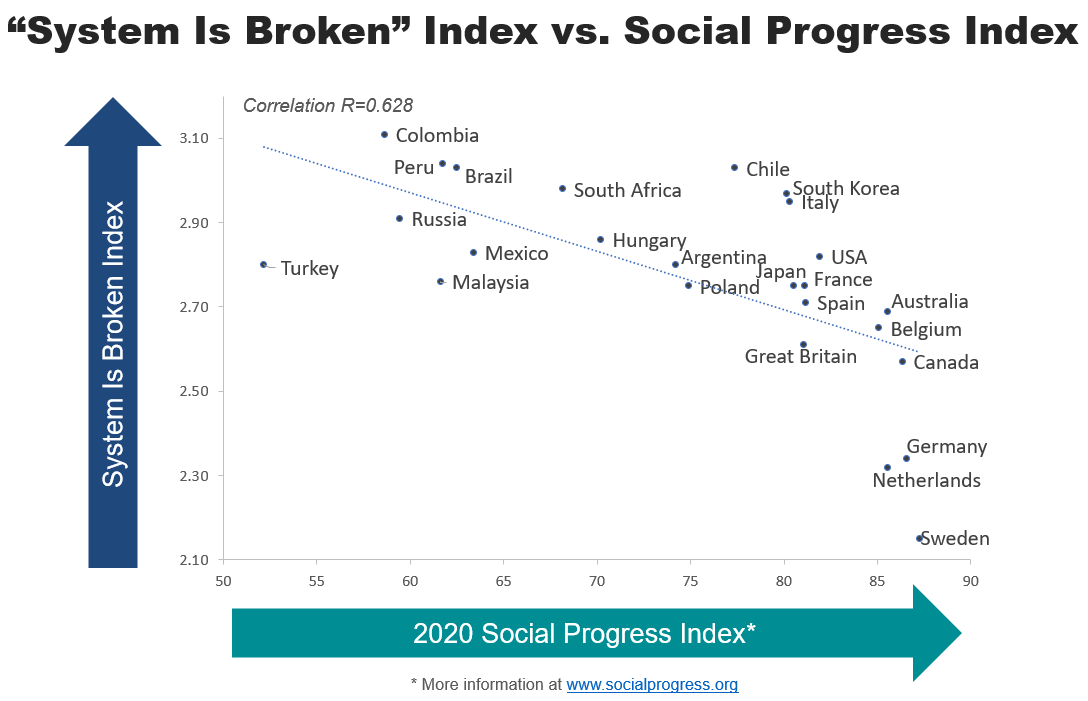
Broken-system sentiment is highly linked to populist sentiment, resentment of elites, and natives-first/anti-immigration views. Ipsos also found that its System Is Broken Index is highly correlated with both the Social Progress Imperative’s Social Progress Index, an outcomes-based indicator of how well citizens’ social and environmental needs are met, and Transparency International’s Corruption Perceptions Index. Countries with higher levels of wellness, equality, inclusion, sustainability, personal freedom, and safety and those with lower levels of perceive public-sector corruption tend to show lower levels of broken-system sentiment.
Since 2016, broken-system sentiment has gained ground most in Japan, South Africa, Sweden, the United States, and Argentina; it has receded most in Spain, Mexico, and France. Compared to 2019, months before the pandemic, it has increased most in Malaysia and decreased most in Great Britain.
Populism and Resentment of Elites
On average across the 25 countries:
- 81% agree that politicians always end up finding ways to protect their privileges,
- 72% say the political and economic elite don’t care about hard-working people,
- 70% think the main divide in our society is between ordinary citizens and the political and economic elite,
- 62% agree politicians should be able to say what’s on their minds regardless of what anyone else thinks, and
- 60% say the most important political issues should be decided directly by the people through referendums, not by the elected officials.
Populist/anti-elite sentiment is strongly correlated with broken-system sentiment; it is most prevalent in Chile, Hungary, Colombia, Peru, and Russia.
The “elite” is widely perceived across the world as a closely connected group making decisions based on their interest and ignoring the needs of others. On average, 15% of those surveyed identify in any way with their country’s elite; Americans and Japanese are those least likely to do so.
Nativist Views
The “average global citizen” is ambivalent about immigration, leaning toward a natives-first view:
- 57% say employers should favor natives over immigrants when jobs are scarce,
- 38% agree their country would be stronger if it stopped immigration (while 33% disagree), and
- 38% say immigrants take jobs away from their country’s “real” nationals (while 35% disagree)
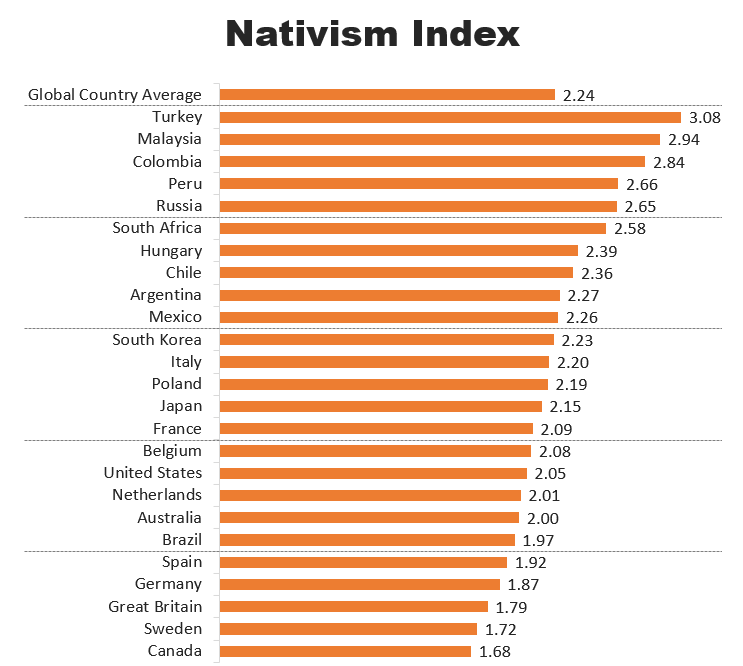
The Nativism Index is strongly correlated with the “System Is Broken” Index, indicating how much social and political alienation and anti-immigration views tend to go hand-in-hand.
Since 2016, nativist sentiment has grown most in Peru, Sweden (where it was marginal), Japan, South Africa, South Korea, and Turkey. Meanwhile, it has receded most in the U.S., Canada, Spain, Italy, and Hungary.


