Taking Real Steps to Address Climate Change
Do questions like these keep you up at night?
- How does my audience perceive my brand in terms of its sustainable and environmentally responsible practices?
- How prevalent is sustainability in the context of my specific markets, product categories and competitor brands?
- What can I implement almost immediately, that will improve the perception of my brand as it pertains to sustainability?
As sustainability is becoming a topic of growing interest, brands feel obliged to talk to their sustainability agenda and show their actions through initiatives and commitments to various time frames. However, being a ‘sustainable brand’ has different meanings to different consumers.
Download our detailed research paper outlining some of the challenges and opportunities that exist for brands.
KEY FINDINGS:
- Recent global research from Ipsos finds that 72% of respondents agree that if ordinary people do not act now to combat climate change, they will be failing future generations.
- 68% globally say that if companies do not act to combat climate change, they are failing their employees and customers.
- 65% globally believe that if their government does not combat climate change then it is failing citizens.
In November 2021, the world’s attention turned to Glasgow, Scotland, where the United Nations Climate Change Conference (COP26) was taking place. The global climate crisis was present in everyone’s mind, dominating news headlines and filling opinion pieces. Back then, an Ipsos study revealed that only 31% of people felt that their country had a clear plan in place for tackling climate change. Post-COP26, the sustainability challenge remains; many G20 members, who account for 80% of greenhouse gas emissions, do not have policies in place to achieve neither long-term goals (net zero) nor short-term imperatives (decrease global emissions by 2030 to half of 2010 values).
While a global approach is needed, progress relies on individual commitments of all parties, and some activities such as international shipping and aviation fall through the cracks because they are not “owned” by any single participating country.
Initiatives on how to combat climate change not only come from the United Nations but from government agencies, lobby groups and the private sectors. This complex picture means that the public holds contrasting views on who should take action to combat this crisis.
While organizations are forced to comply with regulations, they are challenged to implement sustainable practices that are timely, tangible, realistic and—importantly—resonate with their audience. Brands are keen to fulfil consumer expectations in a context where citizens are demanding more of them.
This paper aims to help brands understand how consumers think of and act upon sustainability initiatives. From there, it suggests ways to embrace and implement sustainability as part of the brand’s strategy
Who should be responsible for combating the climate crisis?
People feel the burden of responsibility. In a recent global survey from Ipsos, 72% agree that if ordinary people do not act now to combat climate change, they will be failing future generations. 68% globally say that if companies do not act to combat climate change, they are failing their employees and customers, and 65% globally believe that if their government does not combat climate change then it is failing citizens.
Governments design policies that strive to combat the global climate crisis, which in turn companies adhere to through their business practices. Consumers also prompt brands to become more sustainable. When asked, “Who should be responsible for finding a way to reduce unnecessary packaging?” 40% of people surveyed said everyone, 38% said manufacturers and retailers and only 3% said consumers alone.
Consumers also prompt brands to become more sustainable. When asked, “Who should be responsible for finding a way to reduce unnecessary packaging?” 40% of people surveyed said everyone, 38% said manufacturers and retailers and only 3% said consumers alone.
Product packaging is something that brands (not consumers) own and control. Yet consumers influence business decisions through the share of wallet they allocate to a given brand, based on its impact on the environment.
Further, brands must confront pressure groups. One example is Badvertising, which recently rolled out a campaign to call out advertising agencies, accusing them of “greenwashing” consumers on behalf of their brand clients that have high carbon-footprint. In other words, they are willingly misleading consumers to believe that the advertised products are more environmentally friendly than they are, using words like “ethical,” “conscious” or “sustainable” in their messaging.
When it comes to implementing sustainable practices, organizations face a monumental task as they rarely control their entire supply chain ecosystem. London’s Heathrow Airport, for example, recently committed to becoming carbon neutral by 2030, but only for the parts of the airports it runs. It excluded the emissions of the 1,300 flights that take off or land at the airport every day
What people believe contrasts with how they shop
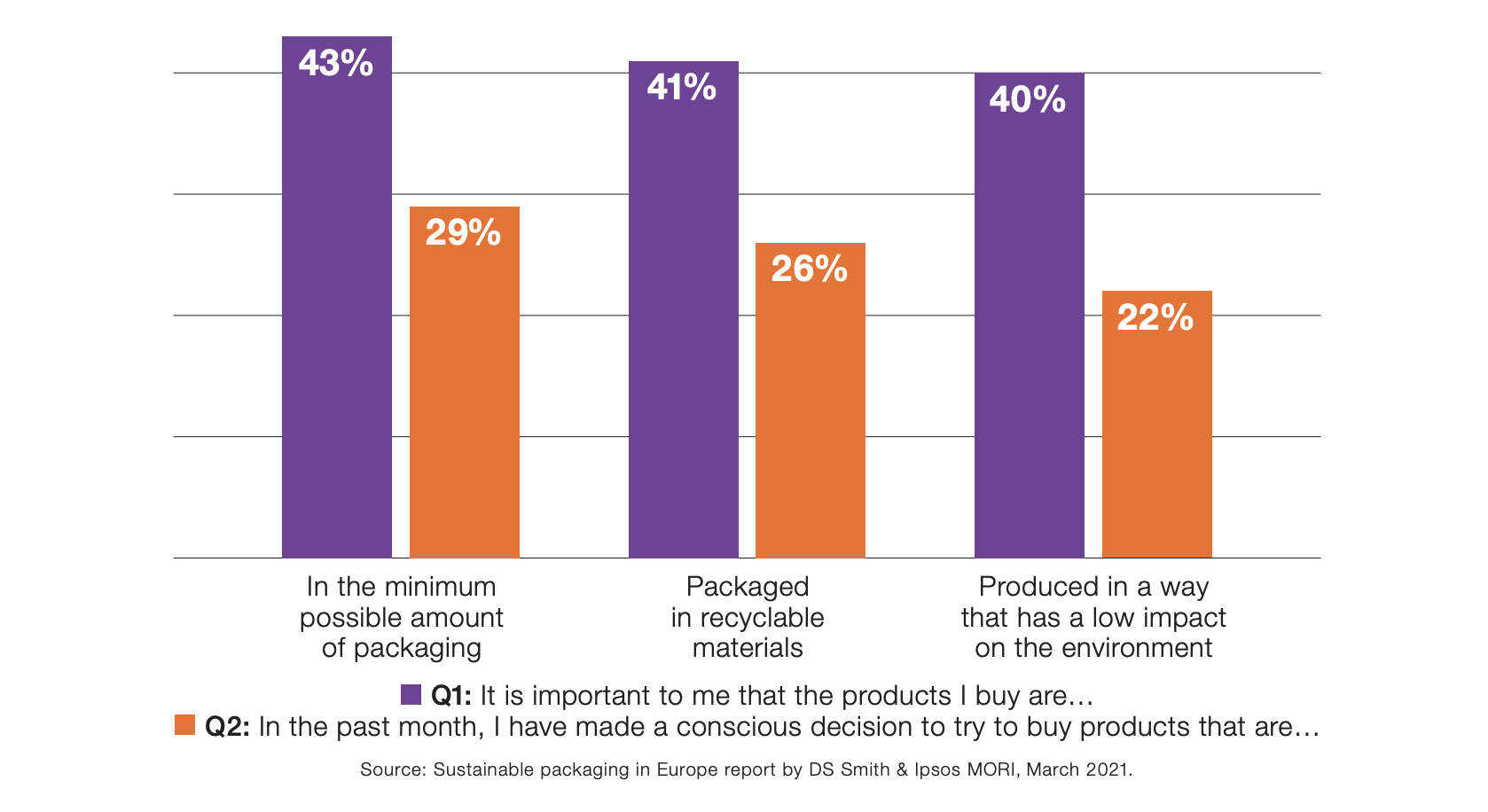
While people claim to be concerned with the environment, their efforts to live in a more environmentally friendly way often fall short, and they default on easier actions. An Ipsos study reveals that almost nine in 10 worldwide are confident recycling and using lowenergy light bulbs. Conversely, only 55% would consider switching to a mostly plant-based diet, and six in 10 (59%) would avoid driving a car and longdistance air travel. When it comes to shopping, Ipsos Essentials data shows that globally, just over half of citizens consider themselves to be ethical or sustainable shoppers. In the U.S., only 24% of shoppers see sustainability as a crucial factor when making a purchase, compared to 53% who say the same for affordability and 71% for quality of product or service.
In baby and toddler products, for example, an Ipsos study shows that sustainability is not a top priority. Parents favor diaper brands that make a product that is safe for their baby (70%) and fit their baby well (60%). By contrast, only 22% care that the brand is environmentally responsible, declining by three percentage points over the last year.
Brands are challenged to communicate their commitment to sustainability
As sustainability is becoming a topic of growing interest, brands feel obliged to talk to their sustainability agenda and show their actions through initiatives and commitments to various time frames.
Many brands aim to eventually become carbon neutral (offsetting one’s emissions by planting trees), including:
- Netflix, by 2022
- Apple, Microsoft and Facebook, by 2030
- Amazon by 2040 Coca-Cola and Nestle, by 2050
Starbucks aimed to become “resource positive” by 2030, which it defines as reducing carbon emissions, water withdrawal and waste by 50%, while expanding plant-based menu options, shifting to re-usable packaging, and investing in regenerative agricultural practices.
Brands rely on a range of terms to describe their sustainability initiatives, including but not limited to “carbon Zero” (Hytch, a commuting app), “zero carbon” (Zero Carbon Coffee), “climate positive” (Max Burgers) and even “Air-made” (the carbon-neutral alcohol brand Air vodka).
Embracing sustainability
Being a “sustainable brand” has different meanings to different consumers.
Some brands are purposefully built around sustainability
“Oatly was born sustainable. Its very existence is the manifestation of their mission. Specifically, to help support ‘a systemic shift towards a sustainable, resilient food system’…to ensure the future of the planet for generations to come.”
Some brands have a purpose that aligns with sustainability
Although denim is notorious for requiring large quantities of waters to create jeans, Levi’s new collection, Water<less, uses 96% less water. Levi’s implements sustainable practices through its entire design and manufacturing process and is working towards sourcing cotton that is 100% sustainable.
Some brands must shift to sustainability
VWG’s mission is to power a grand switchover to electric vehicles. Such is their commitment to this cause, they have enshrined the mission in VW’s new tagline, which is now “Way to Zero.” They aim to achieve this by shooting for total carbon neutrality by 2050, with the hope of creating a totally sustainable production process from design concept to forecourt.
THREE QUESTIONS TO GET STARTED: COFFEE WITH AN EXPERT
As discussed in this paper, implementing sustainable practices is no easy feat and often takes years. Prior to embarking on these large-scale endeavors, here are three examples of avenues Ipsos can help you explore straight away and address in a timely fashion. Please contact us to schedule an ideation session specific to your brand and its audience.
- How does my audience perceive my brand in terms of its sustainable and environmentally responsible practices?
- How prevalent is sustainability in the context of my specific markets, product categories and competitor brands?
- What can I implement almost immediately, that will improve the perception of my brand as it pertains to sustainability?
- For example, using recycled materials, recyclable packaging, starting a ‘gently used’ program in a similar vein as IKEA, Levi’s and Lululemon. These short-term initiatives will all add up and help drive long-term perception.