Most Malaysians Consider Themselves "Real" Nationals
- Malaysia is one of the top 3 countries with respondents (92%) who consider themselves "real" nationals of the country.
- A majority of respondents in 13 countries - including three-quarters in the US and two-thirds in Canada and Australia - consider that an immigrant who has become a citizen of a country is a "real" national. On the other hand, most people in Malaysia, Hungary, Serbia, and Turkey disagree with this statement.
- Fluency in the national language, Bahasa Malaysia is very important to Malaysians to be regarded as a "real" national. Naturalized citizens who are fluent in Bahasa Malaysia were identified as "real" nationals by 33% of Malaysians, while only 6% of those surveyed would regard a naturalized citizen not fluent in the local language a "real" national.
Ipsos, a global research company, conducted a study in 27 countries to explore global citizens' definition of nationality.
Arun Menon , Managing Director, Ipsos in Malaysia comments: "While self-perceptions of themselves as being real Malaysia is high, Malaysians tend to be less positive towards other people around them. They show much less positive views of naturalized citizens, native-born children of immigrants, lifelong immigrants who don't become citizens and illegal immigrants who have lived here most of their lives.
Malaysians place the country of origin and being born in Malaysia as being more important than any other factor in order to be identified as a "real" Malaysian. This is clearly seen with the big percentage difference in perception of who they see as "real" nationals when comparing native-born children of immigrants with children of expatriates. However, this also tells us that Malaysians do not take their citizenship lightly. They want immigrants to work hard and there should be no short-cuts to be a real Malaysian, whether by birthright or for mere convenience."
Key Findings on National Inclusiveness
Self Perception as a "Real" National
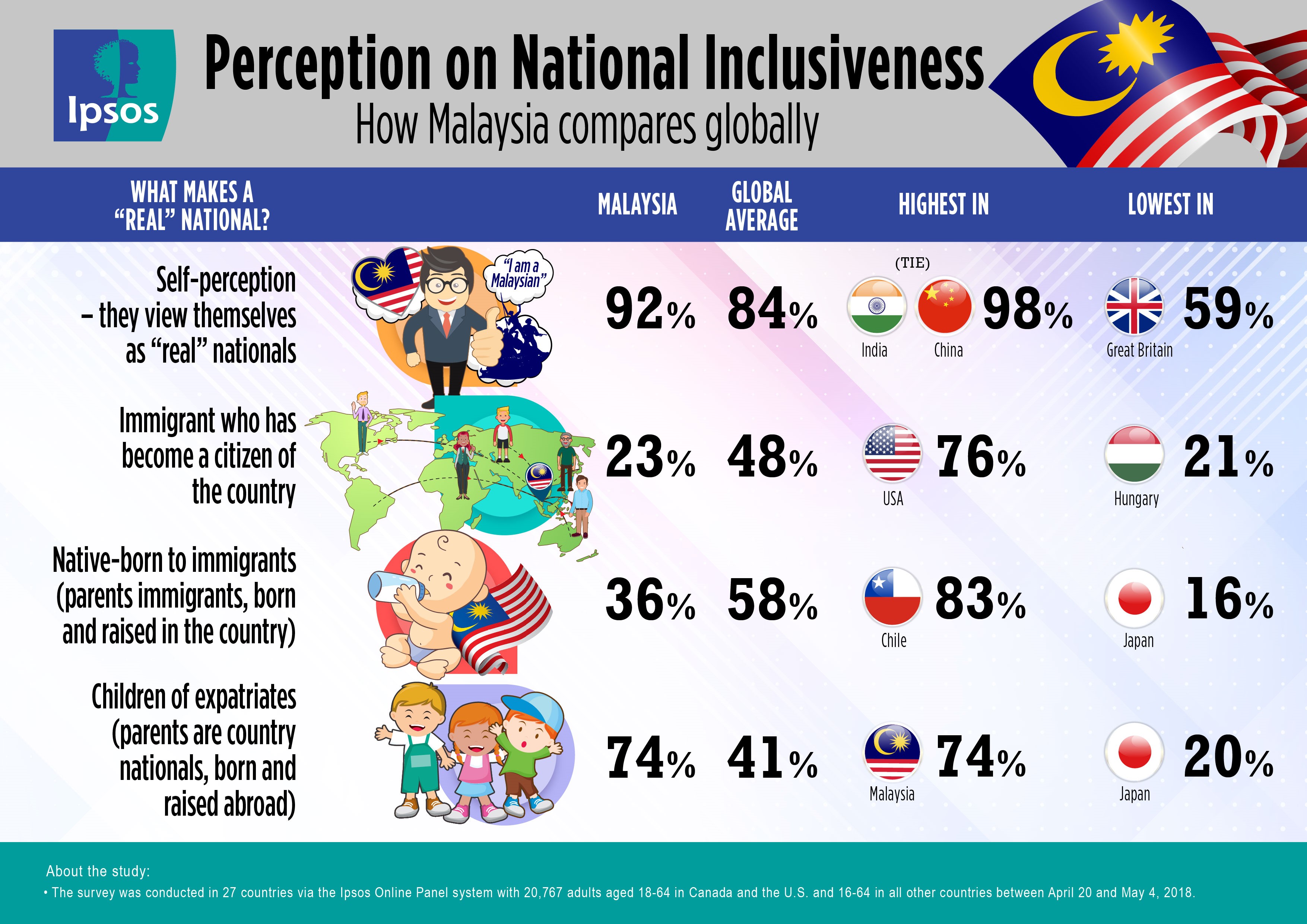
Malaysia, China, and India are three countries in the study where the sense of being an integral part of the nation is most widely shared: 92% in Malaysia consider themselves as "real" Malaysians, while 98% of respondents in China and India consider themselves as "real" Chinese and "real" Indians in their respective countries.
Self-perception as a "real" national is least prevalent in Saudi Arabia (where 28% do not view themselves as "real" Saudis and 7% are not sure) and Japan (where 7% do not think of themselves as "real" Japanese while 29% are not sure).
Second-generation Malaysians
Malaysia is among six countries(Serbia, Saudi Arabia, Turkey, China and Japan) where nationals believe that children of expatriates are more likely to be seen as "real" nationals than are native-born children of immigrants. 74% of Malaysians believe that someone born and raised abroad by parents from their own country are "real" nationals, while only 36% of Malaysians believe that someone born and raised in the country and whose parents migrated from another country are "real" nationals.
Naturalized Citizens
Just under half (48%) of adults asked across 25 countries* think that an immigrant who has become a citizen of a country is a "real" national while 31% consider that he or she is not a "real" national and 21% are not sure.
A majority of adults in 13 countries (including three quarters in the US and two thirds in Canada and Australia) and a plurality in seven other countries consider that a naturalized citizen is a "real" national. Malaysians (23%) disagree with this view, along with citizens from Hungary (21%) and Serbia (22%).
28% of Malaysians consider naturalized citizens who hold a job as "real" nationals, while only 12% consider those who are jobless "real". Being fluent in the local language is considered very important to Malaysians for a person to be regarded as a "real" national. Naturalized citizens who are fluent in Bahasa Malaysia were identified as "real" nationals by 33% of Malaysians, while not being fluent in the local language gave Malaysians a significantly lower perception (6%) as a "real" national.
Although the study found that being fluent in Bahasa Malaysia and being employed does increase the perception of their status as a 'real Malaysian', Malaysia is still ranked near the bottom of the list of 27 nationals surveyed.
Legal and Undocumented Non-Citizens
Malaysia has one of the least positive views on immigrants as "real" Malaysians. Legal immigrants who have lived in Malaysia most of their life, but have not become a citizen are least likely to be considered as "real" nationals with only 15% of Malaysians having this view, whereas the average global percentage is 31%.
Illegal immigrants who have lived in the country most of their lives are least likely to be considered as "real" nationals in Malaysia and Japan, with merely 6% of the respondents disagreeing with that view.
An immigrant who is married to a native (without any mention of their legal status) is less likely to be viewed as a "real" national by Malaysians since only 15% of the respondents thought otherwise, making Malaysia the country with the lowest values alongside Japan (15%) and with Hungary (12%).
People with Extreme Political Views
A majority of people in four countries surveyed (South Africa, the US, France and Canada) and a plurality in six other countries think someone with extreme political views is a "real" national. Almost half in Malaysia (43%) and a plurality in five countries think someone with extreme political views is not a "real" national. In Japan and fie other countries, the prevailing response is "not sure".
People with a Criminal Background
The view that someone who has been convicted of a crime and incarcerate is a "real" national is shared by a majority of adults in only seven countries surveyed (chief among them South Africa and Canada) any by a plurality in ten other countries. A plurality in Saudi Arabia and a majority in Malaysia consider that a felon is "not a real" national of their country. A majority in two countries (Japan and Serbia) and a plurality in four other countries say they are not sure if that is the case.
Armed Forces Veterans
Three out of four adults globally (73%), including at least 65% of adults in all but three of 25 countries* surveyed, think that someone who has served in the armed forces is a "real" national. This view is most widespread in the US (68%) as well as Malaysia and Canada (85% each). However, it is shared by only three among five adults in Serbia and Germany (59%) while a majority in Japan (62%) are not sure.
About the Study:
- The survey was conducted in 27 countries via the Ipsos Online Panel system: Argentina, Australia, Belgium, Brazil, Canada, Chile, China, France, Great Britain, Germany, Hungary, India, Italy, Japan, Malaysia, Mexico, Peru, Poland, Russia, Saudi Arabia, Serbia, South Africa, South Korea, Spain, Sweden, Turkey, and the United States of America.
- Interviews were conducted with 20,767 adults aged 18-64 in Canada and the US and 16-64 in all other countries between 20 April and 4 May 2018.
- Data is weighted to match the profile of the population.
- *Not asked in China and India.