
Credible Corporations
There is an increasing urgency for companies to take action on sustainability. Ipsos research across France, the UK and the US finds that the public place greatest responsibility on companies (over the government or themselves) to ensure that consumer products are environmentally and socially responsible, while our Earth Day study found 68% of people across 30 countries agree that, if businesses in their country do not act now to combat climate change, they will be failing their employees and customers.
To provide multinational corporations (MNCs) with better guidance on their corporate social responsibility (CSR) commitments, Ipsos undertook a global study in March 2021 to understand the priorities of citizen-consumers: people who make purchasing choices with reference to moral values and sustainability commitments. Looking across the three sustainability areas represented by ESG, consumers across 28 countries were asked to rank what they thought most important for corporate responsibility to focus on.
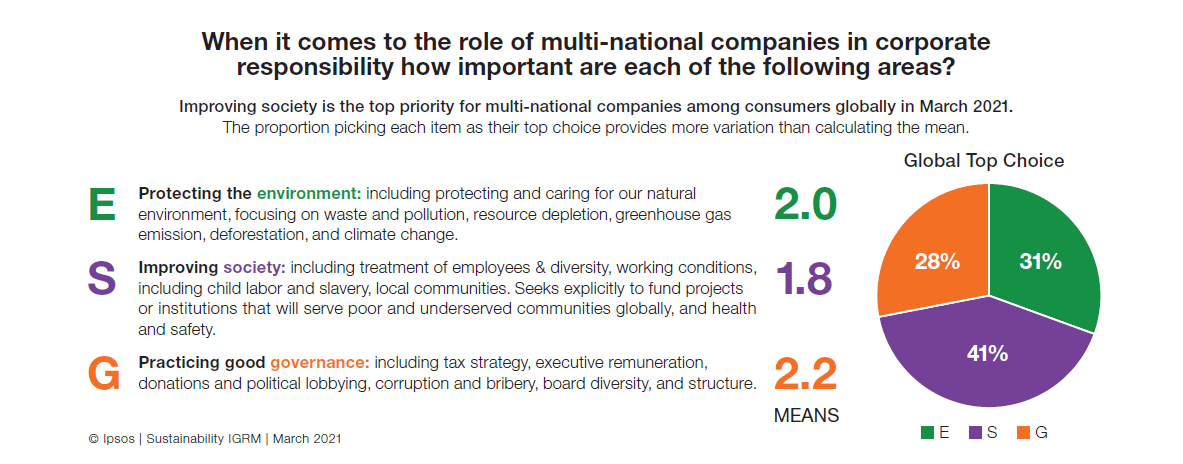
Improving society emerged as the top global priority, with (41%) of people stating it should be the main focus for multinationals, followed by protecting the environment (31%) and then, close behind, by practicing good governance (28%). Society was chosen as the top priority in all but four markets, with Germany and China prioritising environmental concerns instead and Malaysia and South Africa prioritising governance.
However, it is important for companies to challenge the idea that the three ESG areas of sustainability can be treated in silos as we increasingly see the lines between Environment, Society and Governance blurring. For example, even though climate change is itself an environmental issue, it disproportionately affects people of colour, women, people in developing countries, people with disabilities and the poor and vulnerable. In this way, it is increasingly also becoming a social issue.
Businesses that fail to recognise these issues are interconnected and continue to treat sustainability as three separate areas will suffer knocks to their credibility if other pillars are not performing to the same standard.
Citizen-consumers say that there is particularly too little regulation of how companies treat the environment.
Within the tech industry, tech giants are leading the way on CSR. In 2021, HP updated its Human Rights Policy to provide a greater focus on protecting workers throughout its supply chain from discrimination, modern slavery and unfavourable working conditions and committed to reach 75% circularity and maintain zero deforestation for products and packaging by 2030. As a result, HP was named one of the world’s most ethical companies in 2021.
While citizen-consumers’ top priority is for corporations to take action to improve society, another factor that must be considered is the threat of undesirable regulation. More than any other area, citizen-consumers say that there is particularly too little regulation of how companies treat the environment. Our Global Trends survey reinforces this sentiment. Taking authentic action to protect the environment can not only generate reputation and goodwill, but can also protect industry from unwanted regulation.
While the values and concerns of a company’s own stakeholders should be taken into consideration, our research provides an initial starting point and direction for companies to align their CSR engagements with the ESG values of citizen-consumers.
Read How Multinational Corporations Can Lead The Way On Sustainability for a more comprehensive breakdown of the top citizen-consumer priorities with the three ESG areas of sustainability.
Read more in the Sustainability Imperative.
Next article: The Say-Do Gap