Flash Eurobarometer: Women in times of COVID-19

Marking International Women’s Day 2022 on 8 March, the European Parliament, Directorate General for Communication, commissioned Ipsos European Public Affairs to conduct a new Flash Eurobarometer survey to gather women's opinions on the impact of the COVID-19 pandemic.

Key topics covered include: 

  • European Parliament priorities for gender-related issues 

  • Violence against women during the pandemic 

  • The impact of the pandemic on women’s working life and financial independence 

  • The impact of the pandemic on mental health 

Ipsos European Public Affairs interviewed a representative sample of women of 15 years and over in each of the 27 Member States of the European Union: between 25th January and 3rd February 2022, 26 741 women were surveyed via computer-assisted web interviewing (CAWI), using Ipsos online panels and their partner network. 

Key survey findings are: 

  • When asked which gender-related issues they would like to see tackled as a priority by the European Parliament, women are most likely to mention ‘trafficking and sexual exploitation of women and children’ , ‘mental and physical violence against women’ (both 47%), and the pay gap between women and men (41%) 

  • About three-quarters (77%) of women across the EU think that the COVID-19 pandemic has led to an increase in physical and emotional violence against women in their country. 

  • Women’s mental health has been significantly affected by pandemic restrictions, such as lockdowns and curfew measures (41% find this had a major negative impact on their mental health) and limitations on the number of people they could meet (38%).

  • Since the start of the pandemic, women have been most likely to feel worried about missing friends and family (44%), anxious and stressed (37%) and generally concerned about their future (33%).

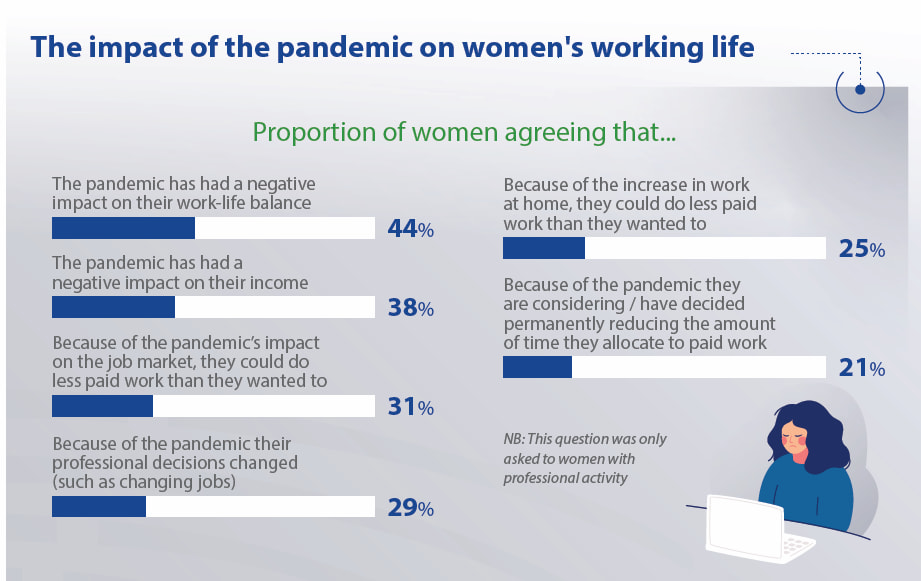
  • About four in ten women (38%) agree that the pandemic has had a negative impact on their income. This can be explained by women doing less work for a salary or wage than they wanted to, either because of the pandemic’s impact on the job market (31% agree this applies to them) or because of the increase in work at home (25% agree).
    Eurobarometer-women-covid-key findings

Full results

Related news

  • Konsument:innenstimmung Wirtschaftslage vor Sommerbeginn 2026
    Wirtschaft Pressemitteilung

    Konsument:innenstimmung vor Sommerbeginn: Österreichs Haushalte zunehmend unter Druck

    Die zaghafte Erholung ist vorbei: Nach dem Ausbruch des Irankriegs im März 2026 hat sich die Stimmung unter Österreichs Verbraucher:innen dramatisch verschlechtert. Das aktuelle Stimmungsbarometer von Ipsos im Auftrag der EU-Kommission offenbart alarmierende Zahlen: Jeder fünfte Österreicher befürchtet stärkere Teuerungswellen, mehr als ein Drittel der Haushalte kämpft mit einer verschlechterten Finanzlage. Die Sparfähigkeit sinkt, die Kaufzurückhaltung wächst – eine nachhaltige Erholung der Konsumlaune ist nicht in Sicht.
  • Know the New America & Beyond: Mai 2026
    Politik Nachrichten

    Know the New America & Beyond: Mai 2026

    Ein monatlicher Überblick über die besten Erkenntnisse von Ipsos zu den USA, zugeschnitten auf die Bedürfnisse der Welt.
  • Worries the World November 2025 - Austria
    What Worries the World Pressemitteilung

    Trübe Aussichten: Drei Viertel sehen Österreich aktuell auf dem falschen Weg. Sorge um Korruption und Kriege präsent wie nie.

    Trübe Aussichten für Österreich: Die aktuelle „What Worries the World"-Umfrage zeigt, dass drei Viertel der Bevölkerung das Land auf dem falschen Weg sehen. Einwanderung (36%) führt erneut die Sorgenliste an, gefolgt von Inflation (33%) und dem Gesundheitswesen (30%). Auffällig: Die Sorge um Korruption und militärische Konflikte ist so präsent wie nie – beide Themen legten um jeweils 5 Prozentpunkte zu. 85% bewerten die wirtschaftliche Lage als schlecht.