Global public ranks ending hunger and poverty and ensuring healthy lives as top priorities among U.N. SDGs
Washington, DC, May 27, 2021 — A new Ipsos survey conducted in partnership with the World Economic Forum about the United Nations’ Sustainable Development Goals finds “zero hunger”, “no poverty” and “good health and well-being” ranking as the global public’s top priorities.
In 2015, world leaders agreed to 17 goals (also referred to as “SDGs”) for a better world by 2030. They engage governments, the private sector, civil society and citizens to achieve a better and more sustainable future for all. Ipsos asked 20,000 adults from 28 countries to rank 8 randomly selected SDGs among 16 of them, in order of priority to address today. Each of the 16 goals was evaluated by close to 10,000 respondents.
The survey finds a remarkable consensus among citizens from all regions of the world when it comes to top priorities.
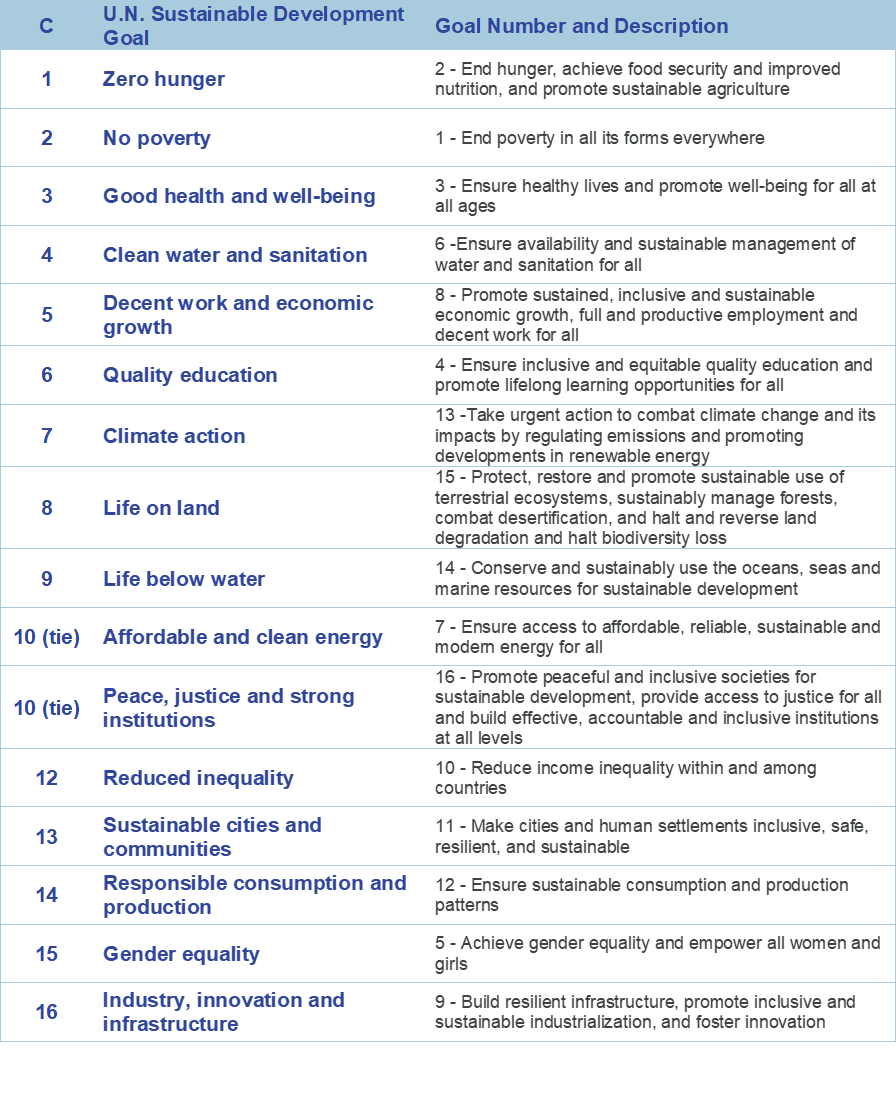
- “Zero hunger”, the SDG most viewed as a priority globally, ranks #1 in 20 of 28 countries and is in the top 3 of 6 other countries
- “No poverty”, the #2 priority globally, ranks #1 in 4 countries and is in the top 3 of 20 other countries
- “Good health and well-being”, the #3 priority globally, ranks #1 in 4 countries and is in the top 3 of 13 other countries
Furthermore, all three of the next priority goals based on the global ranking show in the top 3 of 9 countries:
- “Clean water and sanitation”,
- “Decent work and economic growth”, and
- “Quality education”
All top 3 goals of most countries count among the global top 6. Only 5 other SDGs show in the top 3 of any country: “climate action” at #3 in Great Britain, “life below water” at #3 in Germany; “peace, justice and strong institutions” at #3 in South Korea; “reduce inequality” at #3 in Belgium; and “gender equality” at #3 in India.
The global priority ranking based on the average ranking of all 16 goals in the 28 countries surveyed is as follows:
GRAPH
On average across all the countries surveyed, half of those asked say their government is taking less than their share of responsibility for achieving these goals (53%) while about four in ten say so of businesses in their country (42%) and of “most people” in their country (40%). However, for each of their country’s government, businesses and people, an average of 22% say they are taking more than their share of responsibility.
- A majority think their government is skirting its responsibility in 20 countries—most so in Hungary, (71%), Colombia (69%), South Africa (69%), and Brazil (67%).
- A majority think businesses are not doing enough in Chile (56%) Canada (55%), Turkey (55%), Great Britain (54%), Italy (52%) Hungary (52%), and Colombia (51%)
- A majority are critical of “most people” in their country not doing enough in Turkey (60%), Hungary (56%) Italy (53%), and Canada (52%).
Read the World Economic Forum article.
About the Study
These are the results of a 28-market survey conducted by Ipsos on its Global Advisor online platform. Ipsos interviewed a total of 19,585 adults aged 18-74 in the United States, Canada, Malaysia, South Africa, and Turkey, and people 16-74 in 24 other markets between April 23 and May 7, 2021.
The sample consists of approximately 1,000 individuals in each of Australia, Belgium, Brazil, Canada, China (mainland), France, Germany, Great Britain, Italy, Japan, Spain, and the U.S., and 500 individuals in each of Argentina, Chile, Colombia, Hungary, India, Malaysia, Mexico, the Netherlands, Peru, Poland, Russia, Saudi Arabia, South Africa, South Korea, Sweden, and Turkey.
The samples in Argentina, Australia, Belgium, Canada, France, Germany, Great Britain, Hungary, Italy, Japan, the Netherlands, Poland, South Korea, Spain, Sweden, and the U.S. can be taken as representative of these countries’ general adult population under the age of 75.
The samples in Brazil, Chile, China (mainland), Colombia, India, Malaysia, Mexico, Peru, Russia, Saudi Arabia, South Africa and Turkey are more urban, more educated, and/or more affluent than the general population. The survey results for these countries should be viewed as reflecting the views of the more “connected” segment of their population.
The data is weighted so that each market’s sample composition best reflects the demographic profile of the adult population according to the most recent census data.
Where results do not sum to 100 or the ‘difference’ appears to be +/-1 more/less than the actual, this may be due to rounding, multiple responses or the exclusion of don't knows or not stated responses.
The precision of Ipsos online polls are calculated using a credibility interval with a poll of 1,000 accurate to +/- 3.5 percentage points and of 500 accurate to +/- 4.8 percentage points. For more information on the Ipsos use of credibility intervals, please visit the Ipsos website.
The publication of these findings abides by local rules and regulations.