LGBT+ Pride 2021 Global Survey points to a generation gap around gender identity and sexual attraction
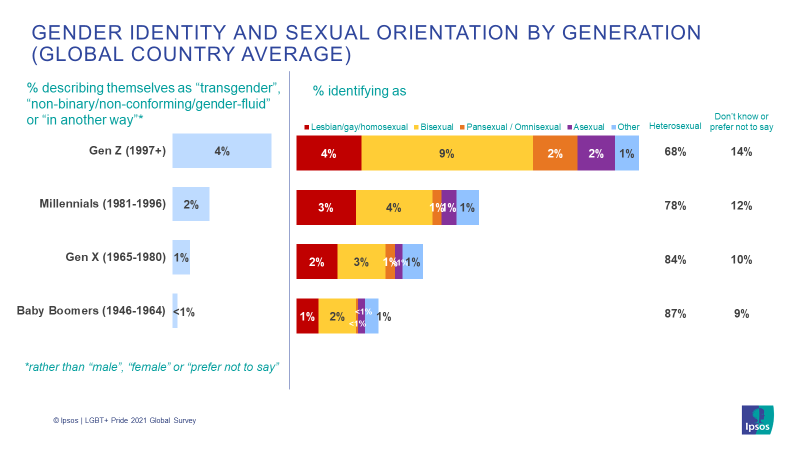
New York, NY, June 9, 2021 — Ipsos’s LGBT+ Pride 2021 Global Survey points to a wide generation gap around gender identity and sexual attraction. On average, across the 27 countries surveyed, those who identify as transgender, non-binary, non-conforming, gender-fluid, or other than male or female make up 4% of Gen Z (born since 1997) compared to 1% among all adults. Younger adults are also significantly more likely to identify differently from heterosexual and to say they are equally attracted to both sexes.
The survey, which was conducted on Ipsos’s Global Advisor online platform among more than 19,000 individuals aged 16 (or 18, depending on the country) to 74 between April 23 and May 7, 2021, shows how much exposure to LGBT+ people and engagement with the LGBT+ community varies across the world. For example, 66% in Brazil report having a gay or lesbian relative, friend or colleague vs. 7% in Japan and South Korea.
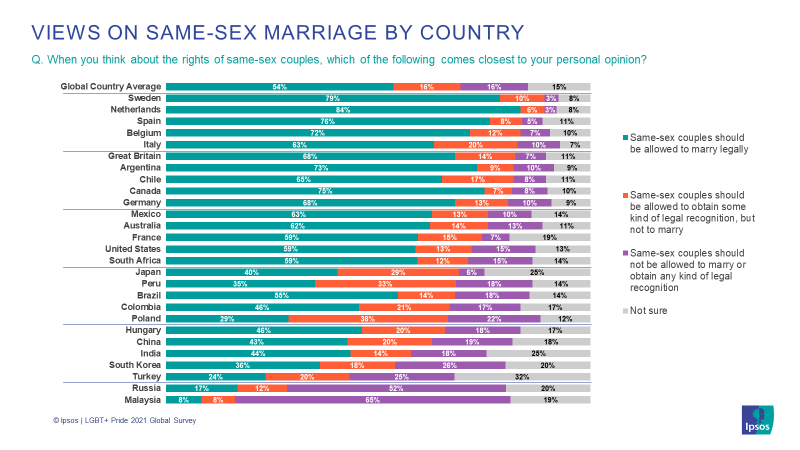
Similarly, anti-discrimination laws and equal marriage and adoption rights for LGBT people are supported by majorities in most of the 27 countries, but are fiercely opposed in several countries.
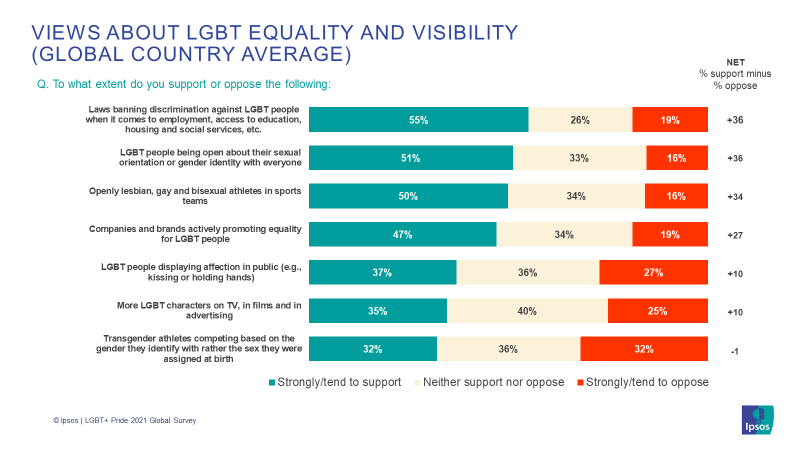
The survey also finds a lot more support than opposition toward corporate activism promoting equality.
Majorities in most (but not all) countries support LGBT people being open about their sexual orientation or gender identity with everyone. And there is generally more support than opposition toward LGBT people displaying affection in public and more LGBT characters on TV, in films and in advertising.
There is a great deal of support in most countries for lesbian, gay and bisexual athletes in sports teams being open about their orientation. On the other hand, when it comes to allowing transgender athletes to perform according to the gender they identify with, public opinion is divided and varies widely across countries.
About the Study
These are the results of a 27-market survey conducted by Ipsos on its Global Advisor online platform. Ipsos interviewed a total of 19,069 adults aged 18-74 in United States, Canada, Malaysia, South Africa, and Turkey, and 16-74 in 23 other markets between April 23 and May 7, 2021.
The sample consists of approximately 1,000 individuals in each of Australia, Belgium, Brazil, Canada, China (mainland), France, Germany, Great Britain, Italy, Japan, Spain, and the U.S., and 500 individuals in each of Argentina, Chile, Colombia, Hungary, India, Malaysia, Mexico, the Netherlands, Peru, Poland, Russia, South Africa, South Korea, Sweden, and Turkey.
The samples in Argentina, Australia, Belgium, Canada, France, Germany, Great Britain, Hungary, Italy, Japan, the Netherlands, Poland, South Korea, Spain, Sweden, and the U.S. can be taken as representative of these countries’ general adult population under the age of 75.
The samples in Brazil, Chile, China (mainland), Colombia, India, Malaysia, Mexico, Peru, Russia, South Africa and Turkey are more urban, more educated, and/or more affluent than the general population. The survey results for these countries should be viewed as reflecting the views of the more “connected” segment of their population.
The data is weighted so that each country’s sample composition best reflects the demographic profile of the adult population according to the most recent census data.
Where results do not sum to 100 or the ‘difference’ appears to be +/-1 more/less than the actual, this may be due to rounding, multiple responses or the exclusion of don't know or not stated responses.
The precision of Ipsos online polls is calculated using a credibility interval with a poll of 1,000 accurate to +/- 3.5 percentage points and of 500 accurate to +/- 4.8 percentage points. For more information on the Ipsos use of credibility intervals, please visit the Ipsos website.
The publication of these findings abides by local rules and regulations.