
Old age begins at 66, but six in ten say they are not looking forward to it
In countries across the world, populations are getting older. The UN predicts that by 2030, one in six people will be aged 60 or over. But are cultural attitudes adapting to this change?
In this 32-country study, we examine people’s attitudes towards ageing, picking out how these have changed – or not changed – since 2018.
Key findings include:
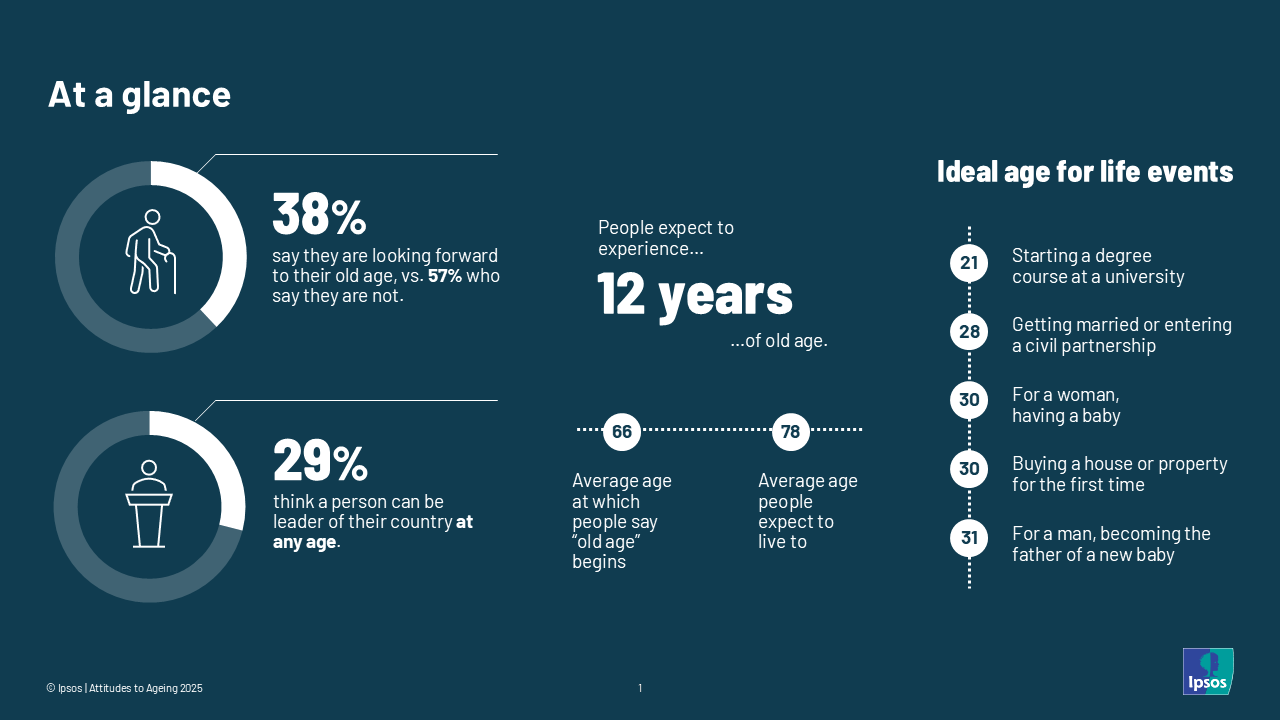
- The world may be ageing – but when you’re considered old hasn’t changed. On average across 32 countries, people say that “old age” begins at 66. But perceptions of ageing have hardly shifted since 2018 – and have reversed in Latin America.
- Most countries vastly overestimate the size of the ageing population. Mexicans think three in 10 people (30%) in their country are over 65, more than three times the actual figure of 8%. Japan – now defined as a superaged society – is the country that most underestimates the size of its over 65s.
- Most people are not looking forward to their old age. Across 32 countries, 57% say they are not looking forward to their old age (vs. 38% who say they are). Enthusiasm rises with income, education level, and youth.
- People expect to enjoy 12 years of “old age”. On average, people across 32 countries expect to live to 78 years old, leaving them 12 years of “old age”. This rises to 17 years of old age among Filipinos and Indonesians. Meanwhile in Hungary, old age begins at 65 – yet people only expect to live until 64.
- The Prime of Life? 28-35 are seen as milestone years. For a majority of countries, the ideal moment to reach key milestones like getting married, buying a first house, and having a baby are between 28 and 35 years old.
- Three in 10 think a person can be leader of their country at any age. For those who are willing to set an age limit, 61 is seen as the age when a person becomes too old. In 16 countries, the current leader is now older than its citizens’ upper age limit.
- Find out more about to tap into the potential of older adults in the Ipsos Generations Report 2025 or watch the webinar replay of KEYS: Rethinking Generations.
About this study
These are the results of a 32-country survey conducted by Ipsos on its Global Advisor online platform and, in India, on its IndiaBus platform, between Friday, January 24, and Friday, February 7, 2025. For this survey, Ipsos interviewed a total of 23,745 adults aged 18 years and older in India, 18-74 in Canada, Republic of Ireland, Malaysia, South Africa, Türkiye, and the United States, 20-74 in Thailand, 21-74 in Indonesia and Singapore, and 16-74 in all other countries. “The Global Country Average” reflects the average result for all the countries and markets in which the survey was conducted. It has not been adjusted to the population size of each country or market and is not intended to suggest a total result.

