World Mental Health Day 2022: Three in four globally say mental and physical health are equally important
The annual Ipsos World Mental Health Day survey is designed to examine the public’s perceptions and experiences around mental health. Topics covered include how it relates to physical wellbeing, how we talk about mental health issues, and how healthcare services treat it. We ran the survey in 34 countries between 22nd July and 5th August 2022 on Ipsos’ Global Advisor online platform.
Key findings
- For the first time, mental health (mentioned by a global country average of 36%) is ranked higher than cancer (34%) when people are asked to think about top health concerns.
- Over half (58%) surveyed say they “often” think about their own mental wellbeing.
- 76% on average say that mental health and physical health are equally important. But only 33% say the health services in their country treat them equally
- Just over two-fifths (41%) say physical health is given more priority than mental health by health services, more than 3 times the proportion (12%) who say mental health receives more attention.
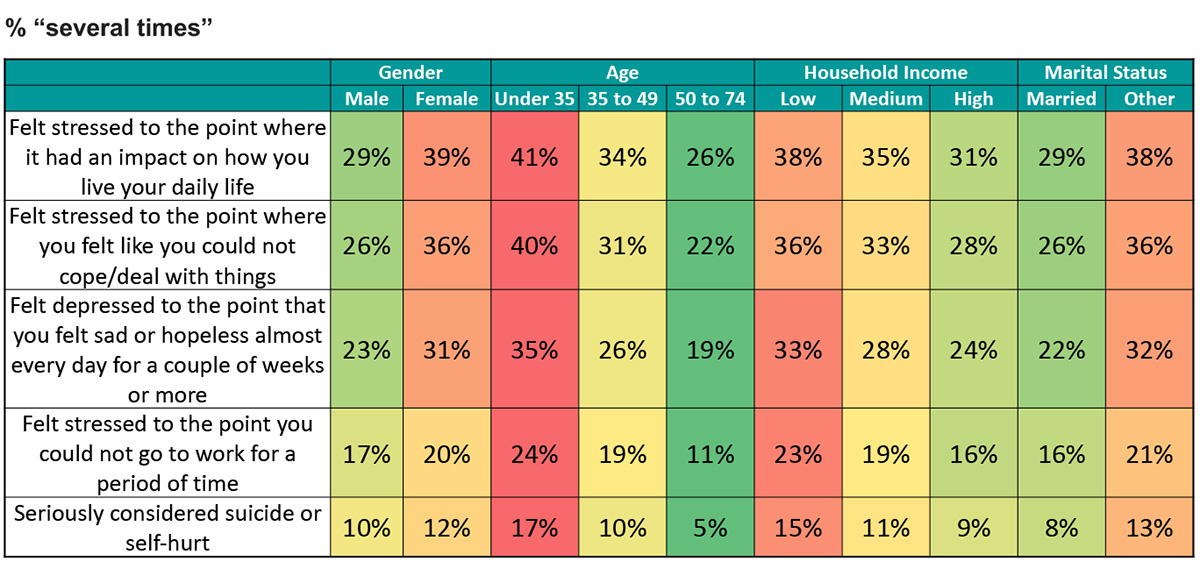
- Generally speaking, mental health issues are felt more strongly by people under 35, women, and low-income households.
Thinking About Our Mental & Physical Wellbeing
On a global country average, 58% of those surveyed think about their mental wellbeing either very or fairly often, this is five percentage points higher compared to 2021. Physical wellbeing on the other hand is 12 points higher on average at 70%.
The proportion thinking about their mental wellbeing “often” show some differences by country, with Portugal (82%) ranking the top, followed by Brazil (76%) and South Africa (75%), down to 33% in China.
Demographic analysis shows that the people most likely to think about their mental health ‘very often’ are the under 35s (31% versus 16% of over 50s) and women (27% versus 21% of men). This pattern is also seen with physical health.
Mental vs Physical Health – Which Takes Priority?
The perceived importance of mental and physical wellbeing seems to cross borders, with nearly 8 in 10 on a global country average ranking them both equal (76%). Out of the 34 countries surveyed, 30 have over 7 in 10 saying mental and physical wellbeing are equally important. There are only four countries that are exceptions, two of which still have it at over half: Thailand (66%), Saudi Arabia (54%), India (49%), and the UAE (48%). However, Saudi Arabia, India, and the UAE have the highest proportion of people saying mental health is more important than physical health.
Health Services Perceived vs Experienced
So, the public believe that mental and physical wellbeing are equally as important. But do people’s healthcare systems reflect this view and provide equal treatment? On a global country average, a third (33%) believe that both are treated equally. Only 12% on average think mental health is given more priority; this contrasts with 41% saying their healthcare system focuses more on physical health.
MAPThe country with the biggest perceived imbalance by a significant amount is Portugal (73% saying physical is given more importance than mental health), with Sweden next at nearly three-fifths (58%). The countries with the highest perception of mental health being treated with more importance than physical health are also the same countries that have highest proportion saying mental health should have more priority than physical health: India (27%), Saudi Arabia (25%), and the UAE (24%).
The country with the biggest perceived imbalance by a significant amount is Portugal (73% saying physical is given more importance than mental health), with Sweden next at nearly three-fifths (58%). The countries with the highest perception of mental health being treated with more importance than physical health are also the same countries that have highest proportion saying mental health should have more priority than physical health: India (27%), Saudi Arabia (25%), and the UAE (24%).
Experiences Over the Last Year
The effects of stress on daily life are the most frequently reported mental health issues globally, with 63% saying they have felt (at least once) stressed to the point where it had an impact on how they live their daily lives over the last year. Stress has also made three-fifths (59%) feel like they can’t cope with things and two-fifths (39%) feel they can’t go to work at least once. A quarter say they considered suicide or self-harm once in the last year.
These issues are most pertinent among people under 35, women, unmarried people, and low-income households.
For further demographic and country insights, download the report here.
About this study
These are the results of a 34-market survey conducted by Ipsos on its Global Advisor online platform. Ipsos interviewed a total of 23,507 adults aged 18-74 in the United States, Canada, Malaysia, South Africa, and Turkey, 20-74 in Thailand, 21-74 in Indonesia, and 16-74 in 27 other markets between Friday, July 22 and Friday, August 5, 2022.