Innovation that speaks for itself
If you take pop-culture representations at face-value, or speak with seasoned pharma industry communications professionals, you might get the feeling that people don’t much like pharma companies. However, in our latest Ipsos Global Trustworthiness Monitor, pharma is the most trusted sector of those we measure. Those pharma veterans may well have cause to be sceptical, given the brickbats they’ve had thrown their way over the years. So, why is pharma doing so well and why does this seemingly contradict those long-held beliefs about the sector’s reputation?
In our latest data, pharma has replaced the tech sector at the top of the table as the most trusted sector. This follows a long-term trend of continual reputation gains year on year. Back in 2019, one in four (25%) citizens regarded the sector as trustworthy. Now, over one in three (34%) feel this way. That said, a significant minority don’t share this view. Currently over one in four (27%) regard the sector as untrustworthy. But, this proportion has dropped by seven points since 2019, when over one in three (35%) didn’t trust the sector – the balance of opinion is positive and has remained so in recent years.
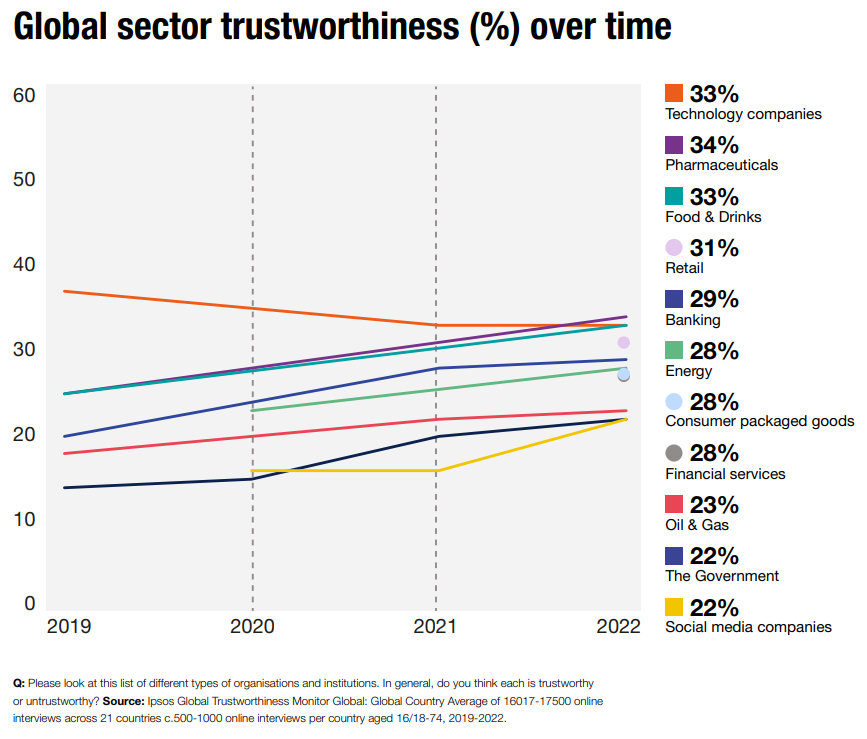
We know from our work with industry bodies such as the ABPI and IFPMA that public perceptions of the sector’s response to the pandemic plays a significant role about how they feel about it overall. As citizens endured lockdowns and the economic and societal shocks delivered by the pandemic, the news that pharma companies were researching, developing medicines and vaccines to tackle COVID-19 provided hope. We saw in our research for specific pharma companies and industry bodies that citizens, policymakers and health professionals alike found great reassurance in the fact that sector boffins and their academic and health-sector collaborators were on the hunt for solutions. When medicines and vaccines received approval for use, this provided a light at the end of the tunnel for many weary citizens.
COVID-19 hasn’t gone away, but thanks to the innovations of pharma companies, the pandemic is moving further away from us in the rear-view mirror. It certainly doesn’t get anywhere near as much coverage in the media as it did back in 2020-21. With that in mind, it would be reasonable to think that perhaps pharma’s reputation might recede back to pre-pandemic levels. Instead, it has continually improved. The powerful demonstration of medical innovation has seemingly awakened people to the vast potential of medical science to save and improve lives. In our 2022 survey of Business Journalists, the pandemic response was still top-of-mind. In the words of one journalist;
Pharma was a bit of an unloved sector before COVID. But, everyone has woken up to the brilliance of pharmaceutical companies.
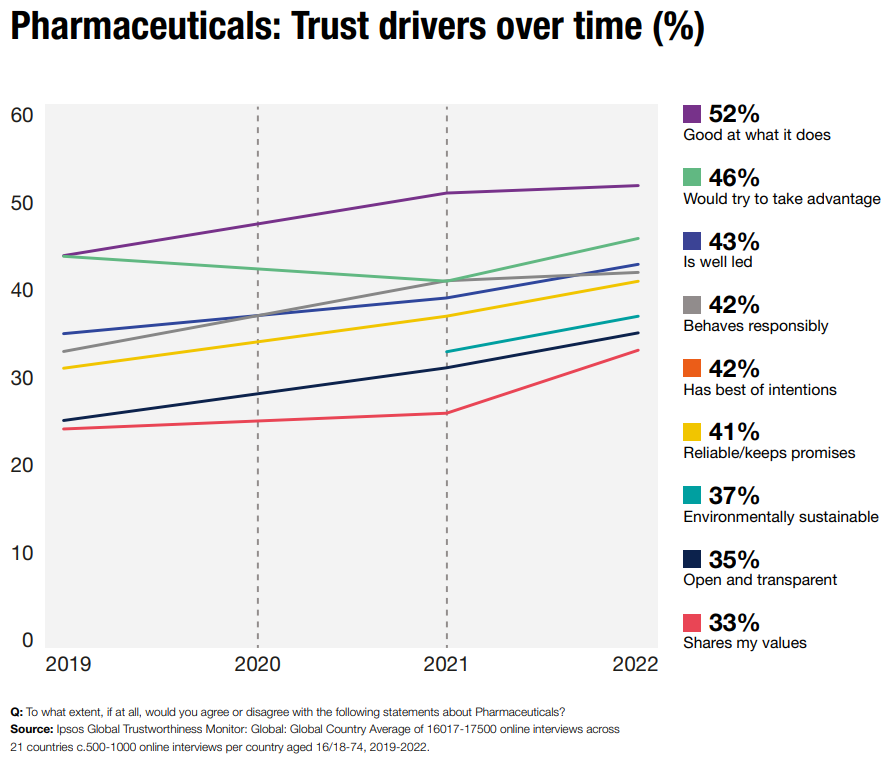
Taking a deeper dive into what drives trust in pharma, on the face of it we can see some obvious strengths. Over half feel pharma companies are good at what they do. Most drivers of trust have also seen sustained improvements over time. Digging a little deeper, public trust in the sector is influenced by other factors – trust in pharma is as complex as any other sector.
Ipsos Bayes Nets (IBN) analysis allows us to explore how perceptions of pharma stack up against the factors the public regard as important drivers of trust generally, versus the drivers that have the most influence over trustworthiness in pharma specifically. IBN is a statistical model which, in this case, analyses how different aspects of trust interact in the minds of the participants in our study. It helps us identify the key growth drivers of a given component of trust, as well as how each component relates to others. As shown on the following chart, we’ve mapped performance ratings for pharma across each trust driver against the derived importance of these drivers.

The sector performs well on two of the three most important drivers of trust; behaving responsibly and being reliable. The demonstration of its capabilities during the height of the pandemic will almost certainly be behind some of this. It also performs very well in other areas, though often in those that have less of an impact on overall perceptions of trustworthiness; being good at what it does, being well led and having good intentions.
However, there are signs of potential weakness that could threaten overall levels of future public trust in the sector. It attracts relatively weak scores for being open and transparent – one of the top three drivers of trust in our IBN model. We know from our work investigating public opinion in the UK with the ABPI, that despite the increased visibility of the sector during the pandemic, familiarity with it rarely deviates from the average of around one in six (16% knowing at least a fair amount about the UK sector). People rarely have cause to come into contact with, or really think about pharma companies in the UK’s healthcare system. In this context, misconceptions about what the sector gets up to stubbornly persist, despite recent high-profile successes. We see similar trends in our work in other geographies.
A young participant in one of our focus groups for the ABPI memorably described the sector as being akin to ‘Batman’. Wealthy, well-intentioned, saves lives, but shadowy and opaque. The pandemic is now rarely front-page news. That unique opportunity to improve public understanding of its work has passed. This is important. In the absence of knowledge, or indeed a genuine day-to-day interest in finding out about the sector, public opinion may revert to age-old tropes that have long dogged pharma companies. This includes a sense of opacity, as well as discomfort about profits – an issue not helped by slightly dated, but high-profile examples of poor corporate behaviour from some pharma companies in the US, for example (the works of Martin Shkreli when at the Helm of Turing Pharmaceuticals being a notable example).
Our veracity index illustrates this point well; citizens have a high degree of trust in professionals associated with the sector; scientists and medics. They don’t feel the same way about business leaders.
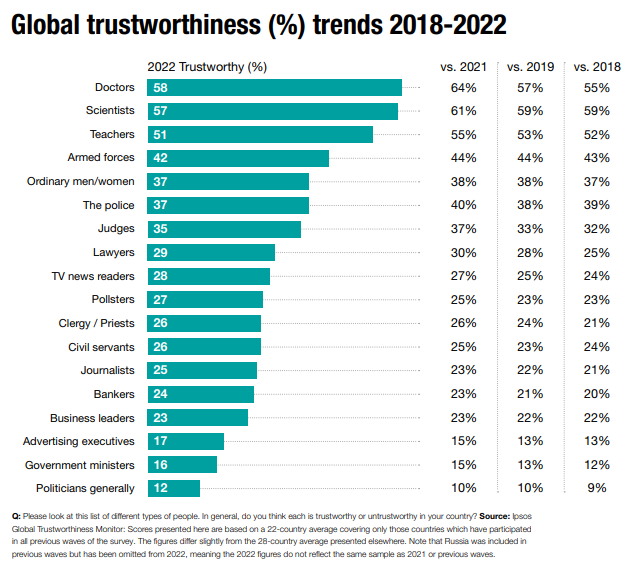
We see similar sentiment in our polling of journalists or politicians; pricing and transparency are reputational issues that are rarely far from the surface. Despite its current level of overall trust and the improving, positive perceptions that underpin this, a high proportion nonetheless believe the sector may take advantage of them given the opportunity. The level of trust the sector enjoys today is fragile.
Those long-held assumptions among some industry insiders that the sector has a poor reputation could be proven right. This comes at a time when there are significant complex debates that touch on those thorny issues of pricing, access to medicines and vaccines and its ability to rely on intellectual property rights. Macro-forces impacting pharma businesses – aging populations, an increased focus on health and wellbeing, accelerated (and expectations of) drug discovery and development, the need to prove value with real-world evidence – mean that it is as important as ever that pharma companies and the bodies that represent them educate and inform citizens about their work.
But, for now, pharma is riding on a trust high. The sector and individual companies within it have an opportunity to harness current goodwill to communicate their values, their purpose, their intentions and their contributions to society and the global economy. This will be vital if it is to continue to enjoy the levels of trust it attracts today – and if those pessimistic industry executives are to be proven wrong about pharma reputation.