Trust in Tech: A tale of the West and the Rest
In 2019, when Ipsos first started its Trustworthiness Monitor, the tech sector was seen by the global public as the most trustworthy of all the sectors we measured and was highly rated (with scores that other sectors would envy) across all the key drivers of trustworthiness that we measure.
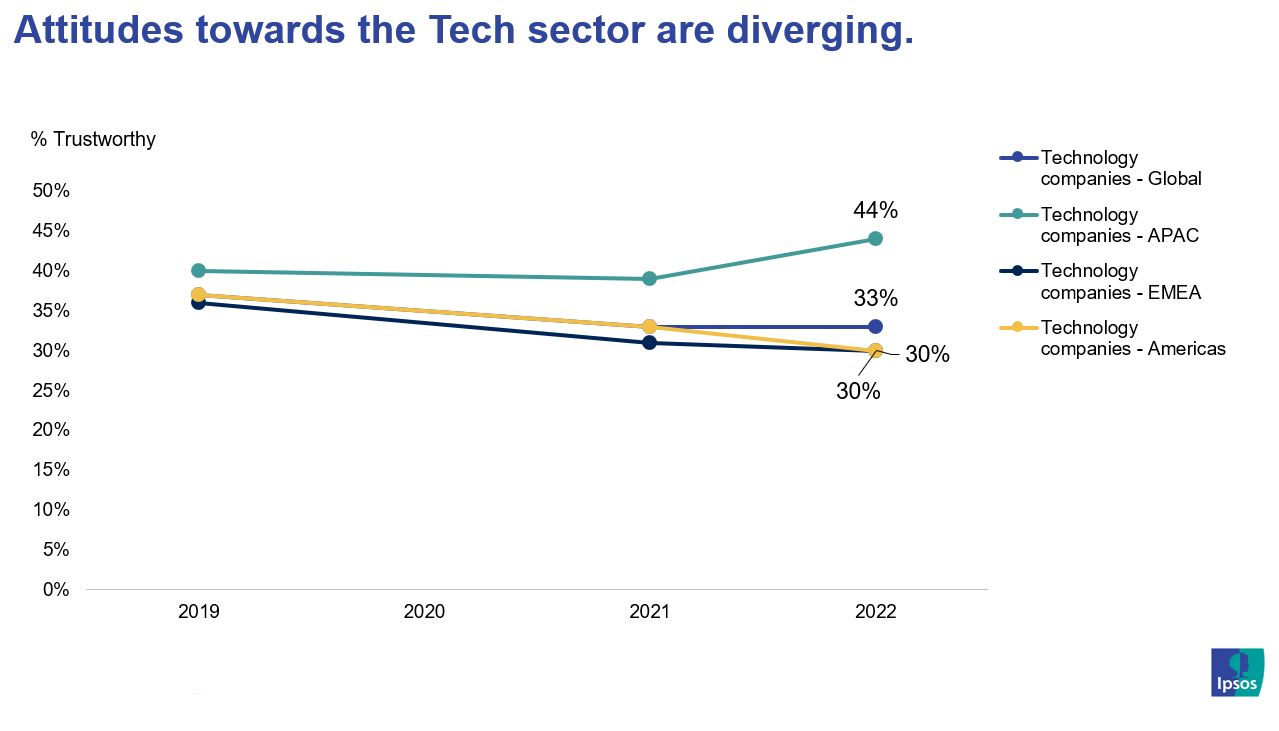
Between 2019 and 2021 however, problems started to appear. These were not dramatic problems; the sector faced no existential crisis or event. Instead, these problems were somewhat more insidious and, consequentially, harder to deal with. So, what happened? Overall trustworthiness, on a global level, fell significantly from 37% to 33%, largely driven by Western markets in EMEA (notably UK and France) and the Americas (such as the US and Canada). APAC scores were stable, while some even improved. Similarly, untrustworthiness increased, globally from 17% to 19%, but this time in all regions and in most countries.

Looking across the trustworthiness drivers between 2019 and 2021 shows an interesting story. While some scores fell, again mostly in EMEA and the Americas, the majority were stable (or even improved). The key change for the sector is the increase in the number of people disagreeing that the sector is reliable and responsible. So, what we saw between 2019 and 2021 is the beginning of increased polarisation – more people adopting actively negative opinions about the tech sector while at the same time the sectors’ fan base was weakening.
The latest data, from fieldwork in early Q4 of 2022, is even more interesting for the tech sector. The decline in overall trustworthiness globally has halted, although the regions appear to be going in different directions; EMEA is stable, Americas is down, and APAC is up. But again, the real changes are across the drivers of trustworthiness, as almost every single driver of trust has improved over the last 12 months in nearly all markets. So why has the sector not seen a more universal improvement across overall trustworthiness? After all, the percentage of people (at global and regional level) disagreeing that the tech sector is performing well across the drivers has not increased, but neither has it decreased. You would think the sector’s performance over the last twelve months would have driven some positive change.
To understand why this has not happened we need to look below the global and regional story, as it is increasingly clear that these are aggregations that mask increasingly stark differences at a country level. As examples let’s look at France and Korea – two developed nations with very different outlooks on both technology and the role it plays within society. Furthermore, they are both representative of the two different groups of countries shaping the narrative – the West, and the rest.
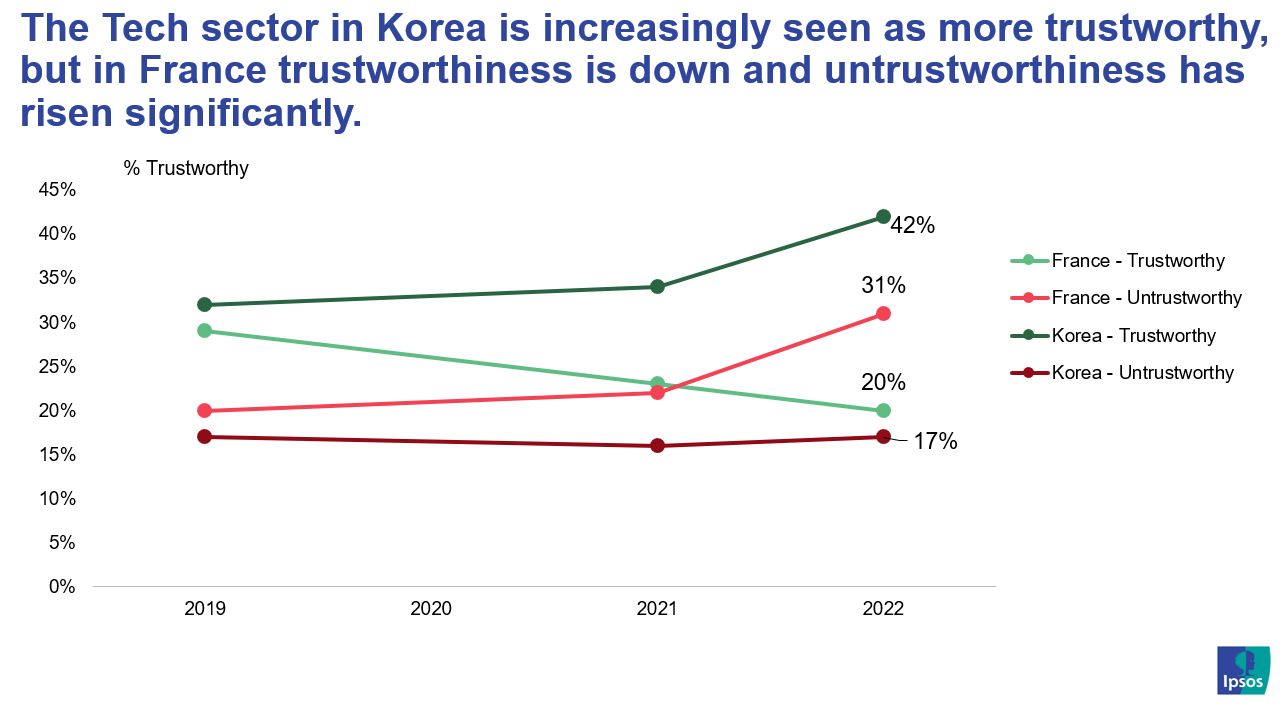
Looking at overall trustworthiness, it is clear these countries are headed in different directions when it comes to attitudes towards the tech sector. In Korea trustworthiness is one that rises year on year, with untrustworthy scores flat. In France it is the opposite – untrustworthy scores are on the rise and trustworthiness is flat. The key thing to notice in both is that it is the neutrals who are changing their minds and picking a side.
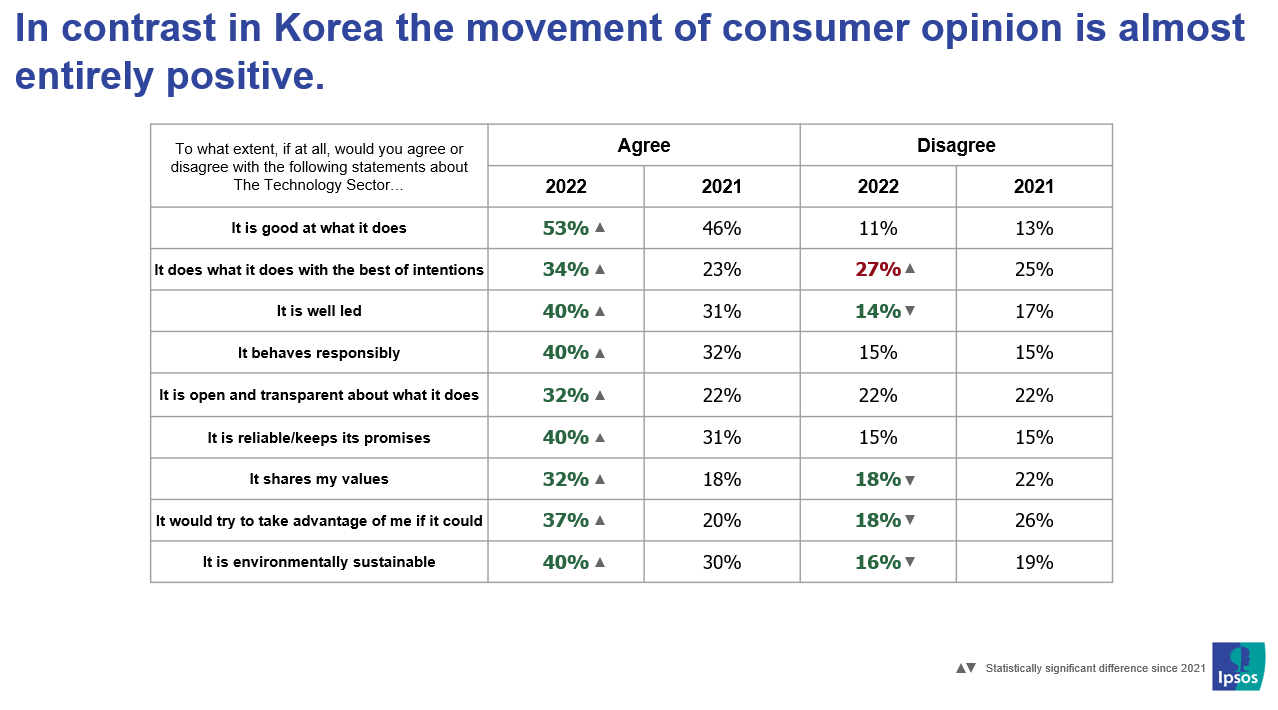
The trends in both countries across the drivers of trustworthiness are, again, perfect examples of how many countries are behaving. In Korea, the sector is performing more strongly this year than ever before, with the percentage of consumers saying the sector performs badly falling on four of the drivers. With the notable exception that the sector’s rating for “taking advantage of me” is also up, you would think this is a clear narrative of a sector going from strength to strength.
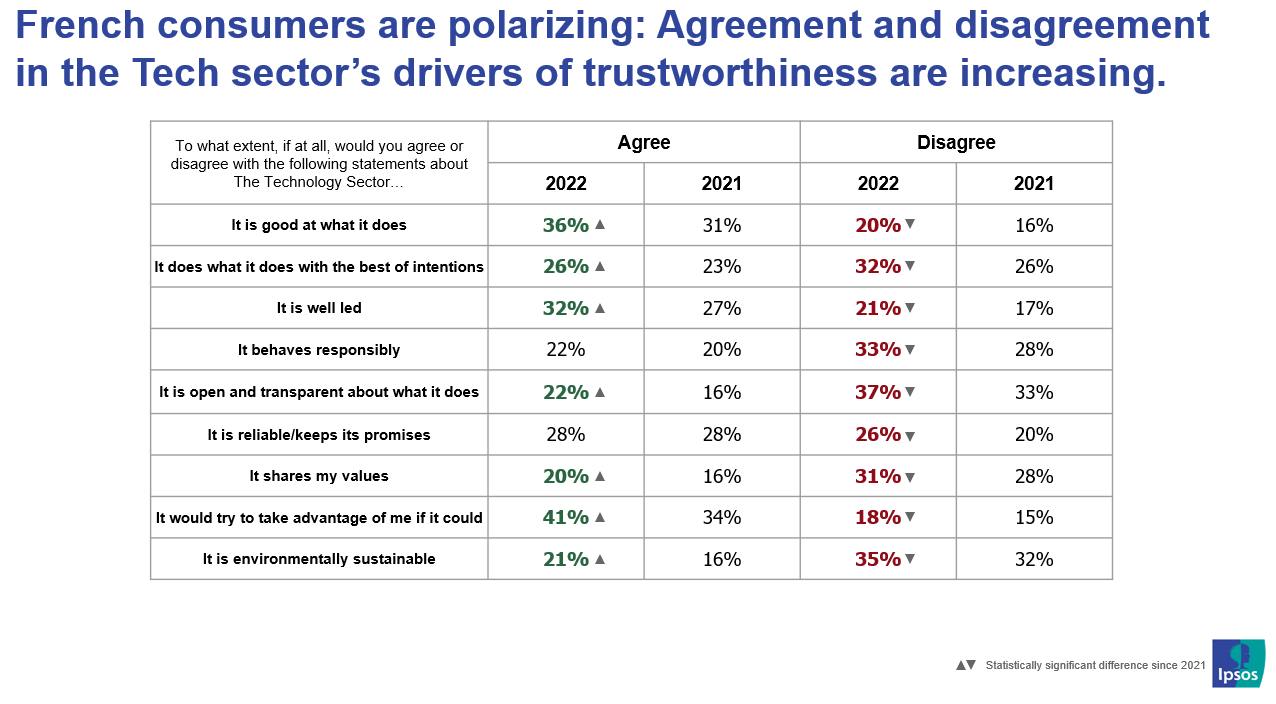
In France, the sector is performing more strongly this year than last on most of the drivers (although like Korea, up on “taking advantage of me”), but the notable difference is on every single driver the sector is also thought to be getting worse.
We see in both countries that the number of people who are neutral towards the sector is shrinking. The difference is that in many Western markets, as per the France example, consumers are polarising – with increasing numbers regarding the sector as trustworthy, and performing well across the drivers, and increasing number rating the sector as untrustworthy and performing badly on the drivers. In most of the markets we measure, especially those in APAC, the sector is only improving.
So, what we have is two flavours of polarization. The first is between the West and rest, the second is within western markets as consumers seem to be increasingly picking a pro or anti tech position. These are changes of opinion that are somewhat concealed by looking at the data at a global and regional level. For the sector it poses some serious questions. While the sector looks increasingly comfortable and popular in most countries of the world, especially in APAC, in the markets that generate the most revenue - and where the major brands within the sector likely feel most at home - there is a growing slice of the population that are increasingly regarding the sector with distrust. With the sector already facing regulation, media attention and falling ad revenue, a surge of public displeasure in core markets is the last thing the sector needs in the short to medium term.