Nearly half of South Africans feel politically homeless ahead of local elections
As South Africa gears up for local government elections (required by law to take place between 2 November 2026 and 31 January 2027), new Ipsos research reveals a nation grappling with political disconnection: nearly half (47%) of South Africans say no political party represents their views, this despite more than 500 parties being registered with the IEC. Yet democratic hope persists. Six in ten eligible voters (61%) say they are looking forward to voting, even as only 38% believe their local governments/municipalities are doing their jobs well.
"South Africans are caught between disillusionment and determination," says Mari Harris, Political Analyst at Ipsos in South Africa. "Nearly half feel no party represents them, yet the majority still want to exercise their democratic right. This tension will define the upcoming local government elections."
These are findings from the Ipsos Khayabus "Pulse of the People" study, conducted twice yearly through face-to-face in-home interviews with 3,600 randomly selected South Africans. Results are weighted and projected and are representative of the adult population (18+). Fieldwork was completed between December 2025 and January 2026.
Key findings include:
- Political alienation: 47% of South Africans say no political party represents their views
- Municipal dissatisfaction: Only 38% believe their local government is doing its job well
- Limited interest: 38% of eligible voters have no interest in politics and elections
- Youth trust deficit: 40% of 18-34-year-olds do not trust the IEC
- Desire to vote: 64% say they want to vote in the upcoming local elections
- Coalition appetite: 63% believe political parties should work together at local government level
Although the exact election date remains unknown, political campaigning is already in full swing. The IEC is planning special “registration weekends”, but potential voters should note they can register to vote at any time, either online or at their nearest IEC office, and this process is ongoing. Under the Electoral Act, the voters' roll closes as soon as an election date is announced.
The political mood in the country
Given the sheer number of choices available to voters, it may seem paradoxical that 47% of South Africans say no party represents their views.
"Too many parties with conflicting messages, focused at winning the support of voters, can create confusion rather than clarity," says Harris. "It's telling that almost half (47%) of South Africans agree that parties with less than 1% national support should be excluded from Parliament1. While that question referred to national politics, the same dynamic plays out at local government level, where small parties can become 'kingmakers' without necessarily contributing to stable governance in the municipality, with the result that service delivery invariably suffers."
Despite the upcoming elections, interest in politics remains notably subdued:
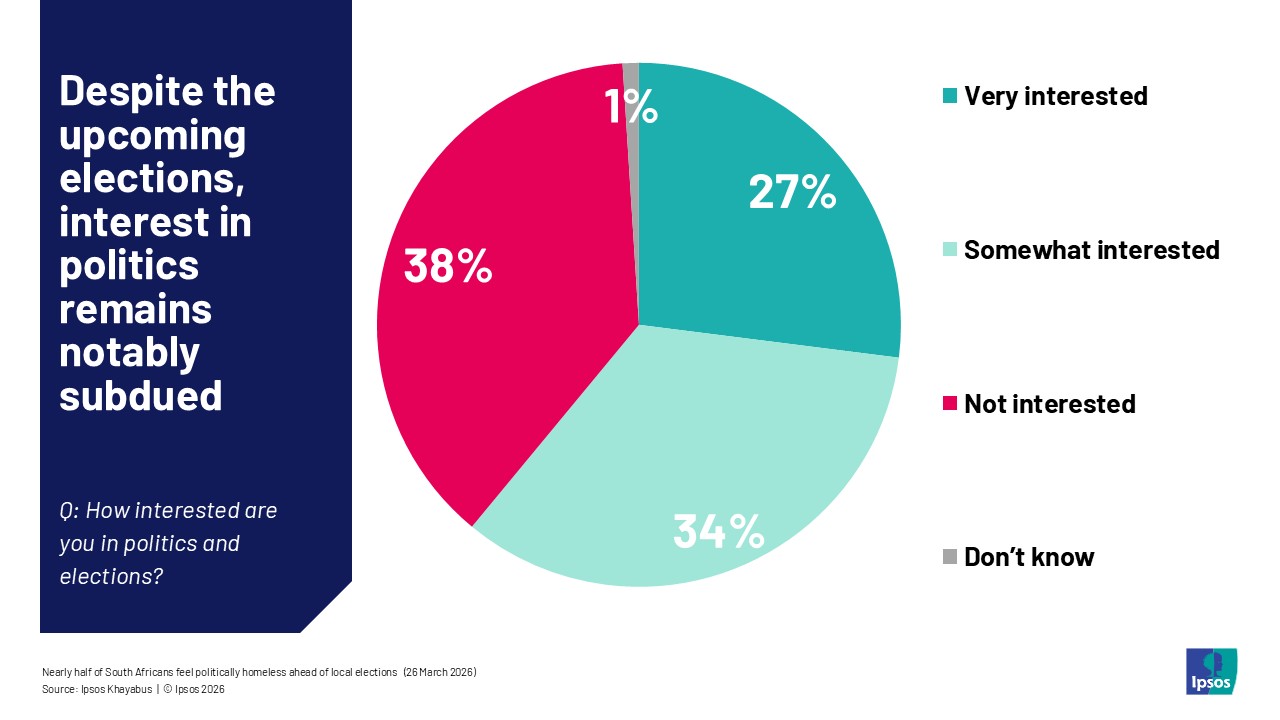
Only six in ten (61%) South Africans eligible to vote say that they have any interest in politics and elections, while 38% are not interested at all. Despite this, nearly three-quarters (73%) of eligible voters say they are registered to vote. However, registration does not guarantee turnout.
The trend of voter alienation and disengagement has grown stronger over recent election cycles, a pattern clearly visible in IEC-calculated turnout rates, particularly since the 2016 Local Government Elections. It's important to note that these turnout figures are based on the proportion of registered voters who participate, not the total eligible voting population.
"When you look at the proportion of eligible voters who actually participate in elections, the numbers are sobering," says Harris. "Voter education and inspiration to register to vote cannot be the IEC's responsibility alone. Concerned citizens, community and civic organisations, and political parties all have a civic duty to encourage participation."
Mixed appetite for voting
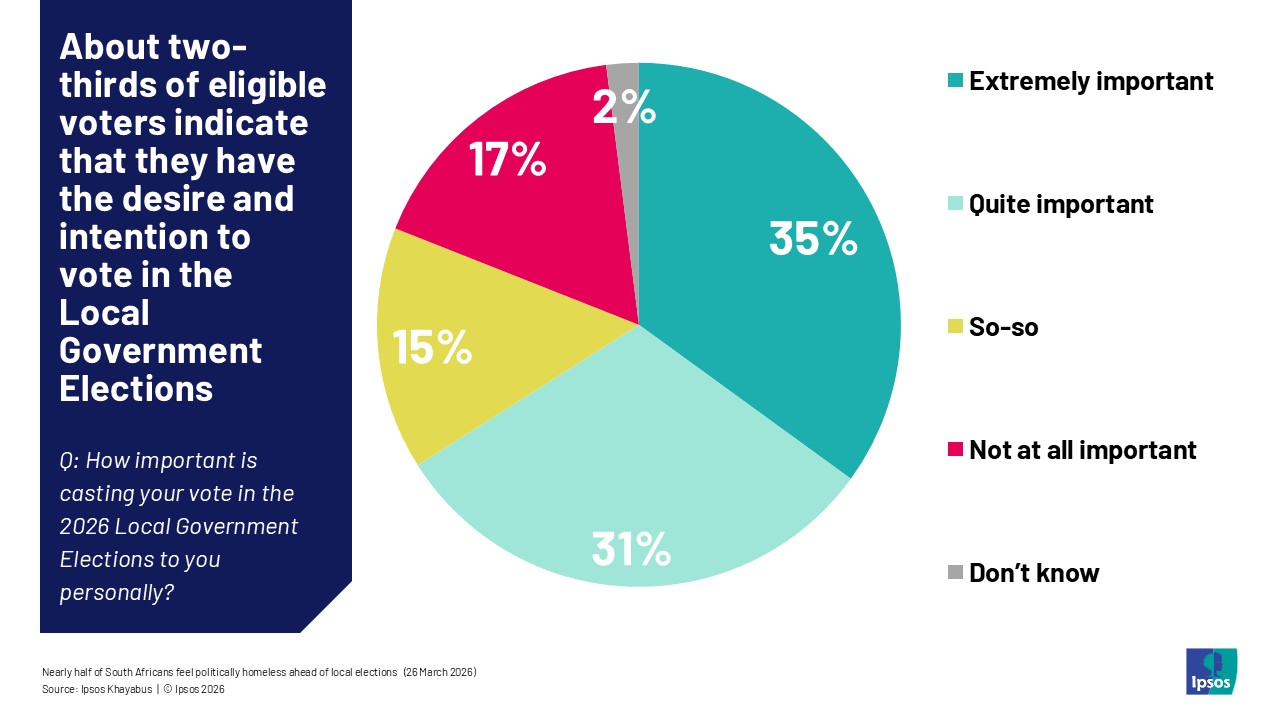
The current situation is that roughly two-thirds of eligible voters indicate that they have the desire and intention to vote in the Local Government Elections:
- 64% say they want to vote (21% "definitely want to" and 43% "want to")
- 67% say they are likely to vote (27% "very likely" and 40% "likely")
- 66% say voting in the local government elections is “personally important” to them
The stumbling blocks
Trust in South Africa's electoral institutions remains divided. When asked about the IEC, opinions are split, with similar proportions expressing trust and distrust:
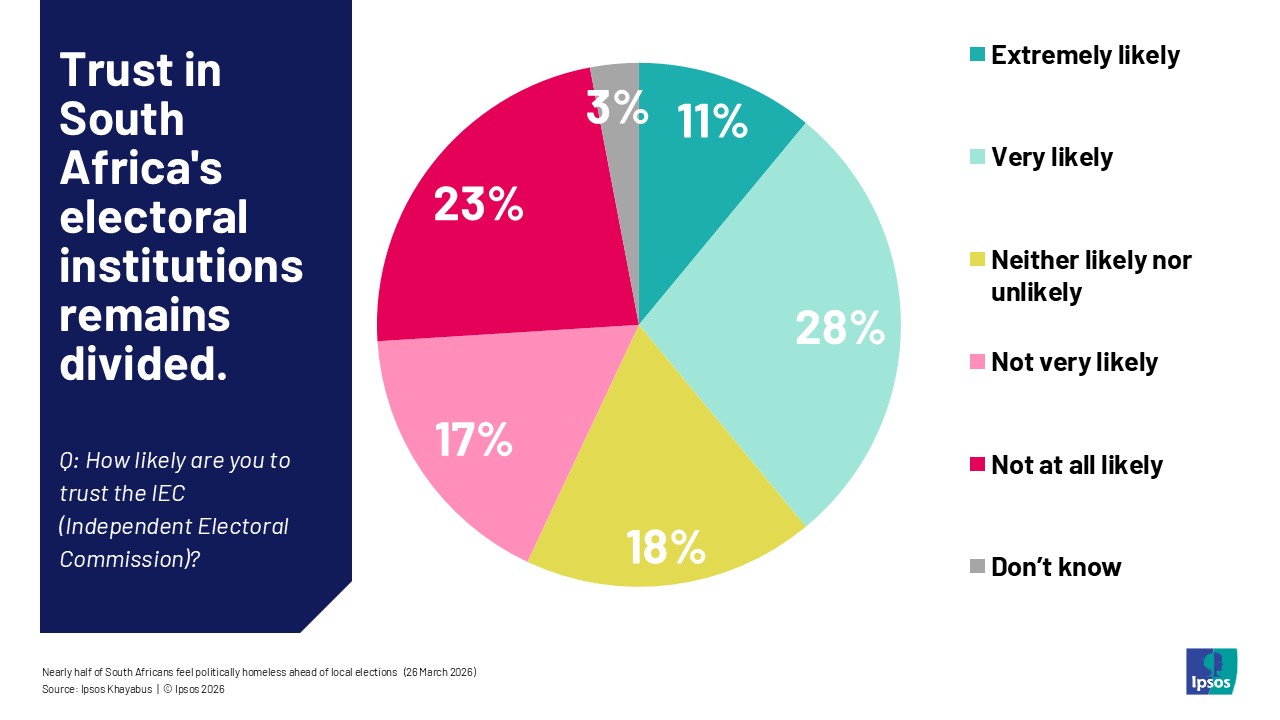
The data reveals information about where knowledge and trust-building of the role of the IEC are needed most:
- Young voters are most sceptical: 40% of 18-24-year-olds and 42% of 25-34-year-olds are more unlikely to trust the IEC.
- Provincial divides exist: Distrust is highest in KwaZulu-Natal (58%), Northern Cape (52%), NorthWest (42%), and Limpopo (42%).
- Geographic priorities emerge: Given population sizes, KwaZulu-Natal and Gauteng, along with metropolitan areas and rural villages, should be focal points for trust-building efforts.
"These findings point to clear priorities for voter education," says Harris. "Young people and certain provinces need targeted engagement if we want to see improved turnout and build confidence in the electoral process."
Support for political parties
To ensure authentic responses, the party support questions were asked using a confidential digital "ballot paper" approach: the electronic device is passed directly to respondents, who mark their own party choices on a graphic replicating a real ballot paper. This method is designed to resemble an actual election and reassure respondents that their choices remain confidential.
The results were analysed across different voter groups: all eligible voters (18+), registered voters only, and registered voters in metropolitan areas, looking at both national and local government voting intentions and party choices.
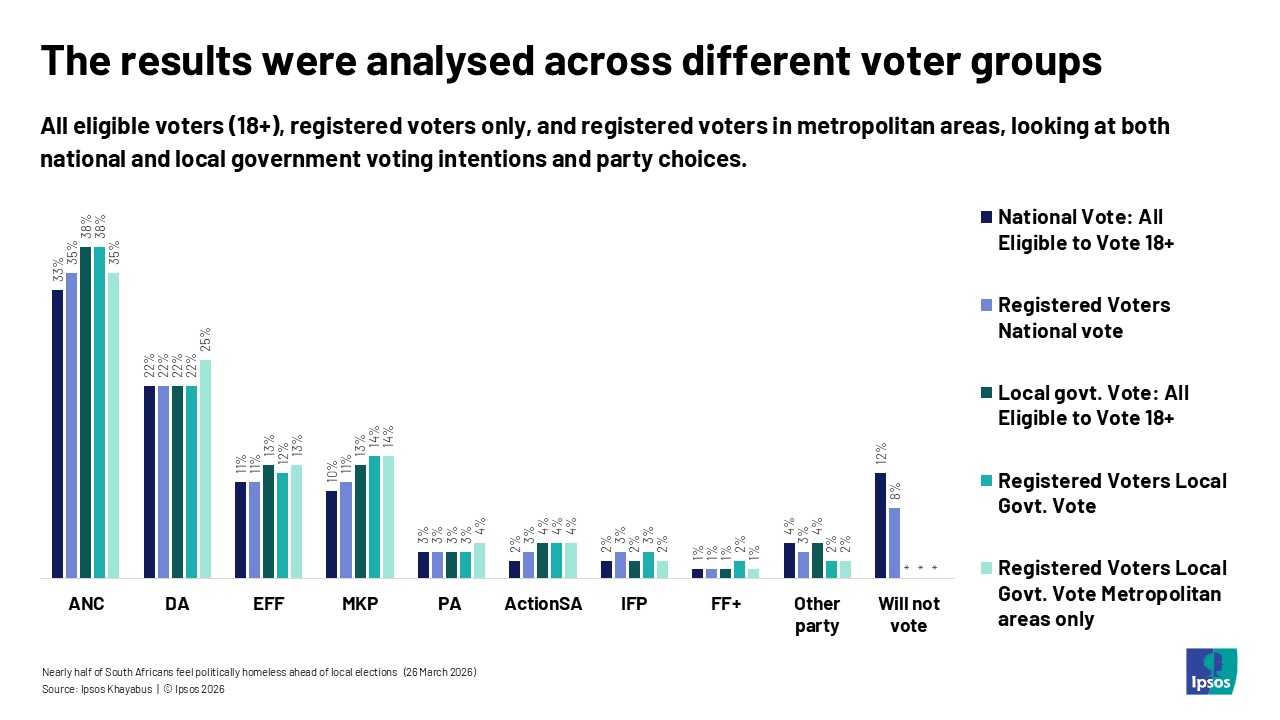
The ANC remains the party most supported by registered voters for local government elections at 38%, followed by the DA at 22%. MKP (14%) and the EFF (12%) are closely matched, followed at some distance by ActionSA at 4% and the IFP and PA each at 3% each. The FF+ registers 2%, and it is the last party receiving more than 1% of the vote.
"The picture for local government shows a competitive landscape," says Harris. "While the ANC maintains its lead, the combined opposition vote suggests many municipalities could see coalition negotiations after the elections."
Coalitions and cooperation
Despite mixed views on the current Government of National Unity, the concept of coalition governance is gaining acceptance. While 43% of South Africans agree that the GNU is working well and represents a better form of government than ANC majority rule, 27% disagree. However, support for cooperation is notably stronger at local level: 63% believe political parties should work together in municipalities, with only 22% opposed.
"Regardless of how South Africans feel about the GNU nationally, the appetite for cooperation at local government level is clear," says Harris. "South Africa is a complex country, and many citizens recognise that parties need to work together to deliver services effectively. The upcoming elections may well produce more coalition-led municipalities, and voters seem to be ready for that."
1 Currently 28% disagree with this sentiment, while 25% neither disagree nor agree or had no opinion.
About the study
Khayabus:
This press release is based on the views of 3,600 randomly selected respondents. Interviews were conducted by trained Ipsos interviewers in the homes and home languages of respondents. Interviews were conducted between December 2025 and January 2026 – with a 2-week break over the festive period. A scientific process of multi-stage stratified random selection distributed interviews in all areas of the county, including deep rural areas. This methodology ensured that the results are representative of the views of the universe (adult South Africans) and that findings can be weighted and projected to the universe. Trained quantitative fieldworkers were responsible for the interviewing and CAPI (Computer-Assisted Personal Interviewing) was used. All results were collated and analysed in an aggregate format to protect the identity and confidentiality of respondents. All sample surveys are subject to a margin of error, determined by sample size, sampling methodology and response rate. The sample error for this sample at a 95% confidence level is a maximum of plus or minus 1.9%.