4 in 10 South Africans depend on government grants, with Child Support and Social Relief of Distress grants dominating
Together, these two dominant forms of social assistance reach more than three-quarters (77%) of all grant recipients1. The findings, from the Ipsos Khayabus ‘Pulse of the People’ study, come amid ongoing national debate about social grant values, eligibility criteria, and the future of the SRD grant. Originally introduced as a temporary measure during the Covid-19 pandemic, the SRD grant is now in its sixth year, underscoring how temporary support has become a long-term lifeline for many South Africans.
The study also highlights the broader economic reality facing the country. More than half (52%) of South African households have only one income earner, or none at all, while only around one in four (24%) of South Africans earn more than R9,000 per month (individuals under the age of 65 generally begin paying personal income tax once their annual taxable income exceeds R99,000 - around R8,250 per month2). This places increasing pressure on both the country’s social grant system and the broader tax base that supports it, with relatively few South Africans earning enough to contribute significant personal income tax3.
“This data reveals the impossible tension at the heart of South Africa’s fiscal reality,” says Mari Harris, Political Analyst at Ipsos in South Africa. “Four in ten South Africans depend on grants to survive, yet less than a quarter of the population earns enough to contribute to income tax. With half of households relying on a single earner, or have no earner at all, the pressure on both systems, social grants and tax revenue, is immense.”
Two types of grants making a big difference
Among South Africans receiving grants, two forms of assistance dominate.
“The Child Support Grant remains the cornerstone of South Africa’s social assistance system, reaching four in ten grant receivers,” says Harris. “But the emergence of the SRD grant as the second most common grant, despite originally being designed as temporary relief, tells us something significant about the ongoing economic pressures facing South Africans. Together, these two grants have become the primary mechanism keeping millions of households afloat.”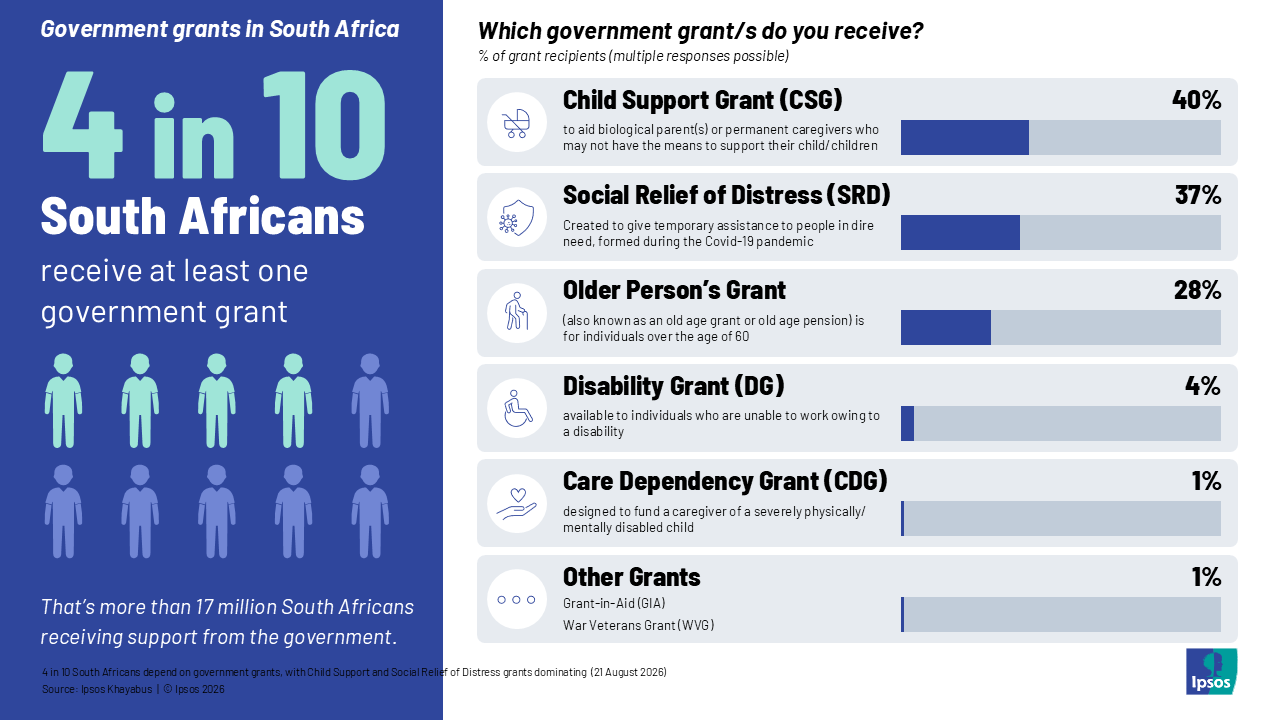
Note: Respondents may receive multiple grants, so the proportions receiving different types of grants add to more than 100%
Youth and the SRD: A “temporary” grant becomes permanent
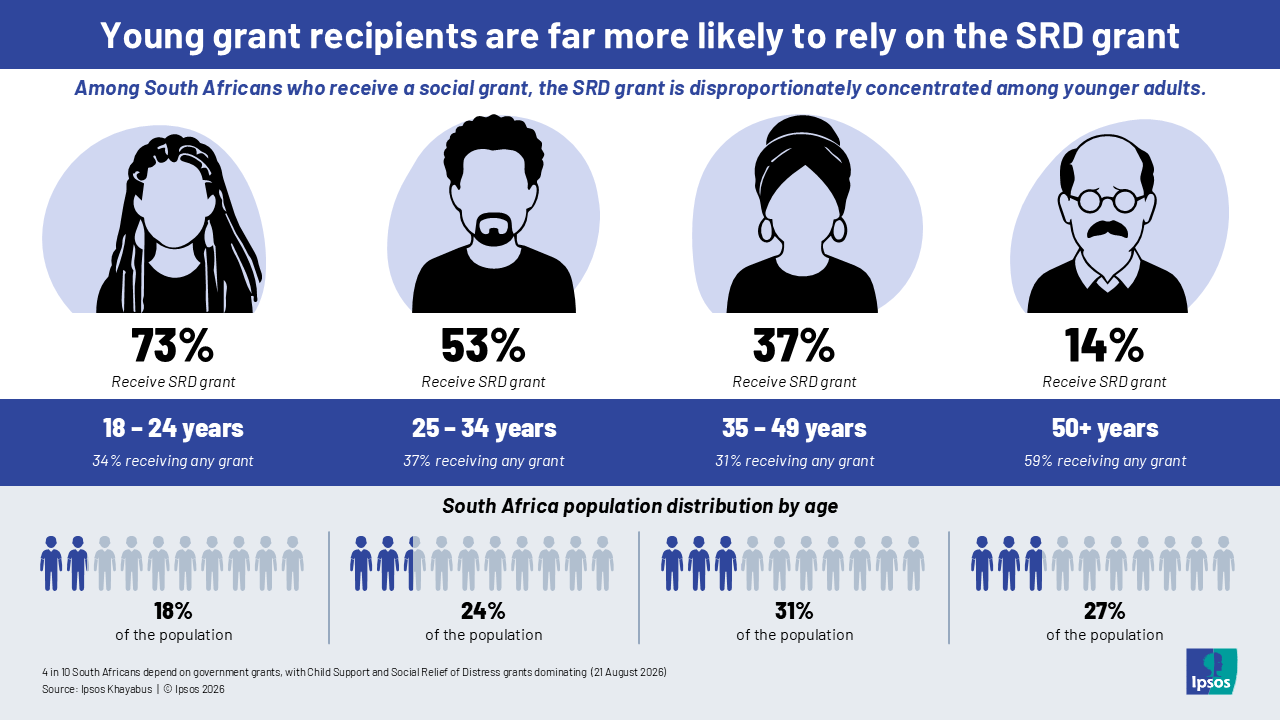
The SRD grant, introduced in May 2020 as emergency relief during Covid-194, has become the primary form of social assistance for young South Africans.
“A third (34%) of South Africans aged 18-24 receive a social grant, with nearly three-quarters (73%) of these young grant recipients relying on the SRD grant,” says Harris. “Six years after Covid-19, this ‘temporary’ measure has become the primary support for millions of young South Africans. The ongoing debate about whether to make it permanent or phase it out isn’t an abstract policy discussion, it directly affects the daily survival of a generation. With the high youth unemployment rate, the SRD grant has become the primary, and often only, income source for millions of young South Africans who cannot find work.”
One earner supporting many
The grant dependency figures cannot be understood without examining South Africa’s household financial landscape.
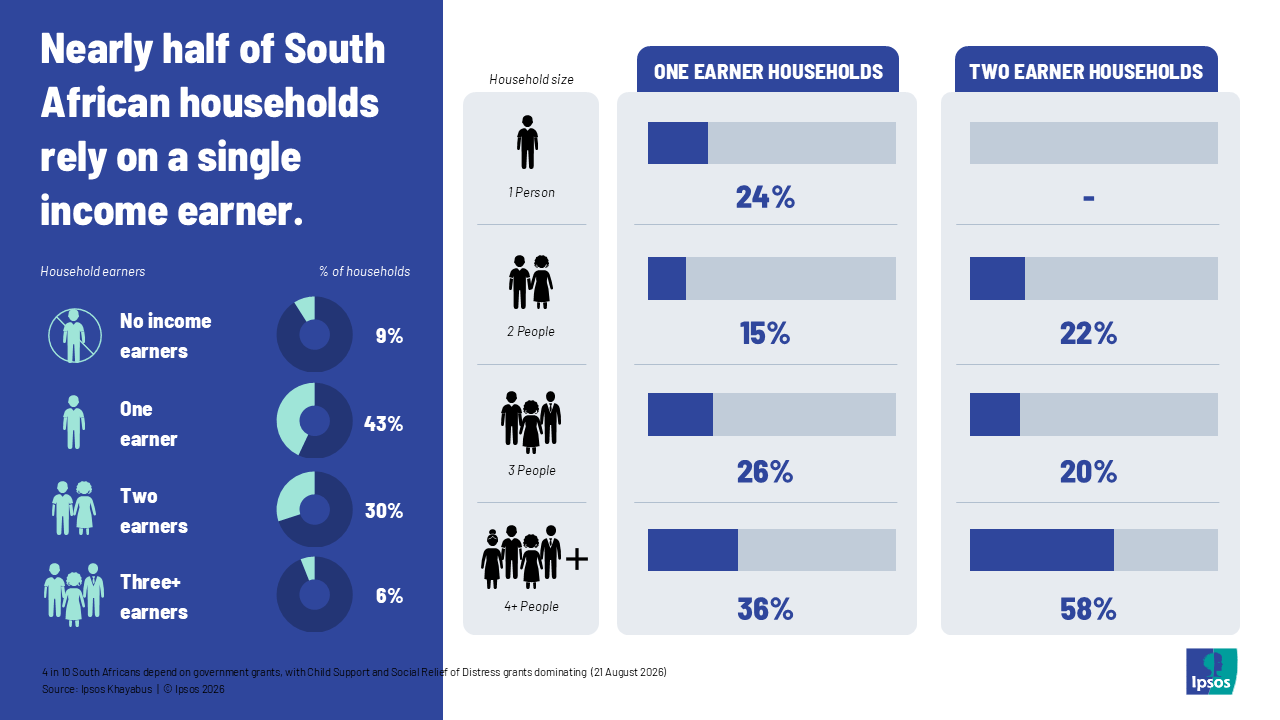
“In single-earner households, more than a third (36%) have four or more people relying on one income,” notes Harris. “Even in two-earner households, 58% are supporting four or more people. This is the reality driving both grant dependency and the pressure on those who earn money, who are often supporting entire extended families.”
The narrow tax base
Only around one in four (24%) South Africans surveyed reported earning more than R9,000 per month. South Africa's current personal income tax threshold for individuals under the age of 65 is R99,000 per year (approximately R8,250 per month), illustrating how relatively few South Africans earn above the level at which personal income tax generally becomes payable.
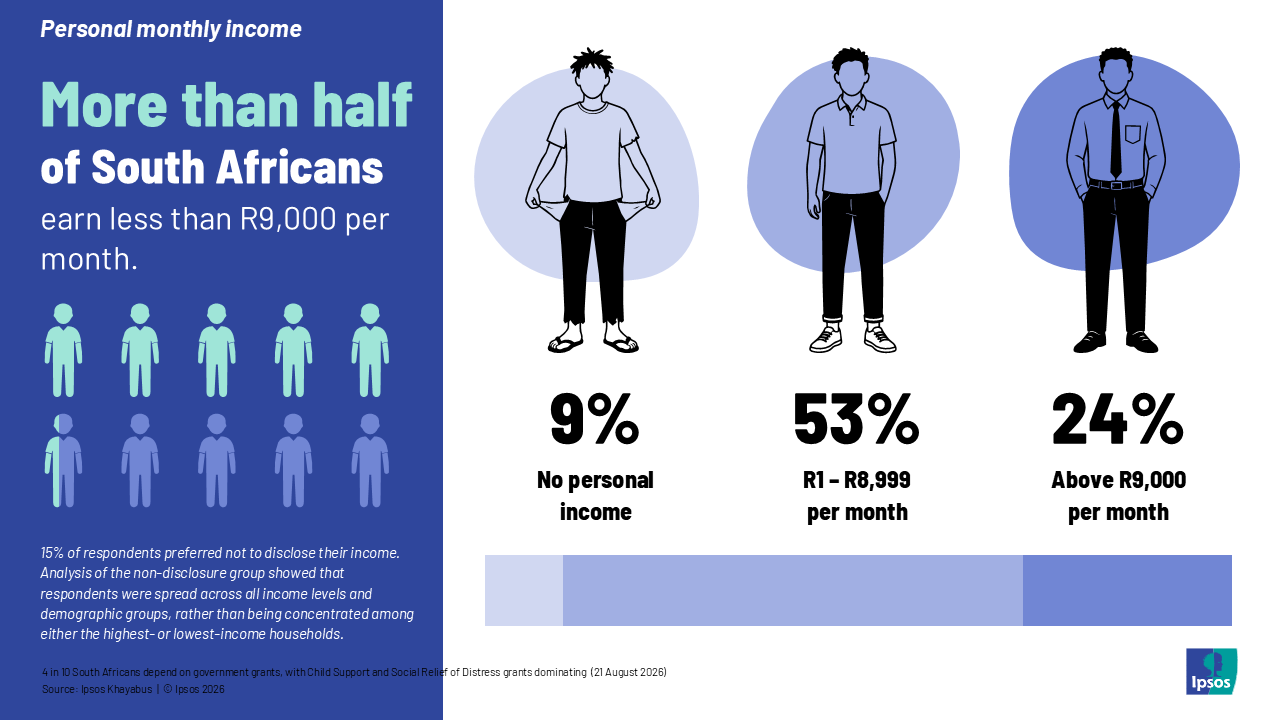
Note: A proportion of respondents chose not to disclose their income. Analysis of the non-disclosure group showed that respondents were spread across all income levels and demographic groups, rather than being concentrated among either the highest- or lowest-income households.
“Our findings highlight the challenge of South Africa's relatively narrow personal income tax-paying base,” observes Harris. “Only around one in four (24%) South Africans surveyed reported earning more than R9,000 per month, while 40% of South Africans receive a social grant. This underscores the immense pressure on both those earning incomes and those relying on social assistance. Both income earners and grant recipients are under pressure, and both have legitimate concerns in the ongoing debate about the sustainability of South Africa's social assistance system. The long-term solution lies in sustainable economic growth that expands employment, broadens the tax base and continues to support the country's most vulnerable citizens.”
The gendered face of grants
Grant dependency in South Africa is sharply gendered, both in who receives grants and in the types of grants they receive.
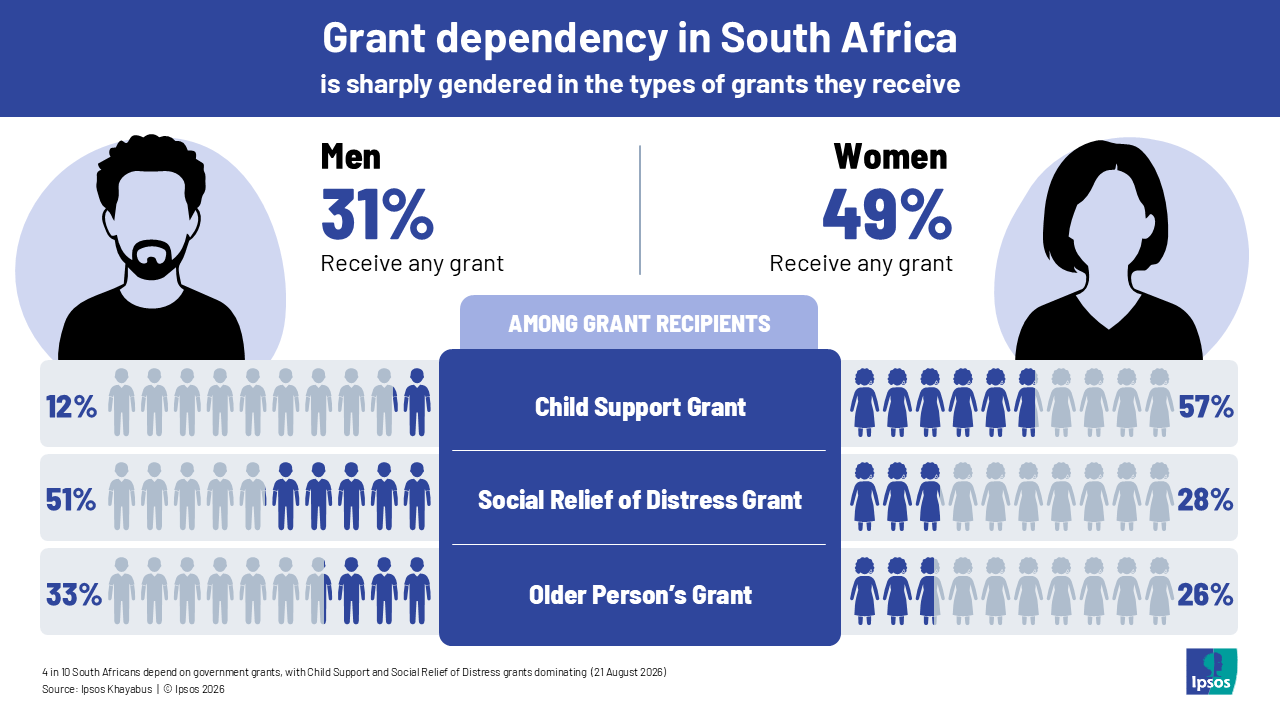
“Nearly half (49%) of women receive a grant, while almost a third (31%) of men do,” notes Harris. “And the type of grant reveals distinct patterns. Women primarily access the Child Support Grant to care for their children, while men are more likely to receive the SRD grant. This reflects broader societal patterns where women more often carry the primary responsibility for child-rearing, and are very often single parents.”
The provincial picture
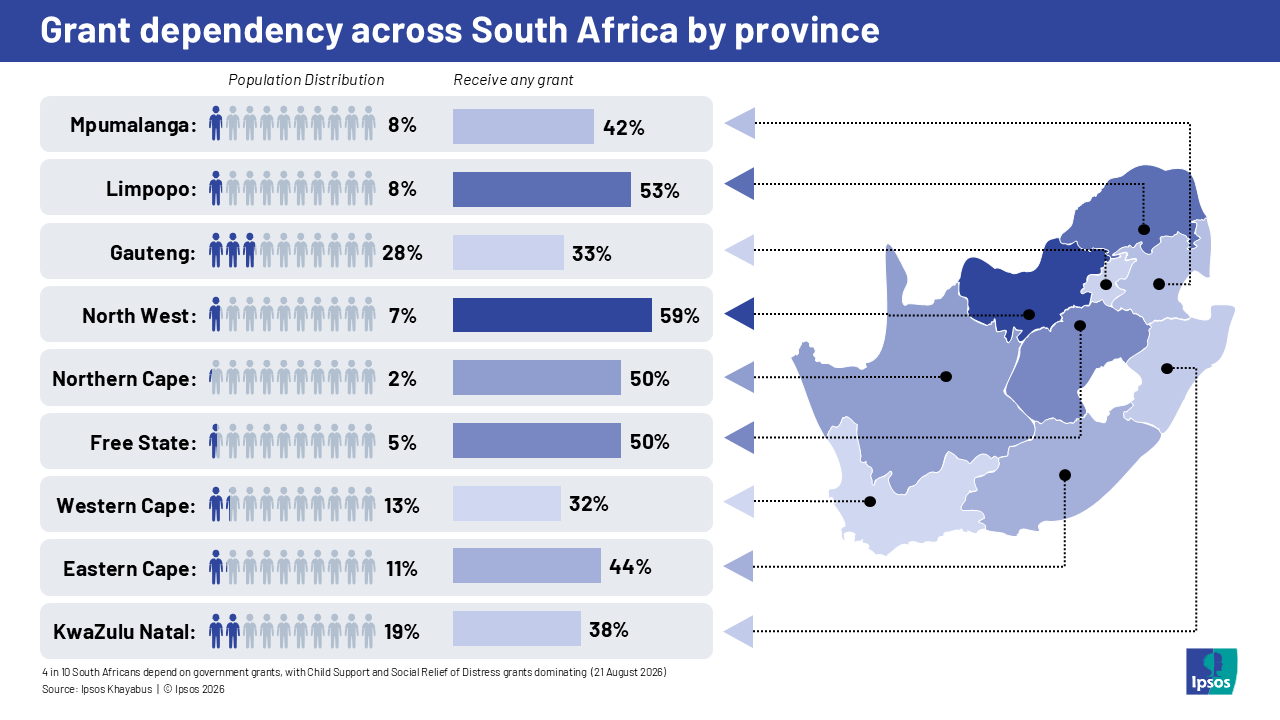
“The provincial picture also varies considerably,” observes Harris. “Grant receipt ranges from 32% in the Western Cape and 33% in Gauteng to 59% in North West. These differences reflect the varying demographic and socio-economic profiles of South Africa's provinces, including factors such as age structure, household composition and employment patterns.”
Urban vs rural as a geographic divide
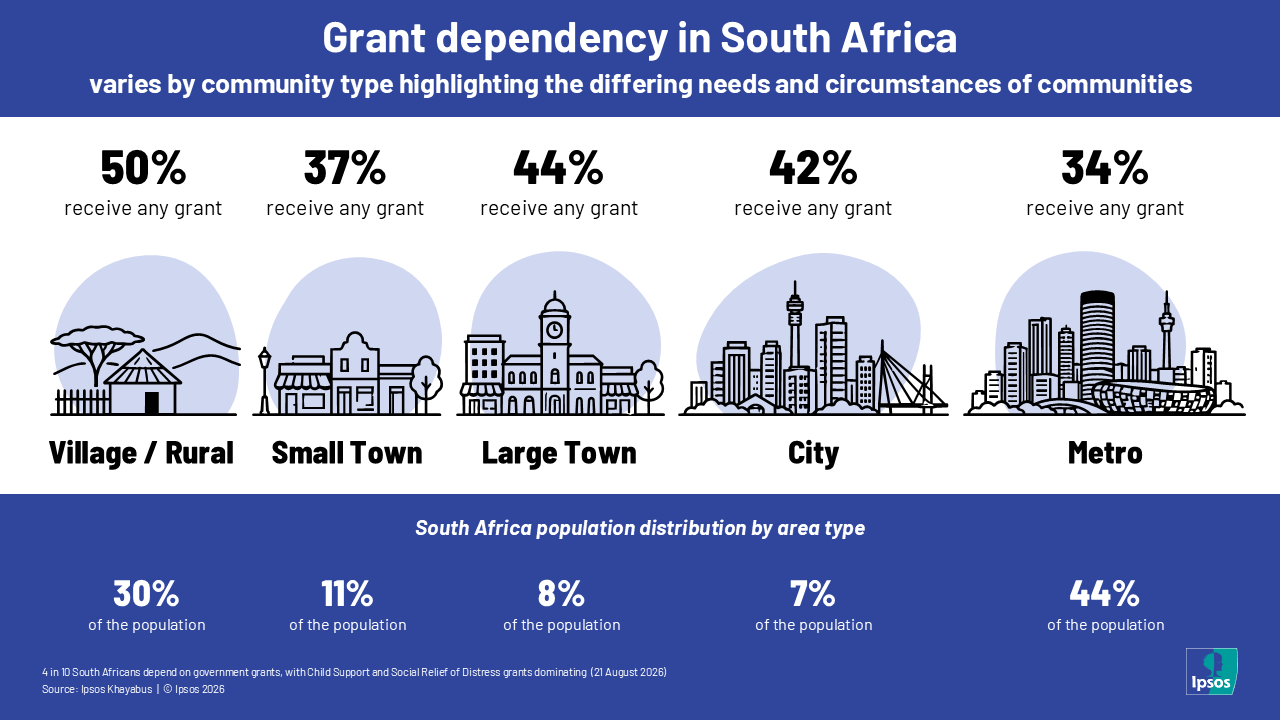
“Grant receipt also varies by community type,” says Harris. “Half (50%) of South Africans living in villages and rural areas receive a social grant, compared with around one-third (34%) of those living in metropolitan areas. These findings highlight the differing needs and circumstances of communities across South Africa and reinforce the importance of understanding local contexts when developing policy and planning service delivery.”
What this means
“These findings illustrate the central challenge facing South African fiscal policy,” Harris concludes. “We have 40% of the population dependent on grants for survival, funded partly by less than a quarter who earn enough to pay income tax. Neither group is comfortable. Grant recipients struggle to survive on amounts that haven’t kept pace with inflation, while taxpayers feel the burden of funding an ever-expanding system.
“Any debate about grant values, eligibility, or the future of the SRD grants must acknowledge this reality. The solution isn’t to pit these groups against each other, it’s to grow the economy and create jobs so that fewer people need grants and more people can contribute. Until then, both sides of this equation will remain under strain.”
1 The “Pulse of the People” is part of the Ipsos Khayabus project, a nationally representative study of 3,600 randomly selected individuals, conducted twice a year in all types of settlements and rural areas across South Africa. The results discussed in this press release refer to findings among the group that are 18-years-old and older.
2 https://www.sars.gov.za/types-of-tax/personal-income-tax/
3 This press release does not deny the significant contribution made to the tax collected every year by the paying of VAT at 15% on every transaction and paid by all people in the country, as few products are zero-rated when it comes to the paying of VAT.
4 https://www.gov.za/news/media-statements/president-cyril-ramaphosa-extends-r-350-coronavirus-covid-19-grant-12-feb
About the study - Ipsos Khayabus:
This press release is based on the views of 3,600 randomly selected respondents. Interviews were conducted by trained Ipsos interviewers in the homes and home languages of respondents. Interviews were conducted between June and July 2026. A scientific process of multi-stage stratified random selection distributed interviews in all areas of the county, including deep rural areas. This methodology ensured that the results are representative of the views of the universe (adult South Africans) and that findings can be weighted and projected to the universe. Trained quantitative fieldworkers were responsible for the interviewing and CAPI (Computer-Assisted Personal Interviewing) was used. All results were collated and analysed in an aggregate format to protect the identity and confidentiality of respondents. All sample surveys are subject to a margin of error, determined by sample size, sampling methodology and response rate. The sample error for this sample at a 95% confidence level is a maximum of plus or minus 1.9%.