Food & Drink
The beginning of 2022 started to offer some hope to a sector beleaguered by two years of lockdowns and supply chain headaches caused by a global pandemic. As countries gradually opened up, there was a tentative sense the world had turned a corner. Then, in February, Russia invaded Ukraine. With a world already struggling to resuscitate the global economy this triggered new energy and food supply challenges and exacerbated existing vulnerabilities in food systems which were already weakened by the pandemic and climate change. Already on the up, inflation rocketed as soaring commodity prices and deteriorating supply chains exacerbated existing circumstances and conspired to create the unprecedented cost of living crisis we now find ourselves in. Output among UK food & drinks manufacturers fell as they raised their prices throughout the year to keep pace with rising costs. Merging with a perfect storm of labour shortages and a weak pound resulting from Brexit, Liz Truss’ ill-fated economic tinkering and demand outrunning supply as society opened up, to say the food & drinks sector has had a torrid time of late might well be considered an understatement.
So what does this all mean for the sector’s reputation? During the pandemic the food and drink sector was lauded for keeping a nation fed, and its reward from a reputational standpoint is that, even now as people continue to struggle with rising costs, it is among the most trusted sectors, behind only pharmaceutical and technology companies. More to the point, it is a sector which sees some of the lowest figures of people who actively see it as ‘untrustworthy’.
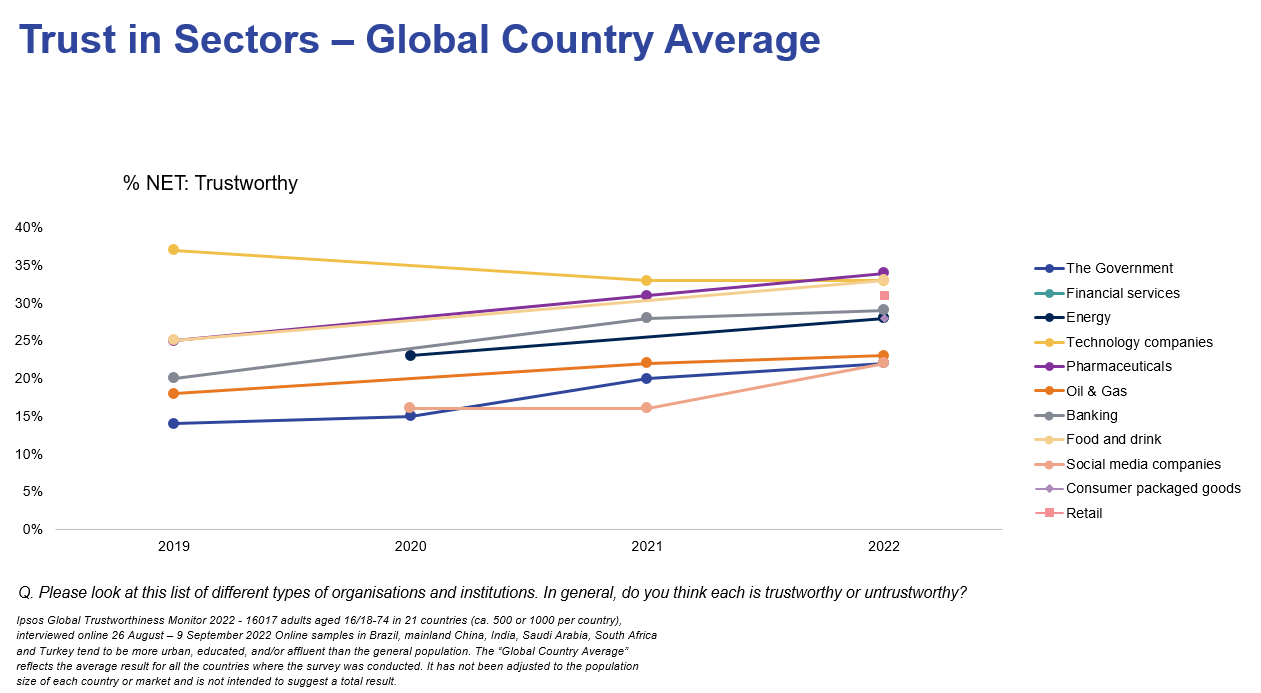
The Global Trustworthiness Monitor tells us that being reliable, transparent and responsible are key drivers of trust, and given the challenging circumstances which the sector has had to navigate, it has been judged well on these. Compared to overall leader in trustworthiness - the pharmaceutical sector - food & drink is seen as on par in being reliable and behaving responsibly, and ahead on being seen as transparent. Where it is not joint first on transparency, it is second only to the retail sector which is marginally ahead.

That said, fourth on the list of most important trust drivers is providing good value for price, and with cost of food having risen a record 10.6%, and fresh food up 12.1% since last year in the UK at least, it stands out as an issue which has all sorts of implications for the reputation of brands operating in the industry. Indeed, cost of living concerns have almost doubled since the start of 2022, and by the end of last year had overtaken COVID-19 as the World’s dominant concern, holding the top spot since March. As such, the affordability of life’s essentials, such as food & drink, are likely to come under closer scrutiny over the coming year, much as we have seen with regards to energy of late. Indeed, the energy sector has faced an uproar over fuel and energy bills as those saying the sector is ‘untrustworthy’ has increased 5pp between 2021 and 2022.
With the financial pain continuing into 2023, research from Ipsos last Spring showed that a third of Britons reported they were ‘just about getting by’, and a fifth said they were finding things ‘difficult’. Moreover, 87% of Britons said 2022 was a ‘bad year’ for their country, and 86% of Britons said it was more likely than unlikely that prices would rise faster than income in 2023. This gloominess is underpinned by data from Ipsos’ Consumer Confidence Index, where Britons surveyed showed a decline of 10 percentage points between February and November to an index score of 41.8. This was one of the largest drops seen in any nation surveyed, with Hungary down 9.9pp to 30.4, Germany down 9.6pp to 44.3 and Belgium down 9.6pp to 38.0. To add insult to injury, Ipsos Broken-System Sentiment Index also shows that the UK is one of the nations most likely to say the economy is rigged to advantage the rich and powerful (71%).
It is not a stretch to imagine then, that following UK food producers’ record profit warnings in Q3 2022 and announcements of 21-year high earnings, similar accusations of perceived profiteering which have afflicted the energy industry may arise if people continue to struggle and become increasingly unable to afford the essentials. While fiscally such earnings may be a positive for the industry, presenting this in a palatable way to consumers needs a sensitive approach, and uncovers a potential reputational risk the industry must navigate in 2023 as organisations like Oxfam start to shine a spotlight on the industry, by calling for a windfall tax on ‘Big Food’.
Increasingly we see that people are looking to corporations and business leaders for solutions to these large societal issues, as 42% globally agree business leaders are overtaking politicians as a force for progressive change in the World, to which only 19% disagree. Half globally also agree that businesses have a responsibility to speak out on social and political issues affecting their country, compared to just 18% who do not. Ipsos’ Global Trust Monitor tells us that the most successful brands in the future will be those that make a positive contribution to society (53% global and UK). Moreover, there is a belief that it is possible for a company to both make profit and behave responsibly (60% global; 67% UK).
That said, there is scepticism on whether business will fulfil a social function, with 58% globally (71% in the UK) saying that when times are tough, profit will always come before purpose. And while clearly consumers increasingly expect businesses to take a stance on societal issues, half globally still believe that responsibility to fix society’s problems lie with government. What we an conclude however is that in an era of seeming ‘perma-crises’, people are looking for leaders to guide us through. The organisations and institutions which show they are in touch with societal concerns are more likely to reap the trustworthy and reputational benefits than those who are perceived to be taking advantage of the situation.
Encouragingly, the food & drink sector currently curries more trust than other sectors we’ve measured, banking a positive balance of trust in which it is seen to be reliable and responsible over the last few years. And yet, it is a sector which finds itself in a maelstrom of external pressures as it tries to provide life’s essentials as efficiently and cost effectively as possible to people who will be struggling. That trustworthiness will buy benefit of the doubt to a point, however the food & drink sector must remain on the front foot of transparency when explaining how it is dealing with these challenges. As consumers are expected to endure these challenges through the cost-of-living crisis over the coming year, questions will be raised as to how the sector is contributing solutions. While only so much can be done in the face of external pressures, continued reliability and transparent communications in telling its side of the story will provide a solid base on which the sector can further build trust.