

The World Cup Didn't Change Norway. It Changed How the World Noticed Norway.
Long before people experience a country directly, they encounter its reputation.
At Ipsos, we view destination brands as dynamic reputation systems. They influence where people travel, work, study and invest, which companies they choose to work with and, increasingly, which products and services they trust. Norway's 2026 FIFA World Cup moment offers a compelling example of how an established reputation can gain power when visibility, emotion and cultural relevance align.
In the 2025 Anholt Nation Brands Index, Norway achieved its highest-ever position and continued to enjoy one of the world's strongest reputations, associated with trust, good governance, sustainability, equality and quality of life, according to Innovation Norway's 2025 report on perceptions of Norway (Source: Innovasjon Norge. Oppfatningen av Norge 2025). Yet Norway's challenge has never been reputation. It has been visibility.
Major global events can accelerate reputation by bringing functional perceptions, emotional associations and cultural relevance together in ways that traditional marketing rarely can. Returning after a 28-year absence, Norway arrived at the 2026 FIFA World Cup not as a traditional football superpower, but as one of the tournament's most compelling stories. The tournament became a global branding platform, reaching millions who may never previously have considered Norway as a destination, a place to study or work, an investment location, or a source of products and services. More importantly, it showcased not only football talent, but also the values, culture and identity behind one of the world's strongest nation brands.
The timing for Norway’s visibility opportunity could hardly have been more significant. Ipsos Global Trends 2026 finds that only 25% across 38 markets are optimistic about the world over the next 12 months, 36% about their own country, compared with 55% who remain optimistic about themselves and their families. (Source: Ipsos, Global Trends: 10th Edition, 2026, p. 8). Against that backdrop, Norway's associations with stability, good governance and quality of life offer a credible, positive counterpoint to uncertainty
Beyond Awareness: Reading Reputation in Real Time
Destination brands are often evaluated through awareness, consideration and visitation metrics. They matter, but do not fully explain why people choose one destination over another. Ipsos combines reputation measurement with social intelligence tools such as Ipsos Synthesio to track how narratives evolve and identify the people, symbols and stories that create cultural relevance.
During the 2026 FIFA World Cup, Ipsos Synthesio recorded approximately 827,000 mentions and 288 million interactions relating to Erling Braut Haaland in English-language online conversations. In total, 73% of the conversation was positive or neutral, making him the fifth most visible football star included in the analysis and placing him among the most favourably perceived. (Source: Ipsos Synthesio, English-language social listening analysis, 11 June–19 July 2026.)
Haaland's visibility among selected football stars:
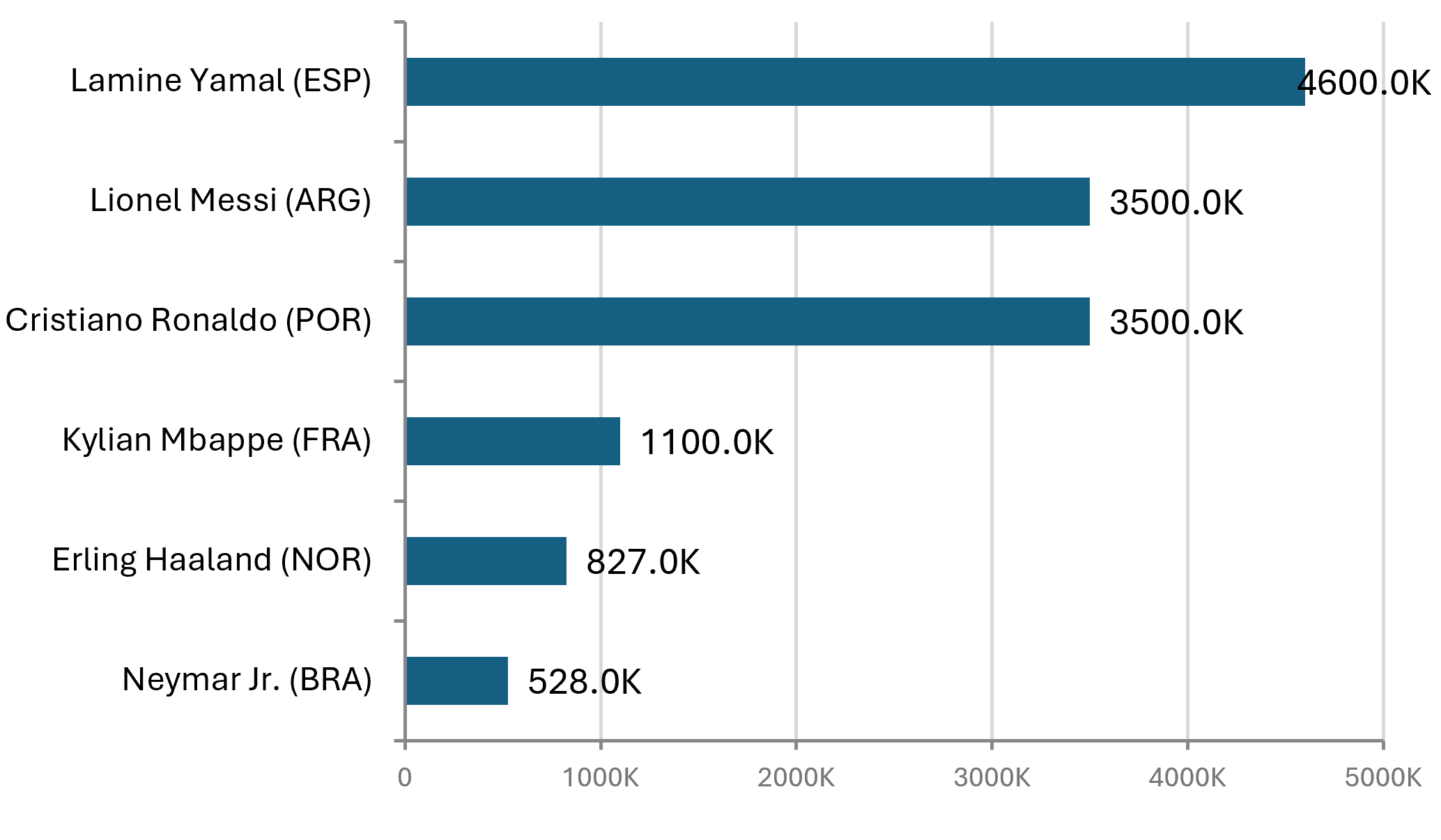
Haaland's impact went far beyond football. Positive discussion reflected not only performance and national pride, but also a distinctive personality and wider cultural presence, particularly in the United States. He became more than a successful athlete representing Norway. He became a likeable, recognisable entry point into the country.
For years, Brand Norway has been built on rational strengths: trust, stability, sustainability and quality of life. Yet people do not fall in love with countries through governance scores alone. Haaland and the Norwegian football team added something Brand Norway has historically lacked at scale: emotional connection. Together, they complemented Norway's established livability with greater lovability, adding personality, cultural relevance and human connection to the country's reputation.
Value behind National Reputation
A strong and emotionally engaging national reputation can lend credibility, distinctiveness and trust to connected brands, while a weaker or contested reputation can create friction before price, quality or performance are considered. The Ipsos Countries as Brands digest cites a 31-country mobility study in which 48% said they would avoid certain car brands because of their nationality (Sources: Ipsos, Countries as Brands Digest, 2026, pp. 18–19). A related dynamic appears in Norway: an Ipsos Norway study of 1,000 consumers found that Tesla remained highly visible and commercially successful yet was mentioned far less often as a favourite brand than Volvo, BMW or Toyota (Source: Anastasiia Chernykh, Ipsos Norway, 'Borderless Brands: What will it take for Norwegian brands to win internationally?', 29 May 2026.). Without isolating brand origin as the only cause, it reinforces the broader point: commercial performance, country-of-origin associations and emotional meaning interact, and brands become vulnerable when practical strength is not supported by trust, relevance and affinity.
National reputation is therefore not a background association. It is increasingly part of brand equity and market performance. Ipsos Global Trends reports that 66% tend to buy brands reflecting their personal values, while national identity can become a shortcut for those values, as consumers may infer that a company shares the perceived characteristics of its home country, whether or not that assumption is accurate. Country of origin can therefore create competitive advantage or reputational liability across markets. (Sources: Ipsos, Global Trends: 10th Edition, 2026, p. 20; Ipsos, Countries as Brands Digest, 2026, pp. 2, 15–16.)
A Coherent Modern Norwegian Narrative
Destination brands become stronger when multiple assets reinforce the same narrative. During the tournament, sport, culture, heritage, food and national values combined to tell a coherent story about modern Norway. Audiences encountered consistent signals across media coverage, social conversations, athlete personalities, fan behaviour and cultural references. That consistency can help turn a short-lived burst of attention into a longer-term reputational effect.
The underdog story brought excitement, determination and collective purpose. Norway also showed a remarkable ability to turn cultural heritage into contemporary brand assets. Viking-inspired imagery and viral “Row” celebration made familiar symbols feel proud, modern, adventurous and fun. Food became part of the same narrative. Reports that the team travelled with Norwegian salmon and brown cheese created near-perfect branding synergy: one national asset reinforced another and generated international media attention.
Ipsos measurement published by the Norwegian Seafood Council found that, among salmon buyers in the north-eastern United States, unaided association of salmon with Norway rose from 9% to 15%. The share naming Norwegian salmon as their first choice increased from 8% before the tournament and related campaign to 13% afterwards, while the share likely to buy Norwegian salmon rose from 42% in 2024 to 47% in 2026. (Source: Norwegian Seafood Council, 'VM løftet norsk laks i USA', 2026.)
The results illustrate the commercial logic described in the Ipsos Countries as Brands digest: places operate as reputational platforms, transferring meaning and trust to associated brands. The relationship works both ways. Haaland and Norwegian salmon can strengthen Brand Norway, while Norway's reputation creates a halo around its people, products and companies.
The World Cup did not create Norway's strengths in stability, access to nature, innovation, sustainability and quality of life. It gave global audiences a more immediate and emotionally engaging way to encounter them. Ipsos Global Trends 2026 suggests that people respond increasingly to practical, visible progress rather than grand institutional promises (Source: Ipsos, Global Trends: 10th Edition, 2026, pp. 20 and 22). The spirit of the team and the behaviour of Norwegian supporters translated Norway's values into action: enthusiasm without hostility, loyalty despite defeat and pride without exclusion. The resulting image was powerful: competitive yet respectful, strong yet inclusive. In branding terms, Norway achieved something rare: admiration without alienation. The tournament therefore became not only a destination-branding platform, but also a way to show what Norway's values look and feel like in everyday life.
Measuring What Matters
At Ipsos, we believe visibility without relevance rarely changes behaviour. Treating places as reputational platforms means measuring not only perceptions of the destination itself, but also the value those perceptions create for associated sectors, organisations, products and services. Our approach combines reputation measurement, social intelligence, behavioural science and brand equity principles to answer three connected questions:
• What do people know about a destination?
• How do they feel about it?
• How do those perceptions influence decisions and behaviour?
The framework reveals which associations endure, which expectations are changing and which audiences are becoming more receptive. It also shows whether attention is translating into tangible value across tourism, talent, investment, exports and business partnerships, helping destinations anticipate change and act on emerging opportunities.
From a Moment to Long-Term Value
Norway's World Cup experience offers a broader lesson. A country's reputation becomes most valuable when people can see it, feel it and connect it to something tangible. In a restless decade, Norway's promise is not simply positivity. It is the possibility of stability without stagnation, pride without exclusion and progress people can recognise in everyday life.
The World Cup did not change Norway. It changed how the world noticed Norway. The opportunity now is to ensure that what the world noticed becomes what it remembers, values and chooses.
At Ipsos, we help destinations move beyond measuring attention to understanding its long-term value and capitalizing on it, enabling organisations to strengthen reputation, attract visitors, talent and investment, and build sustainable destination brands for the future. Get in touch to discover how Ipsos can help turn attention into lasting value.
Photo by Tobias Bjørkli on Pexels
Forfatter
-
 Maria ToropovaKonsulent merkevare & kommunikasjon