A Panoramic View: With whom and with what do I truly compete?
 Based on the latest science on decision-making, this paper highlights how your competition can be captured no matter where they come from. It presents a clear panoramic view of a consumer’s mental set up, their options, and how they make decisions in our increasingly interconnected world when they are provided with multiple options.
Purchasing is a two-stage decision-making process. It is flexible and context-dependent, allowing for the quick screening of many products with minimal hassle. A bird's-eye view of what characterizes today can determine the trajectory of the future, resurrecting brand value. A frequent assumption is that if people are led toward one brand, they would be drawn to it.
This paper looks at the marketing implications of having a single product category or a specific brand appears in the self-generation stage. This approach provides a one-of-a-kind opportunity to develop strategies, build brand equity, and generate brand preferences.
Key takeaways
- Consumers make decisions by first self-generating options and then choosing one, but then choosing from a brand list does not capture this reality.
- A critical missing piece in current research is the examination and understanding of the self-generation stage.
- A better understanding of this stage can provide marketers with a broader view of who they compete with, an understanding of the relative salience of categories versus brands, and the determination of where branding opportunities are.
INTRODUCTION
Defining the competition in today’s hyperconnected world can be extremely challenging. In the past, competitors showed up on store shelves and were visible to all. The growth of eCommerce, however, means that competition can now come from retailers’ websites (e.g. Amazon), manufacturers’ direct-to-consumer websites (e.g. Dollar Shave Club), or small businesses’ DIY websites (e.g. Shopify). To add even more complexity, consumers’ needs can often be satisfied by products that span multiple product categories. For example, a person who wants a healthy snack can choose from a granola bar, fruit, pretzels, nuts, or a protein bar.
In this paper, we show how your competition can be captured no matter where they come from. Our approach is based on the latest science on decision-making. Getting an accurate and complete answer to the question of who you compete with is critical. It is the foundation from which you determine your brand’s positioning and new growth platforms.
THE SCIENCE OF DECISION-MAKING
Your true competitive set is the consumer’s mental set you are a part of. Faced with what can feel like unlimited options, consumers simplify their decisions with a consider-then-choose decision process in which they first self-generate options for consideration and then choose from this consideration set.1 Deciding what to buy is therefore a two-stage decision process. The term “self-generate” does not mean the first stage is deliberate or fully conscious. Options come to mind spontaneously and without much conscious control.
This two-step process is highly adaptive and context dependent, enabling the rapid screening of many products with minimal effort. Most of us do not have the time, motivation, or mental capacity to evaluate every product option available. This two-stage decision process builds on Ipsos’s brand decision framework: decisions arise along a continuum, where multiple cognitive processes ranging from more mindful to more mindless are operating at the same time and are contextually dependent.
WHEN DO CONSUMERS SELF-GENERATE OPTIONS?
In everyday life, we seldom choose from a pre-defined list of options. There are times this does happen such as when selecting from a restaurant menu or when choosing a mobile phone plan. Often, however, we need to come up with the options on our own; for example, deciding where to eat for lunch or deciding what brand of mobile phone to buy. While we may think of shopping for groceries as being provided with a list of options to choose from, the reality is that consumers don’t look at all the products on a shelf, evaluate every single option, and then decide based on preference. Research has shown that the time spent in front of a grocery store shelf to decide is about 8-12 seconds3 and that shoppers examine only one or two brands on average. These findings suggest that consumers are self-generating options, and then selecting from options available at shelf. This process would apply to eCommerce as well. Given the large number of options provided in-store or online, consumers realistically cannot comb through all options.
SO WHAT?
Many current research approaches capture the competition by asking consumers to indicate their preference from a researcher-provided list of products or brands. When such lists are used, the implicit assumption is that we have captured the full competitive set. The truth of the matter, however, is that a list can easily omit brands or products a researcher has not thought of. Additionally, consumers’ options are not always at the same level. That is, consumers don’t necessarily think of their options at a brand level only (e.g. Gatorade versus Powerade) or at the product level only (e.g. sports drink versus energy drink).
Consumers’ self-generated options can be a mix of both. For example, a consumer who is thirsty and looking for a healthy beverage to drink may decide between drinking fruit juice (with no brand preference) and Gatorade (a specific brand of sports drink). Knowing whether it is a product category, or a specific brand that is self-generated is critical. If product categories come to mind instead of specific brands, consumers are more open to which brands they use. Categories in which no/few brands come to mind are ripe for branding opportunities.
EVIDENCE FROM NEUROSCIENCE
A recent study by researchers from the Berkeley School of Business provides evidence that the decision process where people are presented with a list of options and asked to choose is quite different from one where people first self-generate options and then choose.5 The researchers scanned the brains of a group of participants using fMRI (functional magnetic resonance imaging) while they made decisions. When people made open-ended choices (self-generate and then choose), there was increased activity in two regions of the brain: the memory retrieval regions and regions associated with evaluating options. That didn’t happen when participants simply picked choices from a list. The evaluation region of the brain lit up, but the memory regions showed much less activity. As part of this research, the researchers also found that the brands people choose for fast food and athletic shoes differed significantly when they were asked to choose from a list versus when they were asked to self-generate options and then choose. In short, the outcomes of choosing from a list versus choosing from self-generated options are very different. We should make it clear we are not advocating the abandonment of using lists in market research. There are times when a list is appropriate and answers the research objectives. This is so when the set of options are well defined and identical for everyone (e.g. choosing from a restaurant menu). There may also be times when the goal is to evaluate consumers’ perceptions of a limited number of brands in a specific product category within a specific channel (e.g. laundry detergent brands sold at Tesco). In short, the suitability of a list needs to be evaluated against the objectives. But when the goal is to capture all possible competitors, a pre-defined list will not be adequate.
DEVELOPING A PANORAMIC VIEW OF THE COMPETITION
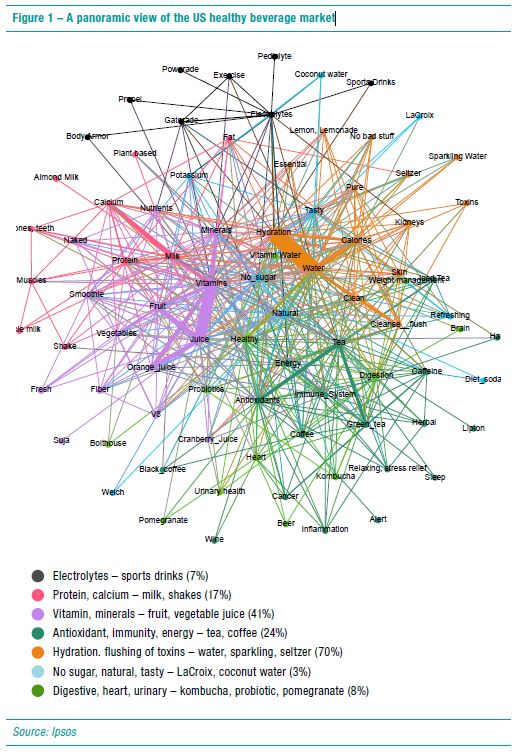
To test a new approach that captures consumers’ self-generation of options, we fielded a survey among 1,000 US respondents in 2021. In this study, we asked consumers what they consider as a healthy beverage. To allow for the self-generation of options, we used an open-ended question format. The instructions for this open-ended question allowed consumers to respond with whatever thoughts came to mind. We did not constrain consumers to using brands or product labels only. For each option that came to mind, we also asked the reasons why they considered each option a healthy beverage. This second question captured the perceived benefits of each option. The verbatim from these two questions were combined, text analyzed, and visualized in Figure 1.
The first thing one notices is the broad diversity of beverages considered healthy: Sports drinks, milk, shakes, fruit juice, vegetable juice, tea, coffee, water, sparkling water, seltzer, coconut water, kombucha, probiotics, and pomegranate juice. In such a situation, it would have been impossible to provide a comprehensive list of options. Even if we could anticipate all possible options and construct such a list, the usage of a list would not accurately capture how consumers make decisions. Given the large variety of beverages, we sought to provide some structure. The beverages were grouped into seven clusters based on their perceived benefits using a clustering algorithm. This is the panoramic view of the US healthy beverage landscape.
WHO DO YOU COMPETE WITH TODAY AND WHERE DO YOU WANT TO COMPETE TOMORROW?
This panoramic view of what constitutes a healthy beverage helps manufacturers determine with whom they currently compete. For example, if a manufacturer is currently in the sports drinks cluster, then the close-in competition is Gatorade, Powerade, Propel, BodyArmor and Pedialyte. These are the mentally salient brands in this space. Knowing the close-in competitive set allows marketers to fine tune their brand’s positioning and compete more effectively.
From this view, beverage manufacturers can also determine where they might want to compete in the future. For example, if a manufacturer is currently playing only in the sports drinks cluster, they can consider adjacent clusters to extend their brand into. One way to do is to incorporate benefits present in other clusters. As an example, the Pepsi company recently launched Gatorade Zero with Protein – a product that combines the benefits of two clusters (electrolytes and protein).
THE ROLE OF ADVERTISING SPENDING ON BRAND SALIENCE
We noticed that the number of specific brand mentions varies by cluster. The highest number of mentions was observed in the sports drink cluster (five brand mentions). This is likely a result of the huge amount of advertising spending in this cluster. As an example, in 2019, Gatorade alone spent US $134 million on advertising.6 Advertising spend increases the mental salience of brands and helps them to be recalled in purchasing situations. Contrast this to the “Antioxidant, immunity, energy” cluster. This cluster consists of product categories (e.g. tea, green tea, herbal, coffee, wine) which do not spend as much as the sports drink cluster on advertising. There is only one brand that is salient in this cluster, Lipton, which not coincidentally, is a top advertising spending brand, spending US $54 million in 2018.7 The difference in whether a generic product category or a specific brand appears in the self-generation stage has important marketing implications. For clusters where product categories are more salient than brands, there is opportunity to build brand equity and drive preferences based on brand.
CONTEXT MATTERS
We have shared a simple example of how our approach can more accurately and thoroughly answer the question of who you compete with - but developing a panoramic view may require a little bit more research. As people’s needs can differ by occasion and by context,2 their self-generated options can also differ by occasion/context. What we want as a healthy beverage may vary depending on the time of day (e.g. morning versus evening), where we may be (e.g. at home versus in the office), what we are doing (e.g. at work, exercising, watching television) or even with who we are with (e.g. friends versus a significant other). When we have applied our new approach to different contextual situations by changing the wording of the open-ended question (e.g. “beverage would consider when watching TV”), we find that the self-generated options differ.
CONCLUSIONS
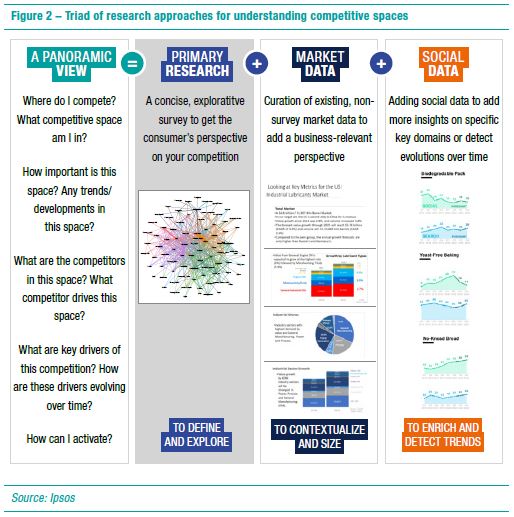
We have laid out the mental processes that underlie consumers’ decisions – people first self-generate options, and then choose from among those options. This is the only way consumers can make decisions when the number of options exceeds our mental capacity and when our motivation to think through all the options is not there. A critical missing piece in current research is the examination and understanding of the self-generation stage. A better understanding of this stage can provide marketers with a broader view of who they compete with, an understanding of the relative salience of categories versus brands, and the determination of where branding opportunities are. Once the competitive space has been defined, there are two additional sources of information that can be used to build upon that foundation: locally available market data and social listening data (see Figure 2). Extending from the beverage example, local market data sources such as Statista, Euromonitor or IBISWorld can be used to size the seven clusters. Social listening queries based on each cluster associations would allow us to detect trends over time. Combined with an enhanced understanding of the competitive space, this information aids marketers to make strategic decisions.
Central to market research is understanding how consumers make product choices. Much of the effort in this area has been directed towards understanding the brand/product features that drive consumers’ choices. The presumption is that if we develop brands/products with features that drive choice, consumers will be attracted towards them. But here’s the thing; if a product is not in consumers’ self-generated consideration set, then its product features don’t matter at all. All is not lost if you do not show up in consumers’ self-generated set. Advertising can effectively improve the mental salience of products, or alternatively, marketers can leverage point of sale/packaging to make one’s product more visually salient and increase the chance of being added to consumers self-generated sets. The first step, however, is to ensure we have a way to capture a panoramic view of the options available to consumers. It’s time to escape the design limitations of the four walls of the past.

![[WEBINAR] TOAST 2026: Under Pressure - Fewer Fragmented Fought-For](/sites/default/files/styles/list_item_image/public/ct/event/2026-07/thumbnail-templates_1.png?itok=zNnzsWzQ)