Navigating the changing dynamic of e-commerce and DTC relationships
While the recent increase in adoption of e-commerce is encouraging, consumers’ positive sentiments and behavior towards online merchants present challenges for brands. On the one hand, digital-native brands need to grow in a sustainable and exponential fashion. On the other, legacy brands need to harness the power of DTC and e-commerce to foster a personal and seamless relationship with their customers. Download our paper with a detailed exploration of the challenges and opportunities this digital transformation presents for all types of brands.
The insights shared underscore how implementing a digital-first brand strategy will enable you to reach new audiences, foster a personal relationship with customers and drive short-term sales and long-term brand equity. Here are three questions to help you get started immediately on evolving your current brand strategy to harness these opportunities:
- What is my primary objective for the brand? For example, increase awareness and favorability, conversion, harmonization of my strategy and message across channels.
- What data and tools do I already have at my disposal? When considering data, one must think not only about volume, but also about how up-to-date and accurate this data is.
- What defines success and in what period? No brand becomes a market leader overnight. Brand managers need to deliver results in months, not years. What are the key milestones for success over the next 3, 6, 9, 12 months?
KEY FINDINGS:
- Many DTCs/e-commerce brands are struggling to retain subscribers.
- Digital-native brands increasingly lean on brick-and-mortar stores to reach large audiences and achieve sales volumes that only traditional retailers can offer.
- That said, behemoths like Unilever and P&G have a lot to learn from digital-native brands whose business model fosters a one-on-one relationship with their customers.
Introduction
The global pandemic has accelerated the consumer shift to online shopping. In the U.S., e-commerce penetration increased as much in the first half of 2020 than it did over the last decade. In Europe, the COVID-19 crisis has raised overall digital adoption from 81 to 95%.In the meantime, the upcoming demise of the third-party cookie and stringent legal regulations (GDPR, CCPA) force brands to double down on their efforts to collect, analyze and monetize first-party data.
These changing consumer behaviors and new legal restrictions prompt brands to accelerate their digital transformation and deliver a seamless omnichannel shopping experience.
This new market environment changes the dynamic between big legacy brands, digital-native brands, traditional retailers and e-commerce platforms. Indeed, it is 1,000 times cheaper to launch a tech startup today than 20 years ago,and the likes of Shopify and Facebook enable even the smallest brands to open and advertise a storefront in a few clicks.
This paper maps out the changing dynamic for e-commerce and direct-to-consumer relationships and shows a way forward to build and grow ecommerce brands.
Consumers increasingly favor DTC and e-commerce
A recent Ipsos study shows that about a third of consumers primarily shop online. At the current growth rate, online sales will overtake brick-and mortar retail sales by 2024.
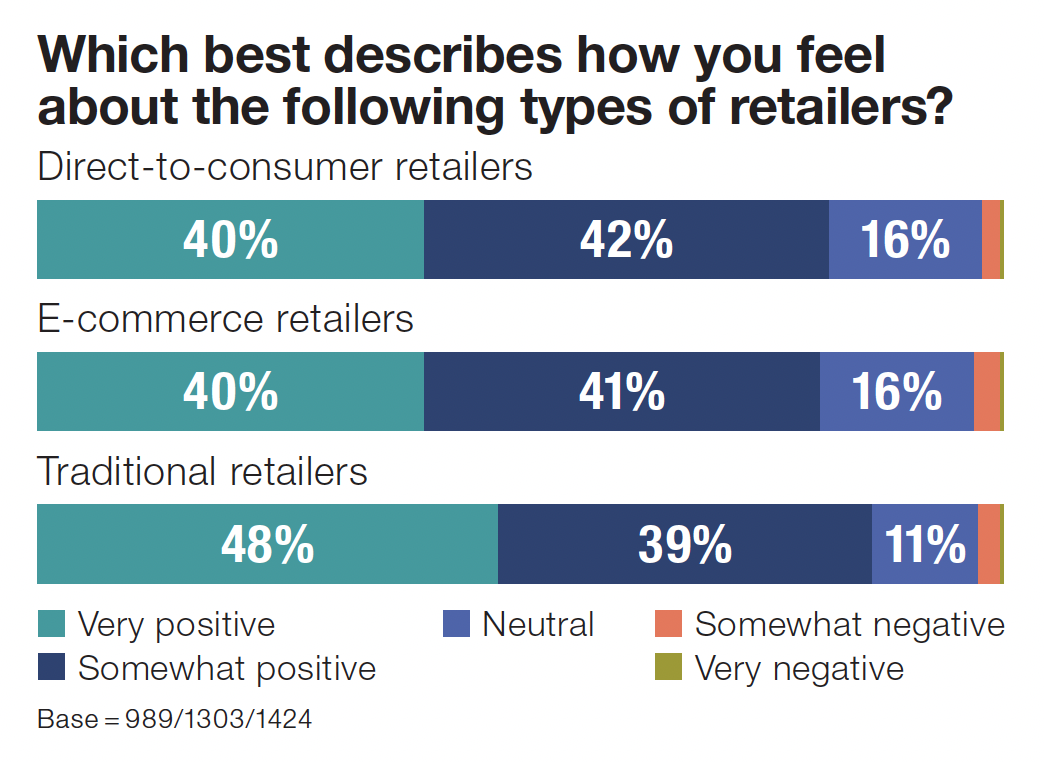
Overall, consumers trust and rely on DTC and e-commerce throughout their purchase journey. An Ipsos Fast Facts study on U.S. consumers’ online and offline shopping habits reveals that consumers’ positive sentiments towards DTC and e-commerce retailers are on par with traditional stores.
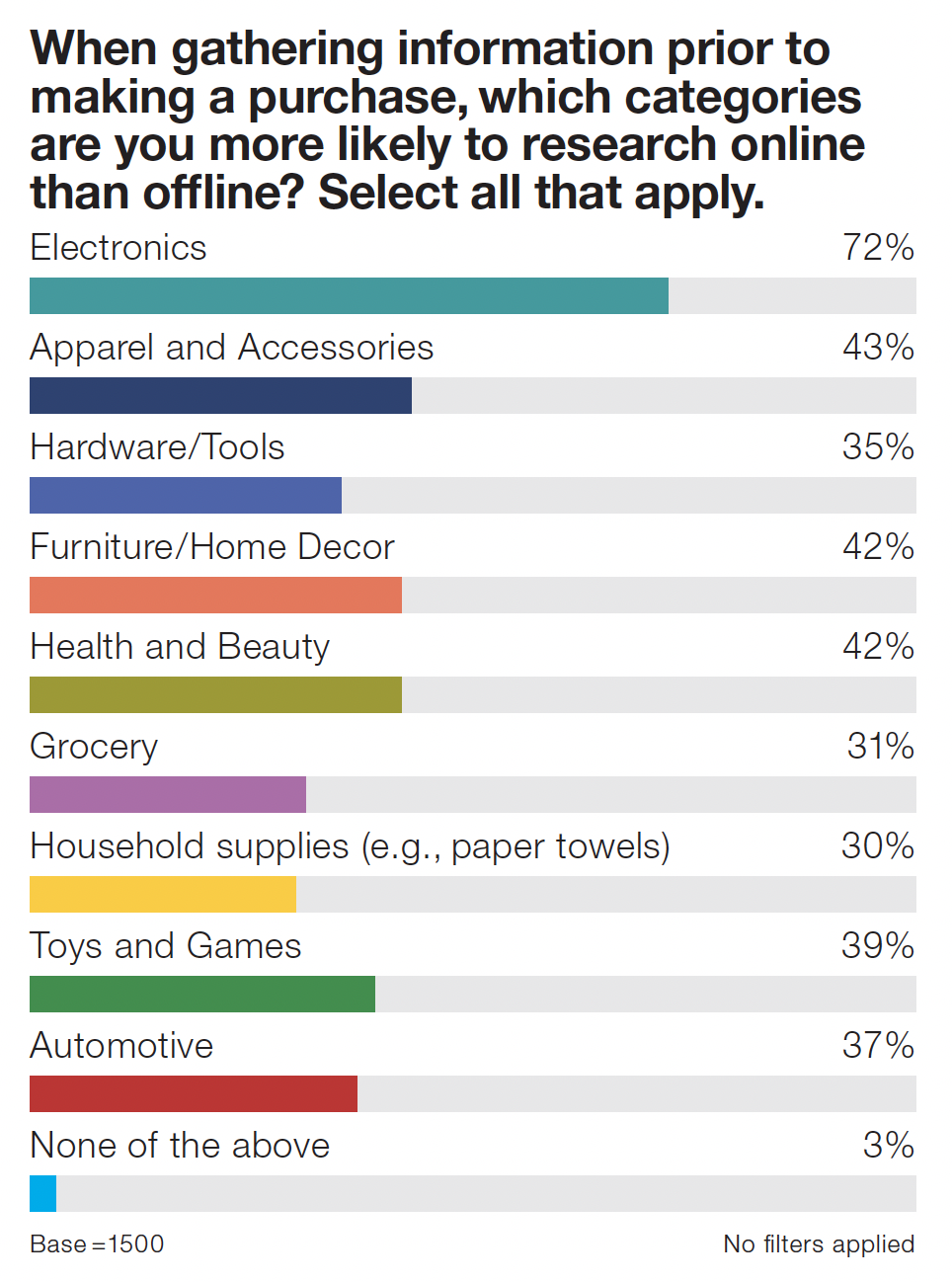
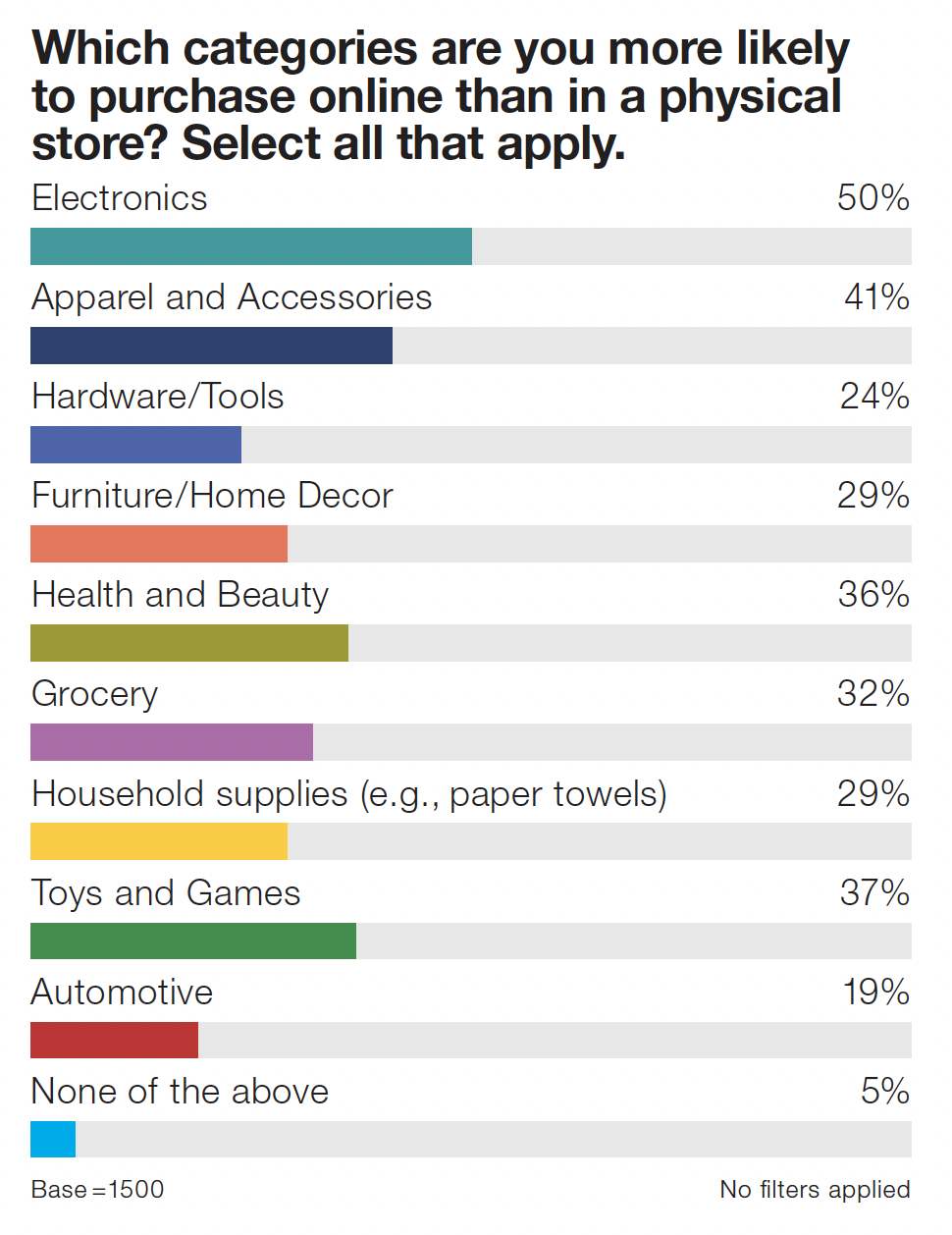
Further, people increasingly rely on online merchants to research and purchase an ever-wider range of products. Noticeably, shoppers now turn to e-commerce for furnishing, groceries and automotive, among the categories that until recently, were the exclusivity of brick-and-mortar retailers.
While encouraging, consumers’ positive sentiments and behavior towards online merchants present challenges for brands. On the one hand, digital-native brands need to grow in a sustainable and exponential fashion. On the other, legacy brands need to harness the power of DTC and e-commerce to foster a personal and seamless relationship with their customers. The subsequent sections of this paper will zoom in on the challenges and opportunities this digital trans-formation presents for all types of brands.
Many direct-to-consumer Brands swirl in a sea of sameness
Since the creation of Warby Parker (eyewear) in 2010 and Dollar Shave Club (razors and grooming products) in 2011, over 400 Direct To Consumer (DTC) brands have launchedmostly in clothing and apparel (Bonobos, Untuck), through pet care (Bark Box, The Farmers Dog), home and furnishing (Casper, Parachute), and even wealth management (Robinhood, Lemonade).
The original recipe for success seemed simple enough: a limited assortment of products focused on one narrow category available at a better price, as DTC brands bypass the wholesale and retail middlemen.
Ten years on, building and growing a digital-first brand proves to be as challenging as with any other brand.
First, DTC brands struggle to differentiate. While DTC brands often claim to be disruptive and challengers in their respective arenas, their identity and tone of voice are often similar. Most of these brands adopt the same colors, typography, and Instagram-worthy photography that attract Millennials. The same goes for their brand promise of “cutting out the middleman” (Brooklinen, Mejuri, Brilliant), positioning themselves as “underdogs” (Oscar, Monica + Andy) and being “different” from all other companies (Burrow, Harrys, Solé).
Further, funneling traffic to a merchant website proves to be expensive and cumbersome. Therefore, DTC increasingly relies on dedicated marketplaces like The Fascination to offset the cost of digital advertising. On these portals, visitors can discover and eventually shop at hundreds of digitally native brands like Allbirds, Untuckit and S’well in one place. These brands are relegated to entrusting a third-party to drive traffic, which contradicts their claim to dis-intermediate retail.
Establishing mutually beneficial relationships
As online shopping becomes more competitive, the cost of digital advertising has soared, resulting in a steep increase in customer acquisition costs. Most digital-first brands only appeal to narrow online audiences. Aware that brick-and-mortar retail still accounts for about 85% of the U.S. retail market,digital-first brands turn to traditional retailers to reach mass audiences and drive greater sales volume.
That’s how brands like Caraway Home partnered with Crate & Barrel when online growth plateaued. Other brands like Harry’s (shaving products), Quip (oral care) and Native (personal care) now sell their products at Target.
Even Netflix, which boasts 200 million subscribers, is looking for ways to cultivate revenue growth beyond its subscriber business. Facing competitions from rivals such as Disney, Netflix needs to build its retail presence, starting with a digital storefront on Walmart’s website to sell merchandise for its blockbuster shows like “Squid Game” and “The Crown."
Traditional brands shift to a DTC model
If DTC has allowed for the rapid growth of new brands, it also presents existing brands with opportunities for expansion. In 2010, DTC accounted for only 15% of Nike’s total revenue. By 2021, the athletics brand has grown its DTC business to $44.5 billion, or 40% of its revenue.
Moving forward, Nike plans on stepping farther back from wholesalers to focus on its own stores and digital channels.8 The same goes for Adidas, which plans to reach a 50% DTC business by 2025, hoping this channel will drive 80% or more of the company’s net sales growth.Counter-intuitively, DTC sales come with lower margins before taxes than wholesale sales, and DTC sales volumes tend to be a lot lower.10 But DTC sales are growing much faster than wholesale and enable brands to fully control marketing and customer experience while accumulating data about their customers. To make sense of this data, brands will increasingly invest in artificial intelligence and analytical capabilities. As such, Nike has recently acquired three data analytics companies: Celect (predictive analytics), Zodiac (demand sensing) and Datalogue (machine learning).
These capabilities allow Nike to anticipate demand and in turn redistribute products, personalize recommendations, and use push marketing to manage lifetime value. It also leverages sentiment analysis to create new products and services, such as Nike Training Club.
Tactical metrics
The average CMO tenure as of 2020 is only 40 months, the lowest since 2009. The median tenure for the same function is 25.5 months, down from 30 months in 2019. Beyond the C-suite, the tenure of marketers at all levels keeps shrinking. And the post-pandemic booming employment market has led to a phenomenon coined “The Great Resignation,” where workers and executives are resigning in droves for better opportunities.
Marketers at all levels often set goals for quarterly or even monthly objectives and are keen to make a quick impact to tout their achievements with prospective employers. They prioritize short-term marketing tactics that drive clicks and purchases at the expense of long-term brand building efforts.
However, e-commerce brands will have to follow most of the rules of brand strategy to deliver sustainable growth and margin. Brands will still need to build a consistent identity and set of associations to make themselves easily recognizable and become an automatic choice, especially as DTC channels become more saturated. The failure of e-commerce company Brandless, which promised to focus on products and abandon branding, shows that consumers favor trusted brands to unbranded, functional products.
Opportunities for marketers
DTC presents lots of short-term opportunities for brands to access niche audiences that do not shop primarily at brick-and-mortar stores and fulfill consumer expectations for a more personal relationship and seamless shopping experience. Meanwhile, companies selling their products through e-commerce channel must invest in long-term brand strategy as consumers’ habits are yet to solidify.
To super-charge their growth both on and offline, brands must both leverage the new opportunities that DTC affords while delivering a consistent brand identity and experience. The 5 pillars of digital-first brand building framework outline the best practices brand managers should follow to unlock this growth.
The 5 pillars of digital-first brand building framework
1st party data collection
The exponential advantage of digital-native brands over traditional companies is the first-party data they own on their users. This data enables these brands to own the entire consumer journey, from awareness through sales and retention. As data privacy regulations are becoming more stringent and third-party cookies are being phased-out, first-party data will become increasingly valuable to uncover trends, develop new products and measure marketing performance.
Ipsos creates and manages consumer communities that enable brands accessing on-tap audiences through video interviews, live chats, discussion boards, blogs, diaries and surveys. Through these communities, Ipsos fosters a social and collaborative customer-brand experience that yields authentic discovery and insights.
Spotlight on data shared vs. data collected
Despite their growing concerns and desire for clarity, consumers are becoming increasingly comfortable with sharing their data. Indeed, nearly half of online users will happily give their information away in return for personalized services and products—a 7% rise since 2013.Millennials and Gen Z are even more inclined than other age cohorts (over 50%) to share their data with tech brands, as they are more exposed to the benefits through curated Spotify playlists and TikTok’s algorithmically produced “For You” videos, along with similar offering on other platforms.
Combine, analyze and monetize disparate data sets
Marketers that adopt a digital-first strategy can both grow brand awareness, preferences and the desired set of associations, while driving sales and other tactical outcomes. That is, sales performance no longer comes at the expense of brand equity, and vice versa.
To deliver on this promise, Ipsos’ data engineers combine disparate data sets that include but are not limited to customer sales data, surveys, advertising exposure and engagement measures, social media, search data, as well as context macro-economic and societal data.
Next, Ipsos’ data scientists leverage Natural Language Processing (NLP), Natural Language Understanding (NLU) and apply artificial intelligence to model time-series data. The aim is to sort the signal from the noise, infer connections between these different data sources, find the short-term signals of long-term brand growth and predict, measure and optimize marketing performance and long-term brand growth.
Market at the moment of need
Based on these dynamic and scalable models, and intuitive reporting tools, marketers can target specific audience segments based on their demographics, psychographics and past-purchase history. Designing audiences based on:
- Life stages and moments of needs
- Behavioral surrogates for category needs and motivations
- Past category and brand interest
- Sequencing the consumer journey
Then, when in-flight marketers have new campaign indicators, that allows them to optimize marketing activity against brand outcomes, as well as the standard short-term performance indicators.
Big idea and creative tone
As previously discussed, digital-native brands often struggle to differentiate as they default to using similar colors, fonts, promises and tone of voice. On the other hand, legacy brands often struggle to create and convey a message that resonates with consumers across both DTC and wholesale channels. Ipsos helps brands develop their Big Idea, along with differentiated creative concepts and specific marketing communications that are consistent and complimentary across channels.
Getting started: 3 questions to ask over coffee
Implementing a digital-first brand strategy enables marketers to reach new audiences, fosters a personal relationship with customers and drives short-term sales and long-term brand equity. Below are three questions to help you get started immediately on evolving your current brand strategy to harness these opportunities. You are welcome to reach out to Ipsos to workshop ideas and solutions that are specific to your brand.
- What is my primary objective for the brand?
-
For example, increase awareness and favorability, conversion, harmonization of my strategy and message across channels.
-
-
What data and tools do I already have at my disposal?
-
When considering data, one must think not only about volume, but also about how up-to-date and accurate this data is.
-
-
What defines success and in what period?
- No brand becomes a market leader overnight. Brand managers need to deliver results in months, not years. What are the key milestones for success over the next 3, 6, 9, 12 months?