

2026 Expectations: How Asia Pacific Looks Ahead
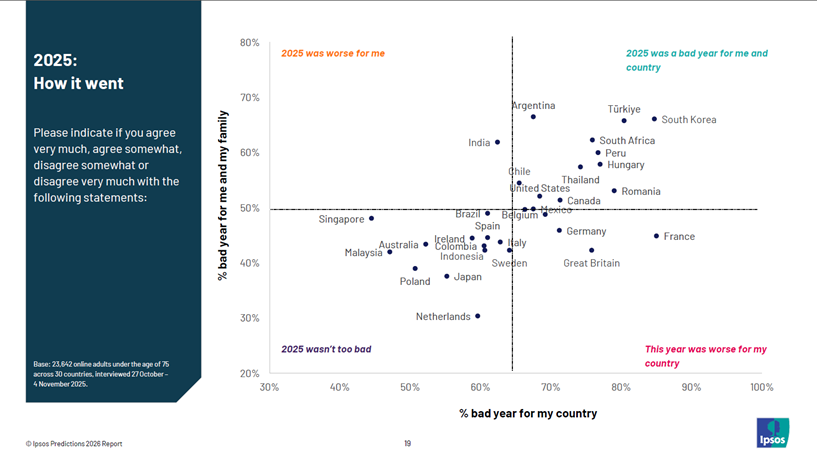
The Ipsos 2026 Predictions Survey, conducted across 30 countries, explores how people perceive the year ahead. Global expectations set the context for 2026. People are more likely to say 2025 was a bad year for their country than their household (66% country vs 50% household). At the same time, 71% globally are optimistic that 2026 will be better. This provides a benchmark against which APEC sentiment can be read.
Optimism for 2026
Global optimism stands at 71%. Indonesia at 90%, Thailand at 86%, India at 85% and Malaysia at 82% sit well above this level. However, Singapore at 67%, Australia at 66% and South Korea at 65% fall below the global average, despite South Korea recording a nine-point increase from 2024 (meaning an in improvement in expectation sentiment from the year before). Japan remains the lowest in the region at 44% though it rises six points. These shifts highlight where confidence is consolidating and where caution persists.
Long-term future sentiment for 2026
Globally, 52% believe people in their country will feel more optimistic about the long-term future in 2026. Indonesia at 84% and India at 81% continue to lead, while Malaysia at 77% and Thailand at 70% remain above the global average. Singapore at 53% and Australia at 49% sit closer to the midpoint. South Korea records the largest increase at 16 points to reach 50%, while Japan remains lowest at 28% despite a 10-point lift.
AI job impact expected in 2026
Concern about job loss from AI in Asia Pacific aligns with global average of 67%. Singapore and Indonesia register the highest levels at 76%, followed by Malaysia and Australia at 72%. Expectations of AI-driven job creation vary more sharply. Thailand leads at 74%. These results indicate where labor markets expect disruption.
Expectations of AI-driven job creation reference a different benchmark, with 43% agreeing globally. Thailand leads the region at 74%, followed by Indonesia at 68% and Malaysia at 67%. Japan at 38% and South Korea at 37% fall well below the global average for job creation expectations. These patterns reflect differing assessments of AI’s potential benefits across labor markets.
Disposal income expectations for 2026
The global average for expecting higher disposable income in 2026 is 47%. Indonesia at 80% and Malaysia at 70% hold the strongest expectations, followed by Thailand at 65% and India at 57%. Singapore at 50% aligns with the global midpoint. South Korea at 44% and Australia at 43% sit below the global average, while Japan at 31% remains lowest. These expectations indicate where consumer activity may stabilize or strengthen in 2026.
Extreme weather expectations for 2026
Globally, 69% expect more extreme weather events in 2026. APEC markets sit above or in line with this benchmark, including Indonesia at 86%, Singapore at 80% and Thailand and South Korea at 73%. Australia at 71% and Malaysia and Japan at 69 % indicate sustained expectations of climate-related disruption in the coming year.
Regional context for 2026
These expectations take shape as the US recalibrates its global role and tariff policies influence trade flows, supply chain planning and competitiveness across Asia. Together, these dynamics outline the conditions under which governments, businesses and households will navigate 2026.
Understanding Asia
 Gillian GuerinRegional Director, Marcom APAC


