What Worries Thailand? June 2026
The latest data from Ipsos' monthly What Worries the World? survey reveals Thailand as a nation balancing cautious optimism with persistent concerns. While consumers are becoming more comfortable making purchases—particularly everyday household spending—confidence in the broader economy remains subdued. Corruption continues to dominate public concerns, inflation is back on the rise, and opinions on the country's direction remain evenly divided.
Corruption remains Thailand's biggest concern
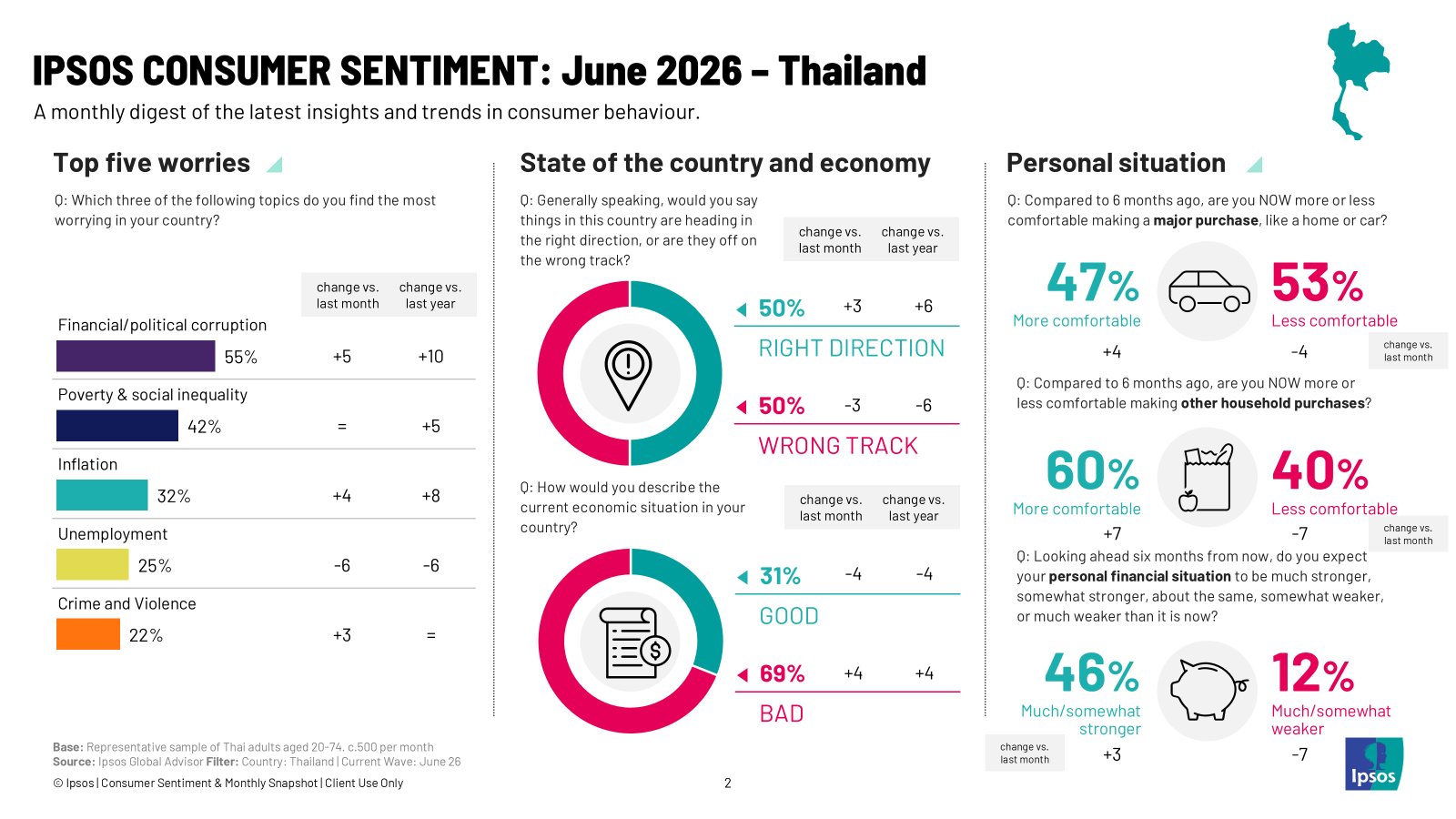
Financial and political corruption continues to be the issue weighing most heavily on Thai consumers. More than half of Thais (55%) now identify it as one of the country's top concerns, increasing 5 percentage points from last month and 10 points compared with a year ago.
The continued rise suggests that trust, transparency and governance remain front of mind for many consumers amid an active political environment and ongoing public scrutiny of government policies and institutions. While economic issues fluctuate with market conditions, concerns around corruption have shown remarkable resilience, reinforcing that institutional trust remains fundamental to public confidence.
Inflation returns as a growing concern
Inflation has climbed back into the top three worries, with 32% of Thais citing it as a major concern, up 4 points month-on-month and 8 points year-on-year.
The increase reflects renewed pressure on household budgets as higher global energy prices and cost-of-living pressures feed through to consumer prices. Although Thailand's economic outlook has recently improved modestly, inflation is expected to remain elevated in the near term, keeping affordability front of mind for many households.
Meanwhile, poverty and social inequality remain the second-largest concern at 42%, highlighting that many households continue to feel uneven benefits from the economic recovery.
Thailand remains split on the country's direction
Public opinion on where Thailand is heading remains perfectly balanced. Exactly 50% of Thais believe the country is moving in the right direction, while the other 50% believe it is on the wrong track.
Compared with last month, optimism has edged up slightly (+3 points), suggesting some improvement in public sentiment. However, the even split illustrates that confidence remains fragile, with consumers weighing encouraging developments against continuing economic and political uncertainty.
Economic confidence remains weak
Despite the balanced outlook on the country's direction, perceptions of the economy itself remain overwhelmingly negative. Nearly 7 in 10 Thais (69%) describe the current economic situation as bad, an increase of 4 percentage points from last month. Only 31% believe the economy is in good shape.
This disconnect suggests that while some consumers acknowledge signs of progress, many have yet to feel meaningful improvements in their day-to-day financial reality. High household debt, uneven income growth and continued cost pressures continue to shape perceptions, even as policymakers introduce measures to support consumption and stimulate growth.
Consumers are feeling more comfortable spending
One of the brighter findings this month is the improvement in consumers' willingness to spend. Compared with six months ago:
- 60% say they are now more comfortable making everyday household purchases, up 7 points from last month.
- 47% are more comfortable making major purchases, such as homes or cars, increasing by 4 points.
- 46% expect their personal financial situation to become stronger over the next six months.
The stronger confidence in everyday spending may partly reflect the impact of the government's Thai Help Thai Plus stimulus programme, which subsidises spending on essential goods and services between June and September 2026.
However, consumers appear considerably more cautious when it comes to larger discretionary purchases, suggesting that while short-term spending has improved, long-term financial confidence has yet to fully recover.
Looking ahead
June's findings paint a picture of cautious resilience. Thai consumers are demonstrating greater willingness to spend on daily necessities, supported by policy measures and improving personal financial sentiment. Yet these positive signals coexist with persistent concerns about corruption, inflation and the broader economy.