
Economic attitudes | Consumer behavior
Consumer Confidence Increases Following Stability Last Month
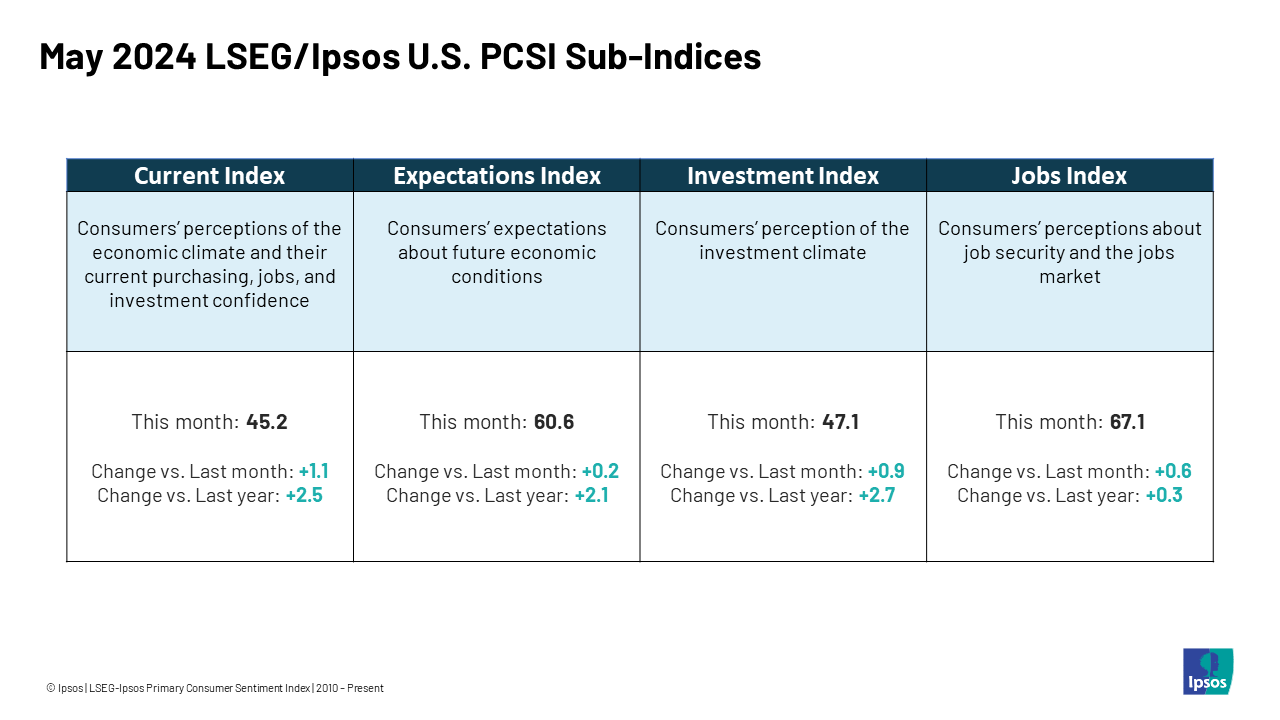
The LSEG/Ipsos Primary Consumer Sentiment Index for May 2024 is at 54.3. Fielded from April 19 - May 3, 2024, the Index is up 0.9 point.
The index increases slightly following relative stability last month. It now sits nearly two points above its reading from this time last year (52.5).

Navigating DEI during a period of high polarization
Diversity, Equity, and Inclusion (DEI) and Environmental, Societal, and Governance (ESG) are tricky subjects for most companies. Political polarization seems to seep into topics that might not seem political. For companies aiming to boost their DEI and ESG profiles, how should they navigate these waters? Long-term public opinion trends show that America has become far more tolerant on a wide range of social issues, even over the last few decades. Even so, DEI and ESG still remain dirty words for many Americans. Here are five charts on how Americans have become more tolerant, but polarized and how brands can navigate these waters.
Store brands hold slight edge over name brands
A new Ipsos poll also finds that younger Americans are more likely to use food delivery apps compared to older Americans. Americans are slightly more likely to say they bought store brand products over name brand products in the past week, according to the poll, which was conducted on Ipsos’ KnowledgePanel Omnibus. Click here to read more.
Where Americans stand on generative AI
Since ChatGPT’s initial release in late 2022, the impact of generative AI models has fallen somewhere between completely fizzling out and radically changing the world. It saw an extremely rapid uptake, but in the time that’s followed, some of the most optimistic (and most dire) predictions surrounding AI don’t seem to be materializing. Here are five charts on the state of generative AI models and how the public feels when it comes to AI regulation.
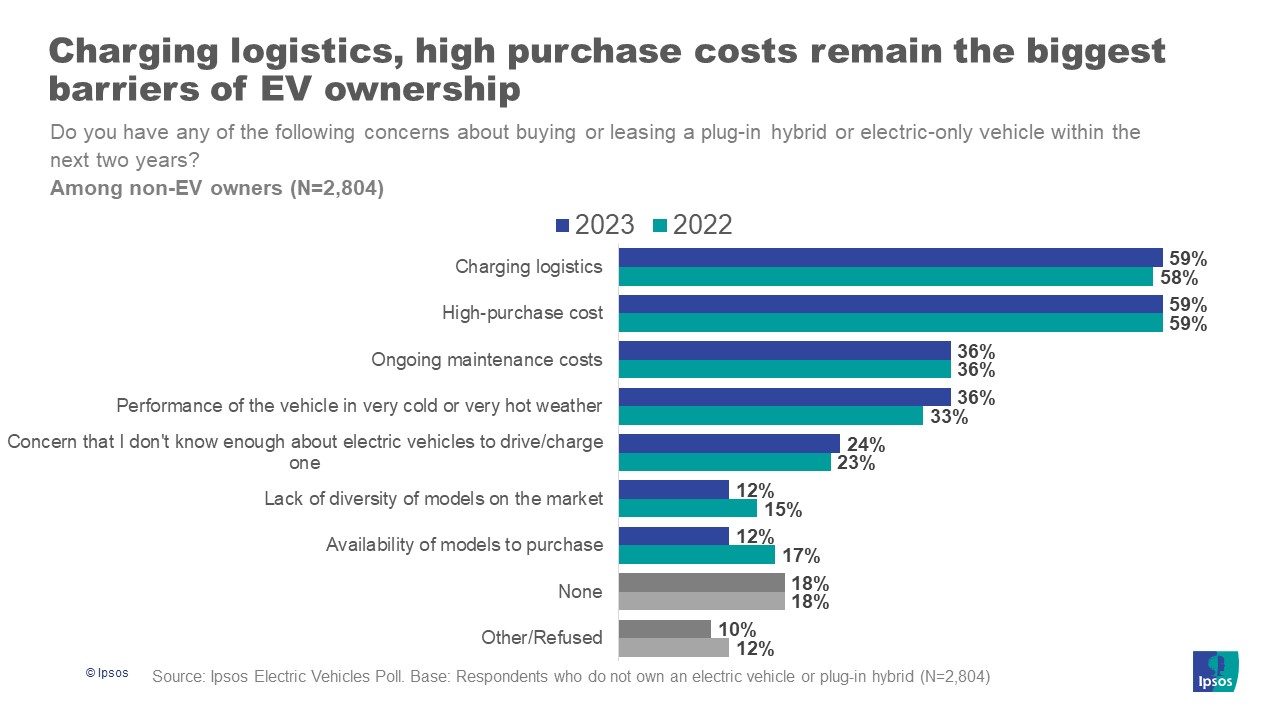
High-purchase cost and convenience of charging logistics remains barriers to owning an EV for Americans
Ipsos polling finds that American attitudes and experiences with Electric Vehicles (EVs) remain largely the same from 2022. Cost and convenience remain pressing concerns for American consumers who don’t own an EV, with majorities citing each as a barrier to owning an EV.
Why are Americans still so pessimistic about the economy?
Five charts on the economy, how Americans feel, and what a lagging economy might mean come November.

Three in four Americans are hopeful their financial situation will improve in the next year
The latest wave of the Ipsos Consumer Tracker 75% of Americans are at least somewhat hopeful that their personal financial situation will improve, including two in five who are very hopeful. These readings are in line with numbers from April 2023. While a majority across all demographics are hopeful, those living in urban areas are more likely than those in suburban and rural areas to share this sentiment.
In the same vein, 58% of Americans are hopeful that the U.S. will avoid a recession, up 8 percentage points from April 2023. A similar percentage are hopeful that inflation rates will decline. Comparatively, Americans are less likely to report that they are hopeful that the use of AI will expand in positive ways or that political polarization in the U.S. will lessen.