
Political parties face an uphill battle winning over South Africa’s youngest voters
Young South Africans have attracted significant attention in the run-up to the 2026 Local Government Elections (LGE2026), with considerable focus on youth voter registrations and participation. However, new findings from Ipsos’ latest Khayabus “Pulse of the People” study suggest that many young South Africans remain unconvinced that using their democratic rights to vote can address the issues that matter most to them.
“Young South Africans appear to be sending a very clear message to political parties,” says Mari Harris, Political Analyst at Ipsos in South Africa. “Many do not feel represented, and many are sceptical of politicians. They say their main issue of youth unemployment does not get sufficient attention, and therefore registration levels remain lower than among older voters. Political parties often speak about the importance of the youth vote, but these findings suggest that younger South Africans still need convincing that democratic political participation can contribute to addressing the issues that matter most in their lives.”
Voter registration among young people remains low
Just over half (53%) of South Africans aged 18 to 24 confirmed that they are registered to vote. Registration among young South Africans remain considerably lower than among older age groups and continues to present a significant challenge for political parties seeking to engage younger citizens in the democratic process.
Levels of political interest are also lower among younger voters, reinforcing the challenge political parties face in mobilising youth participation. While 33% of older registered voters say they are interested in politics and elections, the corresponding figure among registered voters aged 18 to 24 is only 27%, suggesting that political disengagement among young South Africans begins long before election day.
Young voters are sceptical of politics and politicians
Half (50%) of registered young voters aged 18 to 24 say there is no political party that represents their views, matching the result recorded among the broader registered voter population. Young people are also particularly sceptical of political leaders, with seven in ten (70%) agreeing that politicians cannot be trusted.
“Many young South Africans are not necessarily withdrawing from politics because they do not care about issues affecting their communities. Rather, they appear to be struggling to identify a political home that reflects their interests and resonates with their priorities,” notes Harris, “We are not unique, as this opinion is the same as that expressed by many young people all over the world.”
Consistent with findings published earlier this week, trust in local governments remains limited among younger South Africans, with only 28% of registered voters aged 18 to 24 saying they are likely to trust their current local government, while more than half (54%) say they are unlikely to do so.
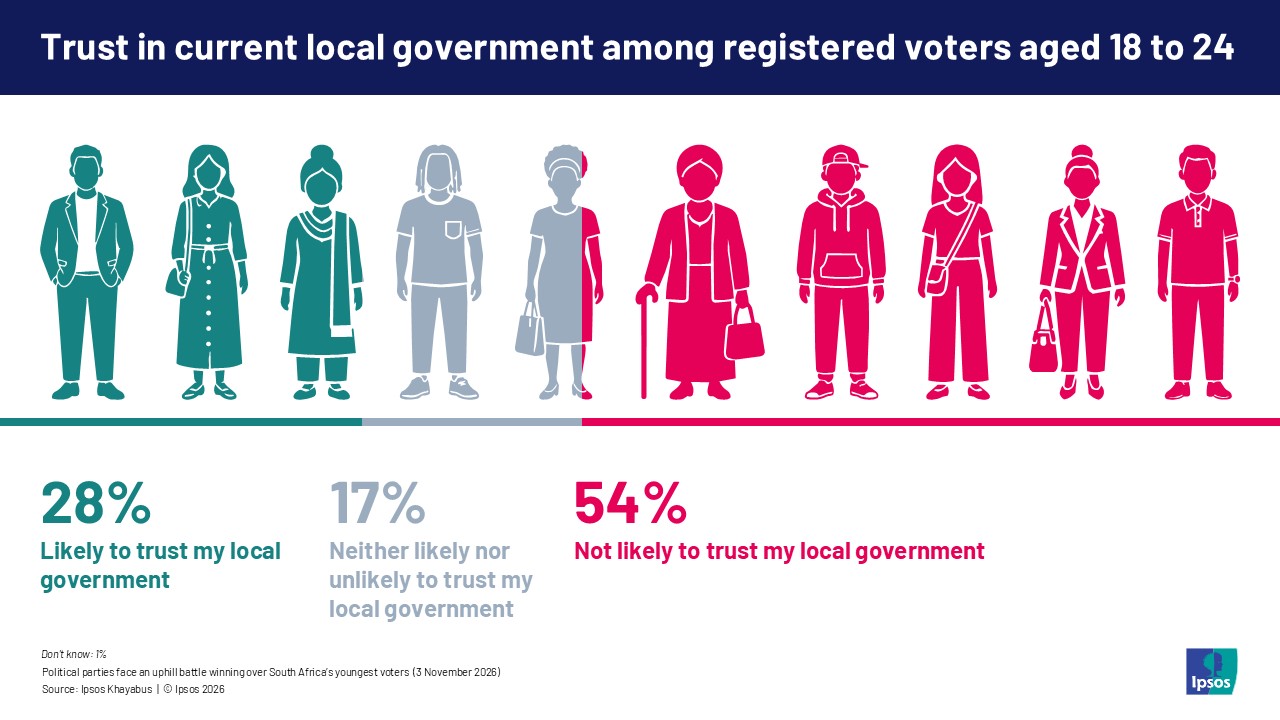
“For many young people, politics is experienced through the same realities that affect the broader South African population, like inconsistent service delivery, neglected infrastructure, inadequate public safety, and scarce economic opportunities,” says Harris. “When trust in local government is low and many feel unrepresented politically, it becomes more difficult to convince younger voters that participating in elections has the potential to make a meaningful difference.”
Political support among young voters is fragmented
Among registered voters aged 18 to 24, who expressed a party preference, no single political party commands strong support. The EFF and ANC are tied as the most supported parties among young voters at 17% each, followed by MK at 15% and the DA at 13%.
Notably, 17% of registered young people either indicated that they would not vote, declined to reveal their political preference or said they did not know which political party they would support, suggesting that choosing a political party remains a difficult decision for many younger voters.
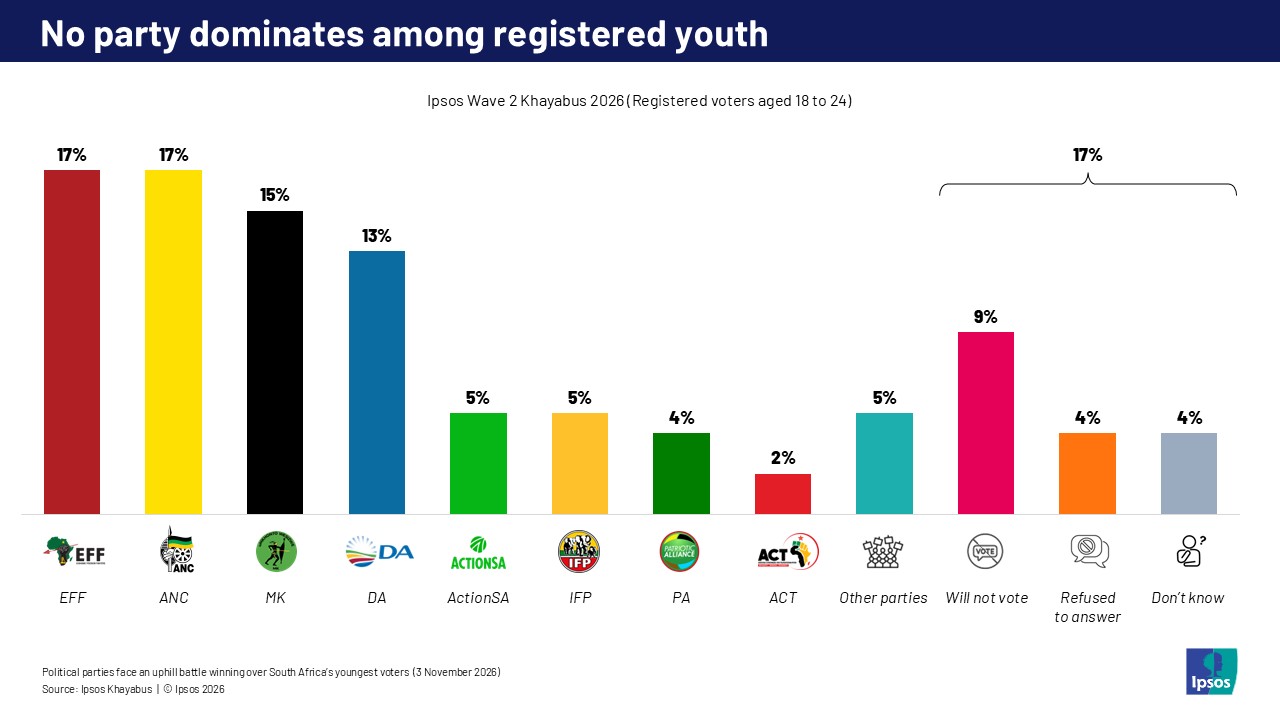
“Unlike older voter groups, where support is often concentrated among a smaller number of parties, young voters appear to be distributing their support across a broader range of political options,” says Harris. “This fragmented pattern reinforces the view that no single party has yet succeeded in establishing a dominant position among South Africa’s youth.”
The youth vote remains up for grabs
South Africa’s youngest voters remain one of the most contested and least predictable electoral groups. Registration levels are lower than among older South Africans, political interest remains comparatively muted, trust in political leaders is limited and many young voters do not feel represented by any political party.
“Political parties seeking to grow support among younger South Africans may need to do more than simply encourage voter turnout,” says Harris. “They will need to demonstrate why younger citizens should believe that participation in the democratic process can lead to meaningful change. This should not only get attention in an election year.”
“The story emerging from these results is not necessarily one of apathy,” concludes Harris. “Rather, it is one of scepticism. Many young South Africans appear unconvinced that political parties represent their interests or that elected leaders can deliver meaningful change. The political party that succeeds in addressing those concerns may ultimately be the one that wins greater support from the country’s youngest voters.”
About the study
Khayabus:
Interviews were conducted by trained Ipsos interviewers in the homes and home languages of respondents. Interviews were conducted from 12 September to 13 October 2026. A scientific process of multi-stage stratified random selection distributed interviews in all areas of the county, including deep rural areas. This methodology ensured that the results are representative of the views of the universe (adult South Africans) and that findings can be weighted and projected to the universe. All results were collated and analysed in an aggregate format to protect the identity and confidentiality of respondents. In data processing filters were applied to isolate the group of respondents who are registered to vote. All sample surveys are subject to a margin of error, determined by sample size, sampling methodology and response rate. The margin of error, dependent on sample size, response rate and sampling methodology, at a 95% confidence level and a response rate of 50% is a maximum of ±1.67% for the sample of registered voters as a whole.


