Breaking Old Habits
Ipsos studies point to heightened public concern about climate change and a broad consensus on the urgency of environmental issues. Our Global Trends survey, conducted across 30 countries, found ‘climate emergency’ (the word of the year in 2019) to be the strongest common value uniting people across the world. And our 2021 edition shows that this position has strengthened.
Only a quarter felt combatting Covid-19 eclipsed talking about protecting and restoring nature.
Ipsos / Global Commons Alliance report
Concern about climate change is apparent in a range of our public opinion surveys. It has now returned to pre-pandemic levels in our What Worries the World survey, and, despite the still-present health crisis, climate change risks once again come first in the ranking of the 2021 AXA Future Risks report. Another global study finds protecting the environment and natural resources is the issue that people most want to see addressed on the world stage.
So, we know that people want to see action to tackle the environmental emergency. But what does this mean in terms of concrete action, and how willing are they to make the necessary lifestyle changes?
We know that people accept that they have a part to play in climate action, with 72% agreeing that if ordinary people do not act now to combat climate change they will be failing future generations.
However, in September 2021, the proportion of people around the world saying they have modified their behaviour specifically out of concern about climate change is lower than it was in January 2020 (56% vs. 69%). This suggests that people have been focused on adapting their daily lives in ways that would keep them safe during the pandemic, rather than necessarily making more environmentally friendly choices.
At the same time, a majority in the US say that they feel better when they buy sustainably, and over four in 10 purchase brands specifically because of their sustainability practices. And this could be a growing trend as we find over one-third (35%) are more frequently choosing brands based on their sustainability credentials than before the pandemic.
But could this be higher if barriers were removed? We find that consumers say that fair trade, sustainable, and organic products are too expensive, hard to find, and the labels are too difficult to understand. It seems people would welcome further guidance to support them in making greener choices. And the public widely support further regulation when it comes to the environment.
72% agree that if ordinary people do not act now to combat climate change, they will be failing future generations.
Our study with the World Economic Forum finds there is strong agreement worldwide that products using natural resources in short supply should be labelled and taxed – even if this results in a cost to the buyer.
Below are the actions that people say that they now do more than they used to, due to climate change concern, according to our 29-country Global Advisor study.
As people look ahead to how they might modify their lives post-pandemic, reducing food waste, avoiding overpackaging, and cutting back on car journeys are among the changes people expect to do in the future to limit their environmental impact.
Our Global Trends survey in 2021 finds that a majority in all but one of the 25 countries surveyed are willing to travel much less in future to limit their climate impact. However, overall, we see minimal increases in public willingness to change specifically high carbon emission behaviours since 2014, which poses a problem. It points to a say-do gap – the dilemma that public concern is not followed up with action. But there are many factors at play that affect our decision-making (read more on what we can learn from a behavioural science perspective). One of them hinges on a sound understanding of what needs to be done, especially in the complicated area of environmental action.
The believe-true gap
Despite seven in 10 people around the world saying that they understand what they must do to play their part in tackling climate change, we find that this is not always the case. Various environmental misperceptions point to a knowledge gap.
Take the Perils of Perception Quiz
In general, we underestimate high-impact actions such as becoming vegetarian and taking fewer flights, and overestimate lower-impact actions such as avoiding excess packaging. While all these actions can make a difference, understanding their relative impact is also vital.
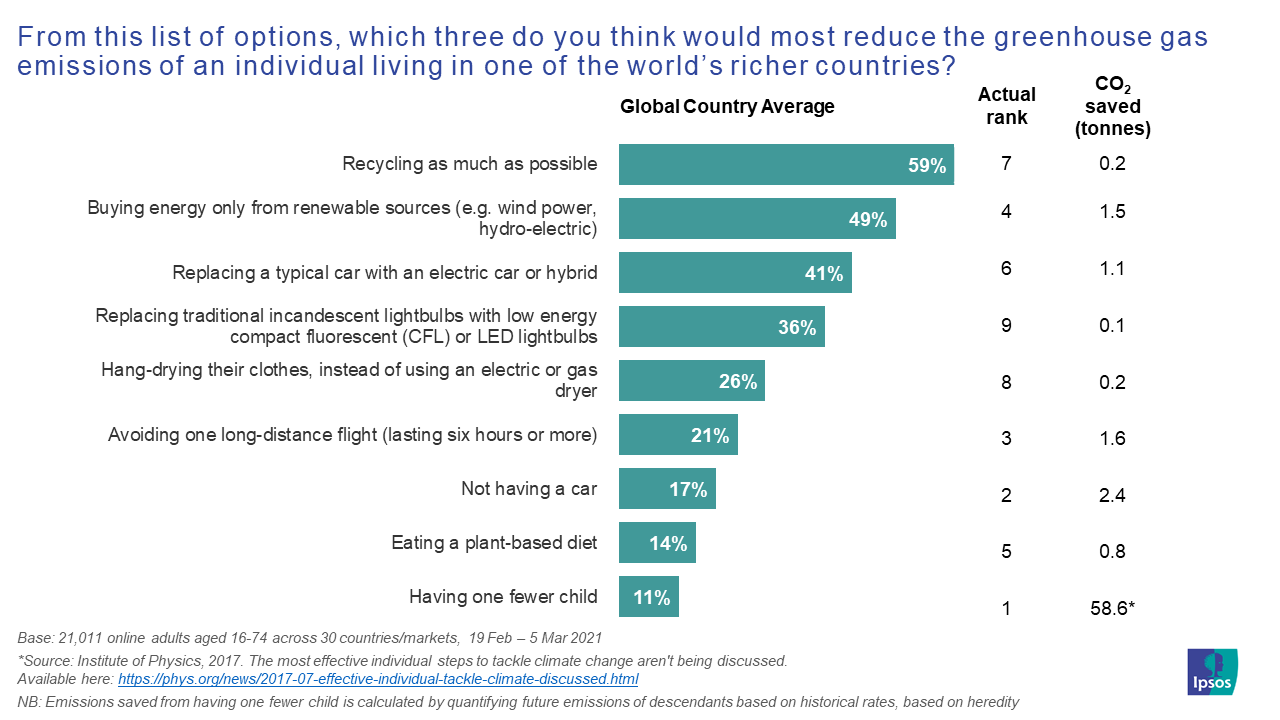
Beyond individual actions, very few recognise the scale of societal transformations needed to protect the planet. And only 4% of people around the world correctly say that each year over the past six years has been the hottest on record.
Read about how organisations can support individuals to live more sustainably.
Next article: Credible Corporations