
Addressing the Sustainability Say-Do Gap
 We know that people care about the environment and feel a sense of responsibility to live in a more sustainable way – Ipsos survey data shows this time and time again. For example, we recently found that 72% of individuals across 30 countries believe that they will be failing future generations if they do not take personal action to combat climate change.
At the same, we are seeing limited and stagnated behaviour change in real life. This represents a “say-do gap” when it comes to sustainability – the dilemma that reported concern about an issue is not always followed up with action.
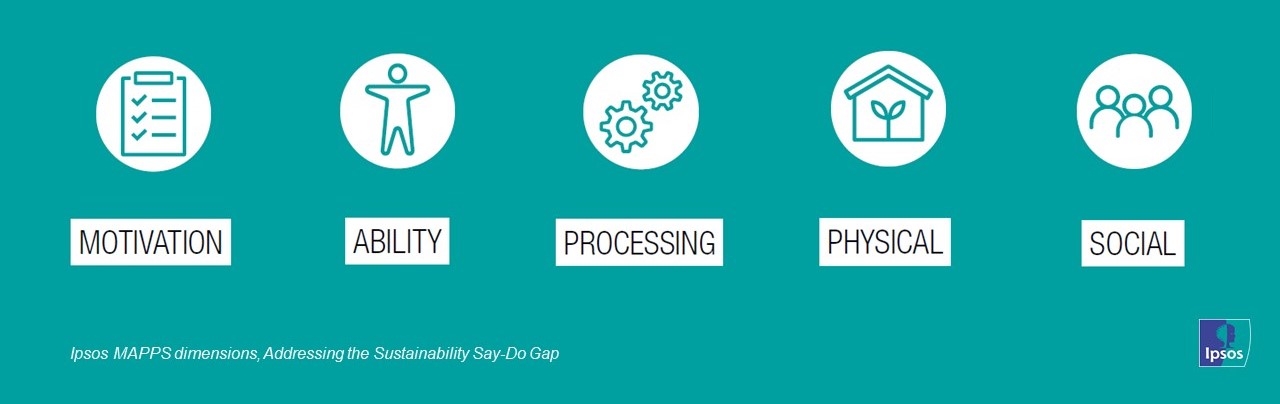
There are many factors to consider as we try to make sense of this. In this paper, we outline some of the key barriers to acting in more sustainable ways, such as recycling or making better product choices. These are grouped according to the key dimensions underpinning our behaviour; motivation, ability, processing, physical and social (according to our behavioural science framework MAPPS).
Crucially, action is not only up to the individual. People expect government and brands to take a leading role in tackling climate change and environmental issues. In this way, organisations should act on their duty to close this say-do (or believe-true) gap. We believe this involves gaining a deeper understanding of behaviour and encouraging people to take actions that they are already inclined to do.
Read more in: Addressing the Sustainability Say-Do Gap.
The author(s)
-
 Colin StrongGlobal Lead of Behavioural Science, UK
 -

![[WEBINAR] KEYS: Dialling Up the S In Sustainability](/sites/default/files/styles/list_item_image/public/ct/event/2026-06/keys-webinar-sustainability.webp?itok=xPunvoGu)
![[Webinar] Real-World Evidence: Empowering the Patient](/sites/default/files/styles/list_item_image/public/ct/event/2026-05/healthcare-real-world-evidence-webinar.jpg?itok=kT0PwLPQ)