
Borderless Brands: What will it take for Norwegian brands to win internationally?
We are surrounded by brands.
Look around you right now. Without moving from your seat, how many brands can you spot? Your phone. Your coffee. Your shoes. Your laptop. Your streaming service. Chances are, you can already count more than 20.
Brands shape almost every part of our daily lives. And yet, when asked why we love one brand over another, most of us struggle to explain it rationally. Something simply ‘feels right’.
What’s even more interesting is that consumers no longer think about brands within national borders. Our favourite brands are rarely only local. They are a mix of Norwegian, Nordic, and global brands competing for the same emotional space in our minds.
That reality creates both a challenge and an opportunity for Norwegian companies.
We recently asked 1,000 Norwegians a simple open-ended question: ‘What are your favourite brands?’. We deliberately avoided prompting respondents with a list of brands because we wanted to understand what naturally comes to mind.
The result? More than 800 unique brands were mentioned.
That tells us two things:
- Consumers live in an incredibly fragmented brand world.
- Norwegian brands are not just competing locally anymore – they are competing globally, even inside Norway.
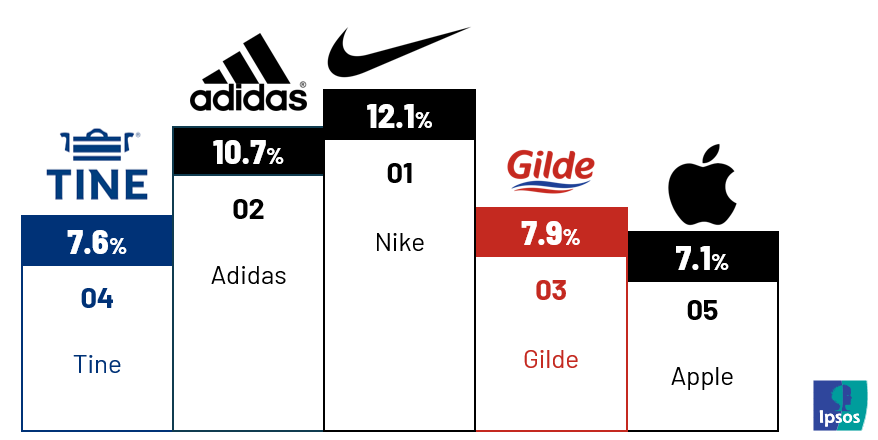
The most-mentioned favourite brands were Nike and Adidas, followed by local giants such as Gilde and Tine. The message is clear: consumers compare local and global brands side by side every day.
Chart 1: Top 5 favourite brands of Norwegians
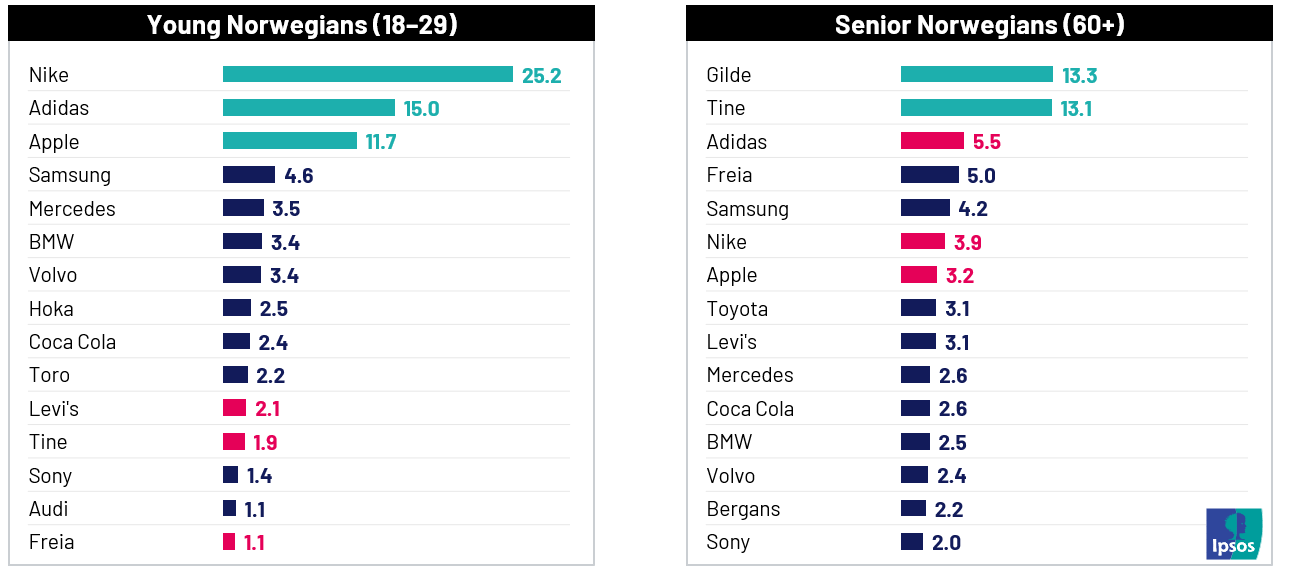
And among younger Norwegians, this trend is even stronger.
Younger consumers increasingly gravitate toward international brands like Nike, Adidas, and Apple, while older generations still show stronger emotional attachment to traditional Norwegian brands such as Tine and Gilde.
Chart 2: Top 15 favourite brands by age groups
This matters because today’s younger consumers are tomorrow’s mass market.
In other words, competition from international brands will only intensify in the years ahead, accelerated by social media and digital culture. But for Norwegian brands with international ambitions, this is also the perfect moment to think bigger and build relevance far beyond Norway’s borders.
Yet global success is not only about visibility. It is about understanding why consumers choose one brand over another in the first place. And while those decisions are often more emotional than rational, brand love alone is not enough to secure long-term success.
One of the most fascinating findings from our study is that people’s favourite brands are usually brands they actively experience in everyday life — brands they wear, use, consume, or interact with regularly. Over time, these brands become extensions of identity, communicating lifestyle, values, aspirations, and belonging.
However, emotional connection is only one part of the equation.
At Ipsos, we see brand choice as a balance between emotional and functional factors. Sometimes consumers choose a brand because they genuinely love it. Other times, they choose it because it is familiar, convenient, or simply ‘good enough’ to meet their needs.
Tesla in Norway is a particularly interesting example of this dynamic.
Walk through Oslo and you will likely spot a Tesla within minutes. Norway remains one of Tesla’s strongest markets globally, and Tesla Model Y continues to dominate sales statistics. Yet when we asked consumers about their favourite brands, Tesla was mentioned surprisingly rarely — far less often than brands like Volvo, BMW, or Toyota.
This highlights an important distinction between usage and emotional preference.
Tesla’s success today is strongly supported by functional advantages such as convenience, ecosystem lock-in, habit, charging infrastructure, and technological leadership. In the short term, these factors can outweigh weaker emotional attachment. But in the long term, brands that fail to maintain emotional relevance risk becoming vulnerable as competition increases and consumers become more open to alternatives.
For brands with international ambitions, this is a critical lesson. The strongest brands are rarely built on emotion or functionality alone. They succeed because they combine emotional relevance with practical value — becoming not only admired, but also embedded in consumers’ everyday lives.
So how can Norwegian brands succeed internationally?
Norwegian brands already possess many strengths the world increasingly values: trust, quality, sustainability, innovation, authenticity, and strong design traditions.
But succeeding internationally requires more than exporting products. It requires exporting meaning.
Based on Ipsos’ global experience across 90+ markets and decades of studying brand growth, we see several recurring patterns among brands that successfully expand beyond their home markets.
1. Balance product marketing with brand building
When expanding internationally, many brands focus heavily on product performance, pricing, and distribution, while underestimating the emotional side of consumer choice. While functional superiority may drive short-term success, it is often not enough to build long-term preference and loyalty.
International growth therefore requires more than strong products — it requires strong brand building through storytelling, values, brand personality, and distinctiveness.
The strongest global brands succeed because they combine functional value with emotional connection, creating brands consumers not only use, but also identify with.
2. Use your heritage strategically
Adapting to local culture is important when expanding internationally, but brands should not lose what makes them uniquely Norwegian in the process. In crowded global markets, origin and heritage can become powerful differentiators.
Just as IKEA became a global ambassador for Swedish culture and design, Norwegian brands can strategically leverage associations such as trust, quality, nature, craftsmanship, and simplicity to create distinctiveness and authenticity in the minds of international consumers.
3. Consider going premium
Premium positioning is a powerful way to create differentiation in crowded categories. However, premium is not defined by price alone — it is about the perception and experience a brand creates.
Premium brands evoke a sense of exclusivity, expertise, aspiration, craftsmanship, quality, and emotional reward, which in many ways already aligns closely with what ‘Brand Norway’ stands for internationally. They signal that consumers are not just buying a product, but becoming part of something more meaningful.
When brands successfully combine strong functional performance with emotional resonance, consumers are often willing to pay more — not just for what the product does, but for what the brand represents.
4. Build around universal human needs
The strongest global brands tap into emotions and experiences that transcend borders — belonging, achievement, family, identity, confidence, connection, and joy.
These are universal human needs that exist in every country, regardless of culture or geography. Brands that manage to connect with these deeper motivations, while still staying culturally authentic and true to their origins, are often the ones that travel best internationally.
In other words, successful global brands do not abandon their identity — they anchor it in something that all people can relate to.
The opportunity for Norwegian brands
Norwegian brands do not need to become ‘less Norwegian’ to succeed globally. In many ways, the opposite may be true.
But they do need to think beyond the limits of a small domestic market and recognize a simple reality: they are already competing globally — whether they choose to or not.
The future will belong to brands that manage to combine local authenticity, global relevance, emotional connection, and functional excellence — often strengthened by a clear positioning that signals value, distinctiveness, and ambition in international markets.
The opportunity is clear. The question is no longer whether Norwegian brands can succeed internationally, but which ones will become the next Nike or Apple.
And perhaps an even more important question for brand owners, CEOs, and marketing leaders is this:
Are you building a brand for Norway, or for the world?
If this resonates — and you’d like to explore what it could mean for your brand — we’d be happy to continue the conversation.