Most of us are staying home to stop spread of COVID-19, shows latest poll

The countries with the biggest increase in self-isolation are Russia, Vietnam and Australia.

The majority of people in all except one of the 15 countries surveyed by Ipsos last week say they are self-isolating or quarantining at home to stop the spread of COVID-19.

In a survey of 28,000 people conducted from April 2 to 4, Japan is the only exception to this with just 15% of the respondents saying they are staying home to fight the coronavirus pandemic.

Countries in which at least four in five people now report they are self-isolating include Spain (95%), Vietnam (94%), France (90%), Brazil (89%), Mexico (88%), Russia (85%), the United States and India (84%). The peak for reported self-isolation was reached two weeks ago in about half the countries surveyed, and there has been little movement since.

However, respondents in a few countries have shown slight declines in self-isolation over the past week including China down 4 percentage points, India (-3), and Germany (-3). The country with the biggest increase in self-isolation is Russia (+23 points), followed by Vietnam (+16), Australia (+11), and Mexico (+8).

Overall, the data shows the strategy of self-isolation has become well-accepted by populations in most of the countries surveyed. Not only are governments implementing the measures, but their citizens are mostly complying and staying home.
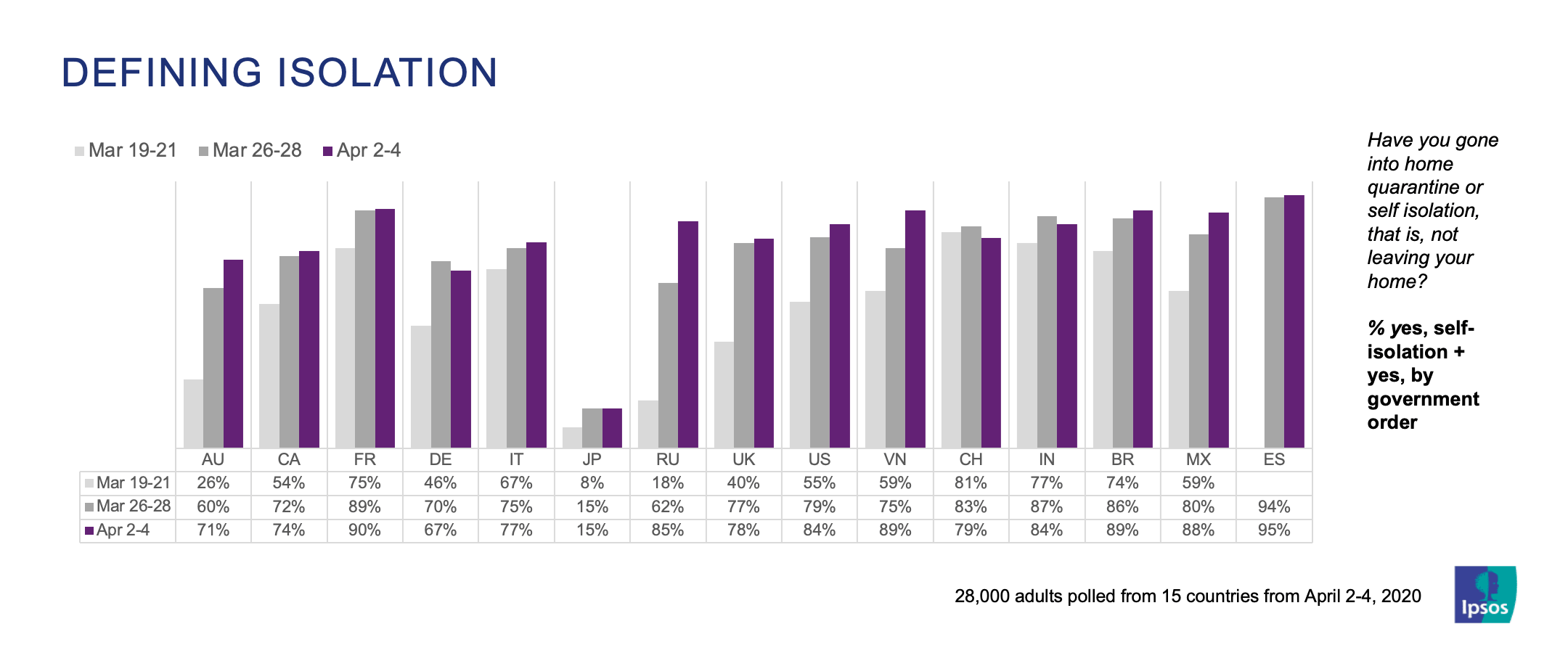
Defining isolation | How have you gone into home quarantine or self isolation, that is, not leaving your home? | Ipsos polls | Global @dvisor

These are the results of an Ipsos survey conducted April 2nd to 4th, 2020 on the Global Advisor online platform among 28,000 adults aged 18-74 in Canada and the United States and 16-74 in Australia, Brazil, China, France, Germany, Italy, India, Japan, Mexico, Russia, Vietnam and the United Kingdom. Where available, tracking results from previous studies, conducted through March and selected results from February are referenced by date.

Related news

  • Ein Foto von Banknoten verschiedener Währungen

    Ipsos Lebenshaltungskostenmonitor 2026

    Die in 33 Ländern durchgeführte Umfrage ergab ein gemischtes Bild: Viele Menschen sind finanziell stabil, aber besorgt über die Zukunft und haben das Gefühl, dass eine Rückkehr zur „Normalität“ immer weiter in die Ferne rückt.
  • AXA-Bericht zu zukünftigen Risiken 2026

    AXA-Bericht zu zukünftigen Risiken 2026

    Künstliche Intelligenz rückt laut dem AXA Future Risks Report 2026 mit dem Titel „The Intergenerational Moment“, der in Zusammenarbeit mit Ipsos bva veröffentlicht wurde, in den Fokus der Experten und steht damit noch vor dem Klimawandel.
  • Ipsos Global Trustworthiness Index 2026
    Vertrauen Nachrichten

    Ipsos Global Trustworthiness Index 2026

    In der siebten Ausgabe des Ipsos Global Trustworthiness Index wurden KI-Chatbots, Tech-Unternehmer und Personal Trainer in den Index aufgenommen.