
Canadians Support Gender Equality, but Younger Men Feel it Discriminates Against Men

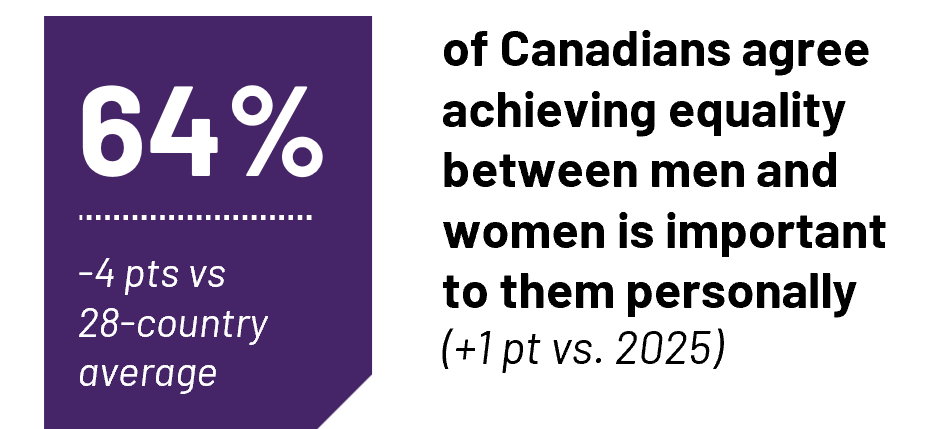
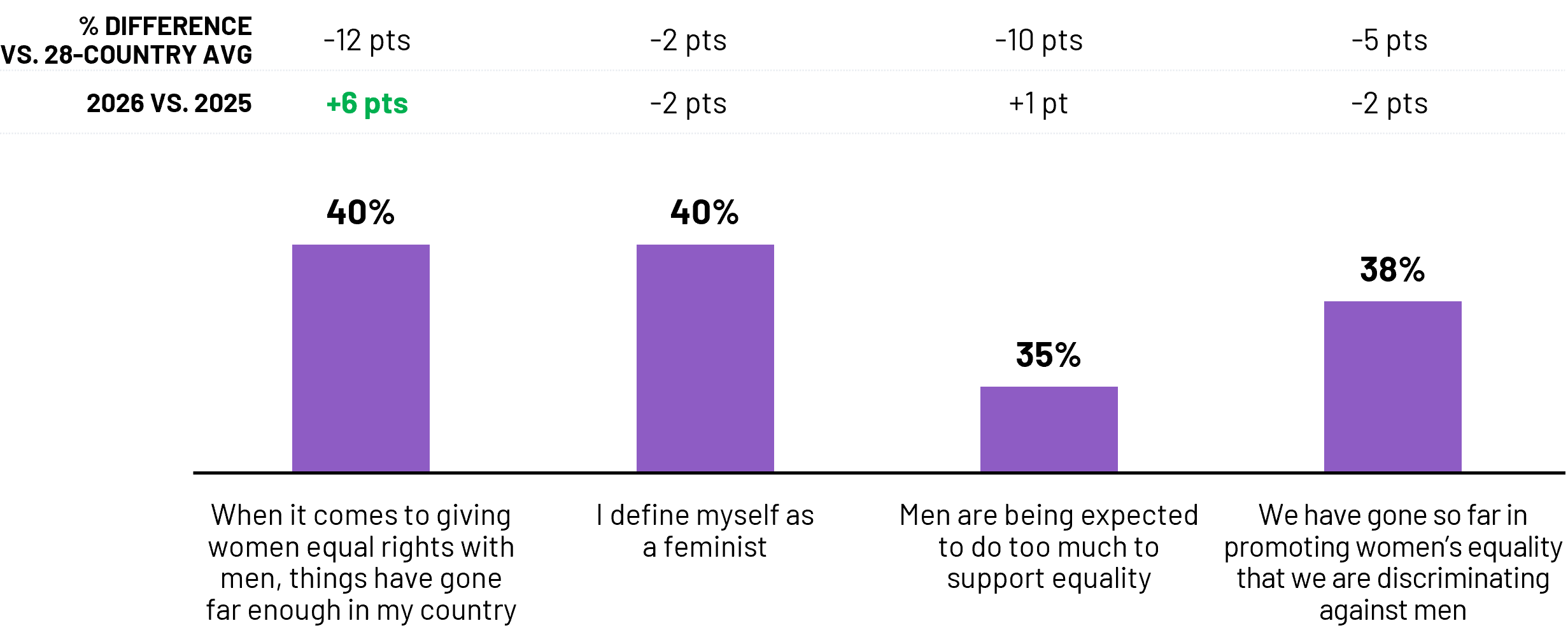
When it comes to attitudes around gender equality, Canadians’ views have remained stable year-over-year: four in ten define themselves as feminists, but the same proportion agrees that we have gone so far in promoting women’s equality that we’re discriminating against men, and one-third feels men are expected to do too much to support equality. The proportion of Canadians who think things have gone far enough (40%) has risen significantly since 2025.
Over half of Canadians agree that women should be included in leadership, both that things would work better if more women held positions with responsibilities in government and in companies and that women won’t achieve equality in Canada unless there are more female leaders. Both views are relatively stable compared to 2025.



When comparing agreement with different aspects of gender roles and responsibilities, Canadians for the most part do not agree with traditional views. For example, around one in ten agree that a wife should obey her husband, or that a husband should have the final world on household decisions.
That said, nearly half of Canadians agree that women are naturally better at childcare than men – though 55% also agree men who take on caring responsibilities are more attractive to women, higher than the 28-country average. While breaking gender stereotypes, namely taking on caring responsibilities, is thought to be beneficial for men in terms of their attractiveness to women, fewer (28%) agree that women who have a successful career are more attractive to men, lower than the 28-country average.

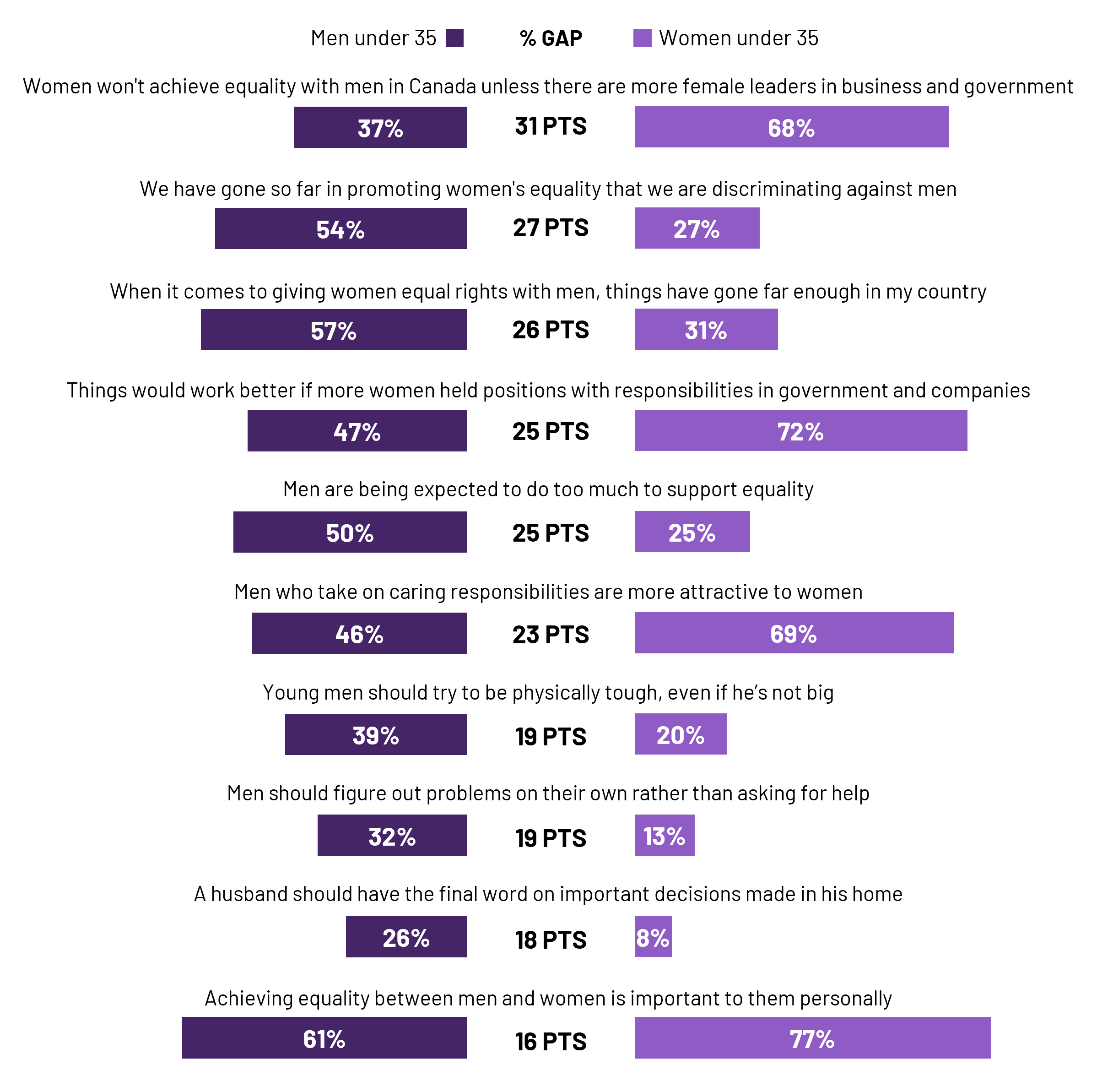
Consistent with 2025, men and women under 35 are divided on key issues relating to gender equality and traditional gender roles and norms. The widest gaps are present in agreement that women won’t achieve equality with men in Canada without more female leadership, that we are discriminating against men in the name of promoting gender equality, that things having gone far enough in Canada when it comes to promoting women’s equality, that things would work better if more women held positions with responsibilities in government and companies, and that men are being expected to do too much to support equality (with half of men under 35 agreeing compared to one-quarter of women under 35).
Although a majority across both groups agrees that achieving gender equality is personally important to them, young women are still 16 points ahead in their agreement compared to young men.

These are the results of a 28-country survey conducted by Ipsos on its Global Advisor online platform between Wednesday, December 24, 2025, and Friday, January 9, 2026. For this survey, Ipsos interviewed a total of 21,028 adults aged 18- 74 in Canada, Republic of Ireland, Malaysia, South Africa, Türkiye, and the United States, 20-74 in Thailand, 21-74 in Indonesia and Singapore, and 16-74 in all other countries. The sample consists of approximately 2,000 individuals in Japan, 1,000 individuals each in Australia, Belgium, Brazil, Canada, France, Germany, Great Britain, Italy, Mexico, Spain, and the U.S., and 500 individuals each in Argentina, Chile, Colombia, Hungary, Indonesia, Ireland, Malaysia, the Netherlands, Peru, Poland, Singapore, South Africa, South Korea, Sweden, Thailand, and Türkiye.
The “28-country average” reflects the average result for all the countries and markets where the survey was conducted. It has not been adjusted to the population size of each country or market and is not intended to suggest a total result. The precision of Ipsos online polls is calculated using a credibility interval with a poll of 1,000 accurate to +/- 3.8 percentage points and of 500 accurate to +/- 5.0 percentage points. Percentages cited may not always add to 100% or to the sum of each value due to the effects of rounding.
For full methodological details on the study, please refer to the full International Women’s Day Global Report.
For more information on this release, please contact:
Sanyam Sethi
Vice President,
Ipsos Public Affairs Canada
[email protected]
Meghan Miller
Director,
Ipsos Public Affairs Canada
[email protected]
Jennie Choi
Research Analyst,
Ipsos Public Affairs Canada
[email protected]

Ipsos is one of the largest market research and polling companies globally, operating in 90 markets and employing nearly 20,000 people.
Our passionately curious research professionals, analysts and scientists have built unique multi-specialist capabilities that provide true understanding and powerful insights into the actions, opinions and motivations of citizens, consumers, patients, customers or employees. Our 75 business solutions are based on primary data from our surveys, social media monitoring, and qualitative or observational techniques.
“Game Changers” – our tagline – summarizes our ambition to help our 5,000 clients navigate with confidence our rapidly changing world.
Founded in France in 1975, Ipsos has been listed on the Euronext Paris since July 1, 1999. The company is part of the SBF 120, Mid-60 indices, STOXX Europe 600 and is eligible for the Deferred Settlement Service (SRD).
http://www.ipsos.com/