

Customer Experience in an Endurance Economy
For years, Customer Experience has been designed around a simple idea: earn attention, create differentiation, and build emotional connection.
Brands invested in standout moments. Seamless journeys. Personalization. Delight.
And for a long time, that worked—because customers had the capacity to notice those things.
Today, sustained financial and psychological constraint is reshaping how decisions are made before Customer Experience has a chance to play its traditional role.
Across Canada, affordability has become a constant consideration rather than a temporary concern. Customers are not just asking what they want from an experience, they are asking what they can sustain.
This shift is subtle, but its impact is profound.
Because before any experience can be evaluated, it now must pass a different kind of test.
From Growth to Endurance
In a growth environment, the role of Customer Experience is relatively clear.
Once a customer chooses to engage, experience becomes the lever that drives preference:
- Making interactions easier
- Creating moments of enjoyment
- Building emotional connection
In that context, differentiation happens early. Experience is what elevates a brand above its competitors.
But the environment has changed.
In what Ipsos describes as the Endurance Economy, customers are making decisions under sustained constraint. Price is a big factor—and the Forces of CX become a heightened filter. Risk tolerance is lower. Expectations of brands are more pragmatic.
This doesn’t mean experience matters less.
Customers are asking:
- Is this affordable?
- Is this predictable?
- Will this work the way I expect it to?
Only after those questions are resolved do other experience elements begin to come into play.
This is the shift captured in the transition from a Growth model of experience to an Endurance model. These are not temporary adjustments. Over time, these behaviours harden into expectations, resetting what customers consider acceptable, fair, and trustworthy.
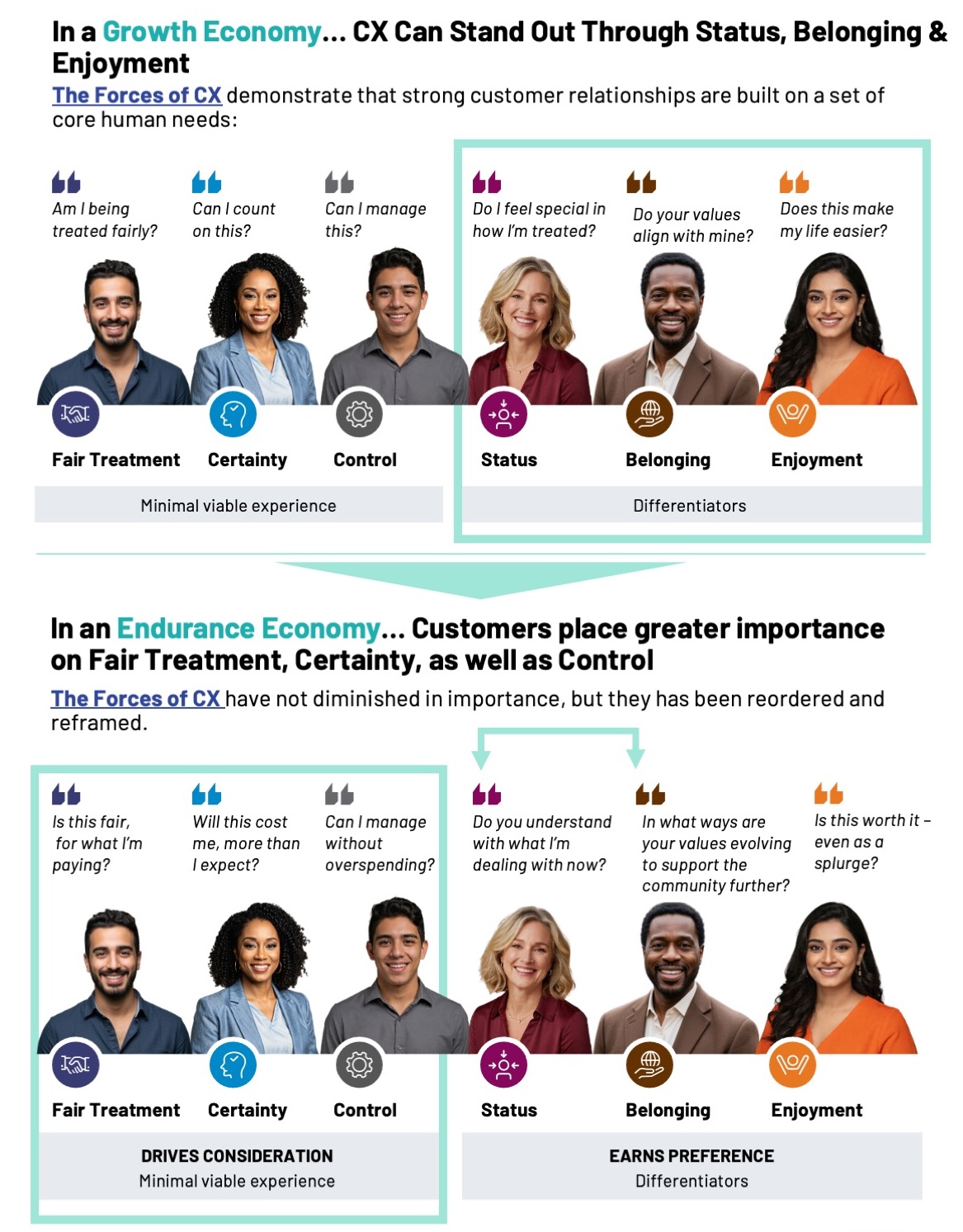
In a Growth context:
- Experience earns preference through differentiation and enjoyment
In an Endurance context:
- Experience must first earn consideration through fairness, certainty, and control
- Then differentiate through status, belonging, and enjoyment
What has changed is not the components of experience, but the order in which they matter.
When the Basics Become Decisive
This reordering is already visible across industries, where the earliest moments of experience are becoming the most critical.
In telecommunications, recent reporting has highlighted a sharp rise in customer complaints, particularly related to billing and service resolution. According to the Commission for Complaints for Telecom-television Services (CCTS), complaints increased by 17% from August 1, 2024 to July 31, 2025, reaching one of the highest levels on record. A significant portion of these complaints are tied to billing discrepancies, unexpected charges, and contract misunderstandings.
In an Endurance Economy, what might once have been considered a service issue is now interpreted as a question of fairness. Customers are less tolerant of ambiguity, and more likely to disengage when expectations around cost and clarity are not met.
In insurance, the claims experience has taken on greater weight. Customers are not just evaluating outcomes, but how those outcomes are reached. Transparency, explanation, and predictability matter as much as speed.
In an Endurance Economy, claims become the primary “trust engine.” Customers want to understand how decisions are made, how amounts are calculated, and whether the process reflects fairness. This is prompting a shift away from competing on price alone, toward delivering clarity and consistency across the end-to-end experience. The experience is judged not only on efficiency, but on whether it feels justified.
In grocery, arguably the most visible expression of this shift, customers are recalibrating their behaviour in real time. Recent national attention on food pricing, including scrutiny around shrinkflation, has heightened sensitivity to perceived fairness. Many Canadians are increasingly frustrated by situations where product sizes are reduced without corresponding price changes, raising concerns about transparency and value.
At the same time, households are actively adjusting behaviour, trading down to private label, seeking promotions, and managing spend more deliberately. In an Endurance Economy, customers are not just asking what they are buying, but whether it is priced in a way that feels justified and transparent.
Across these sectors, a common pattern emerges.
Experience is no longer judged primarily on how it feels at its peak. It is judged on how it performs under pressure.
A Rebalancing of Experience
Ipsos’ work has long shown that strong customer relationships are built on a set of core needs: fairness, certainty, control, belonging, status, and enjoyment.
These needs have not changed.
But their relative weight has.
In the current environment:
- Fairness and certainty have become non-negotiable
- Control has become a critical trust builder
- Belonging is expressed through empathy and relevance under constraint
- Status and enjoyment are still present, but in more contained, intentional ways
This is not a loss of experience richness, it is a redistribution.
What was once assumed to be baseline is now the point of decision.
And what was once the primary driver of differentiation now plays a supporting role.
Where to Focus Next
For leaders, the question is not whether to invest in Customer Experience, but where to rebalance that investment.
A pragmatic starting point is to focus on three areas:
First, ensure the fundamentals hold under pressure.
Pricing, policies, and processes must be transparent, consistent, and defensible. If customers feel surprised or misled, the experience breaks before it begins.
Second, design for control as much as convenience.
Ease of use remains important, but customers are increasingly valuing the ability to understand, manage, and predict outcomes. Control reduces anxiety—and builds trust.
Third, differentiate after trust is established.
Moments of delight and emotional engagement still matter. But their impact depends on a foundation of fairness and reliability. Without that foundation, differentiation is easily overlooked.
From Experience to Endurance
The Endurance Economy is not a short-term cycle. It reflects a broader shift in how customers define value, progress, and trust.
Customers still want meaningful experiences. But increasingly, what feels meaningful is not excess or novelty.
In this context, the role of Customer Experience evolves. It is no longer just about creating standout moments. Because in an Endurance Economy, the brands that succeed will not simply be the ones that impress.
They will be the ones that consistently pass the customer’s test for fairness, predictability, and control—day after day, under pressure.
Building Resilience into Customer Experience – Let’s Connect
For organizations looking to respond, the starting point is clarity: understanding which elements of the experience are now determining consideration, which are sustaining engagement, and which are truly driving preference.
Ipsos’ experience frameworks help quantify these drivers, enabling organizations to identify where gaps exist, prioritize investments, and design experiences that align with today’s realities.
Because in an Endurance Economy, competitive advantage is not created by doing more, it is created by focusing on what matters most.



![[WEBINAR] Global Voices of Experience 2026](/sites/default/files/styles/list_item_image/public/ct/event/2026-02/thumbnail-global-voices-experience_1.jpg?itok=xrYlT82b)