
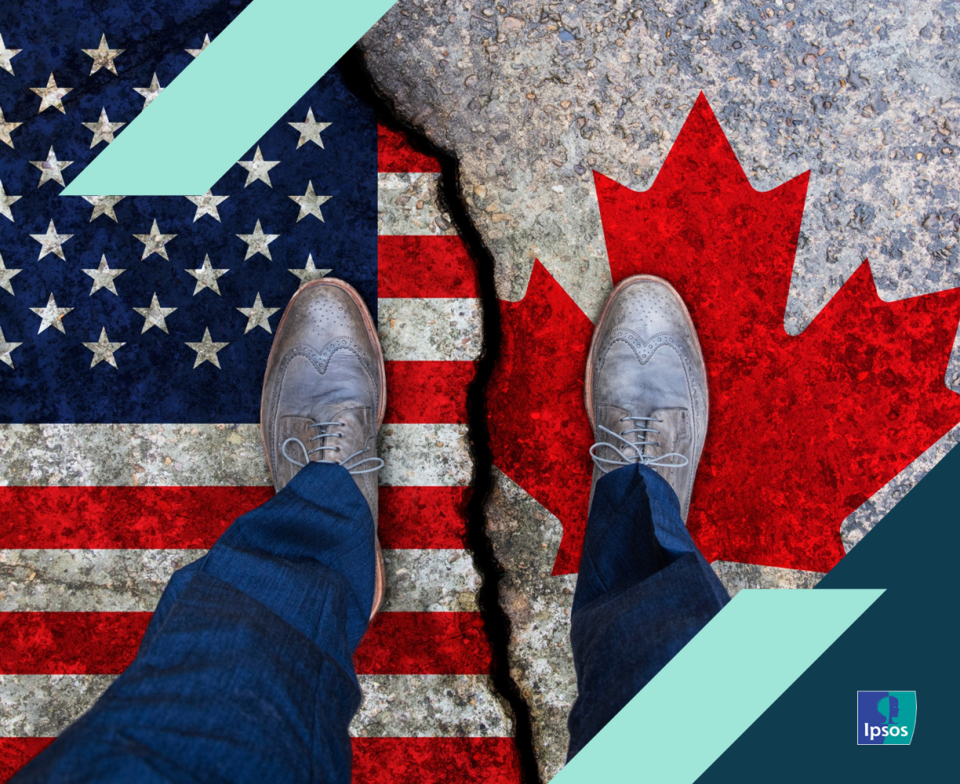
Elbows Up to Eyes Open
What a year of tracking tells us about our relationship with America
When Donald Trump returned to the White House in January 2025, threatening Canada with annexation and tariffs, Canadians responded with fear, anger, and a fierce determination to stand up to America.
"Elbows up" became the rallying cry as 79% believed relations were deteriorating and nearly six in ten immediately began buying more Canadian products. By March, when tariffs became reality, patriotic fervour reached its peak. At that point, 68% supported retaliatory tariffs despite potential costs, and 65% were actively choosing Canadian products over American alternatives.
This emotional response couldn't last. By summer, the new reality had set in, and by December 2025 the exhaustion was apparent in the data. The year that began with defiance ended with weary pragmatism and resolve.
Twelve waves of tracking data from Trump, Tariffs & Turmoil offer us some insights on the year that was, and what may be in store for 2026.
What Changed
The "Buy Canadian" movement proved ephemeral, even if it is not yet completely exhausted. After peaking at sixty-five percent in April, patriotic purchasing steadily retreated to forty-six percent by December, nearly back to February 2025 levels, when we started tracking. The decline was universal across product categories. Even Boomers, who consistently led the “Buy Canadian” charge, showed signs of fatigue.
Economic pragmatism displaced patriotic idealism. While Canadians initially prioritized shared democratic values in trade negotiations, by December they cared most about economic benefits and lower prices. International aid, perhaps once viewed altruistically, has become seen as a tool for advancing Canada's own interests. Support for retaliatory tariffs cooled from its March peak, stabilizing around fifty percent despite continuing provocations. In many ways, Canadians began to echo the president’s “America First” message with a “Canada First” response.
Perceptions of the bilateral relationship itself appear to have transformed. December brought unexpected stabilization, with most viewing relations as unchanged rather than deteriorating. Recession fears dropped below fifty percent for the first time this year, and travel avoidance softened from summer's rigid boycotts. In short, Canadians appear to be getting back to a “new normal.”
What Stayed the Same
Beneath these shifting behaviours, core attitudes set at the start of the year remained frozen. Throughout 2025, roughly half of Canadians consistently maintained they could never trust Americans the same way again. This sentiment proved remarkably stable whether measured in February's initial shock or December's weary calm. Most continued believing current disputes would persist for years, rejecting any notion of quick resolution via Trump’s eventual exit.
The desire to pivot away from America never wavered. Throughout the year, approximately eighty-five percent of Canadians consistently preferred either removing interprovincial trade barriers or developing new international partnerships over strengthening U.S. ties. Support for European partnerships remained steady, and Canadians expressed openness to trade deals with the UK, Netherlands, and Japan, and even China and India to a lesser extent.
"Made in Canada" remained the gold standard for labelling claims, although fewer consumers actively sought such products. If our purchasing habits haven’t been permanently transformed, the attention we will continue to pay to where products are made may be.
A New Normal In Our Relationship With America
Our 2025 data reveal a new normal in Canada-U.S. relations, at least for the foreseeable future. The initial "elbows up" moment gradually gave way to a more sustainable response balancing patriotic preferences with practical realities. Canadians ended 2025 having incorporated American distrust into their worldview while moderating their behavioural responses at the cash register.
This evolution from acute crisis to adapted normalcy may be 2025's most significant development and possibly a sign that Canada is maturing as a nation when forced to confront its sovereignty. Canadians have learned to live with diminished trust in their neighbour while rejecting economic nationalism for themselves. Indeed, there is openness to new trade deals with other countries, but only if those deals benefit Canada and Canadians directly.
Looking Ahead to 2026
2026 may be a year of "cold peace" between Canada and the United States as CUSMA negotiations begin. The stability of distrust throughout 2025 suggests this sentiment has become an embedded feature of the Canadian psyche. The government will no doubt keep this in mind as it approaches making a deal with a negotiating partner we no longer trust.
This baseline skepticism will now colour all bilateral interactions, creating a higher bar for cooperation even on routine matters. Yet exhaustion with active resistance exemplified in the “Buy Canadian” and flag waving is equally clear. The steady decline of “Buy Canadian” behaviours and the pragmatic shift in trade priorities signal that Canadians have moved from asking "how do we fight back?" to "how do we learn to live with this and extract as much as we can?”
We expect Canadians to maintain support for domestic products in categories that matter most emotionally and practically, such as food, financial services, and perhaps alcohol, while abandoning broader boycotts that proved unsustainable.
We also foresee those with means continuing to choose principle over price where feasible, while price-conscious consumers will keep prioritizing their wallets.
Several trends appear poised to accelerate. The consistent preference for new trade partners, combined with Canadians' newfound willingness to prioritize economic benefits over values in trade agreements and in offering foreign aid helps clear the way for supporting trade deals with like-minded allies and even those less like-minded.
These negotiations may achieve higher levels of public support and scrutiny precisely because Canadians now view them through a pragmatic rather than idealistic lens.
Meanwhile, tentative economic optimism evident in December could build into renewed consumer confidence. With recession fears finally dropping below fifty percent and cost-of-living concerns slightly abating, 2026 might see a return to more normal spending patterns.
Economic concerns persist, however, as do fears about inflation and other shocks that could push Canadians back into fearful territory. More trending data will be needed to determine the direction and velocity of any recovery of confidence.
Travel patterns offer another window into normalization. The softening of U.S. travel avoidance in December and the data showing more Canadians planning domestic travel as a preference rather than a boycott of the U.S. suggests the rigid avoidance of summer has passed.
Spring 2026 could see increased cross-border leisure travel, especially among younger Canadians who maintained more pragmatic attitudes throughout the crisis.
Known Unknowns
The wild cards for 2026 remain political and generational. Declining faith in Prime Minister Carney’s ability to negotiate a trade deal suggests Canadians are starting to accept the possibility that a trade agreement with this administration may not be possible. It’s unclear whether this will hurt the prime minister’s polling numbers; so far, it hasn’t.
Goalposts and definitions of success may be shifting in the minds of the public, and merely preserving CUSMA or limiting losses could be seen as a win.
Any major diplomatic breakthrough or another provocation could shift sentiment. Meanwhile, the growing gap between Boomers' sustained activism (which they can afford) and Gen Z's pragmatism (which is all they can afford) will likely add to the distinct consumer segments we have seen emerge in 2025. We believe generational differences will continue to matter as much as regional or gender differences.
Even as we are united in our views of America, social cohesion is frayed in other areas. National unity and provincial sovereignty are also on the agenda for 2026 as Alberta contemplates a separation question and Quebeckers go to the polls with the Parti Quebecois currently leading.
The discussions about Alberta’s and Quebec’s futures will happen in the context of America’s threat to Canada’s sovereignty and the possibility of the United States recognizing a provincial vote for independence or offering a place in the Union to provinces that wish to leave Canada.
The most profound change was not in what Canadians bought, but in what they believe
Conclusion
The most profound change in 2025 was not in what Canadians bought, but in what they believe. Trust in America hasn't healed. Several indicators suggest Canadians have been hardened by the experience with the U.S. Geopolitical instability wrought by the U.S. operations in Venezuela in early January will only add to this view.
The belief that America can't be relied upon as it once was has proven more durable than any boycott or buying pattern.
We now seem to understand that we are responsible for our own economic future, security and sovereignty; that we cannot – and should not - rely on the U.S. or others to ensure it for us. In this way, President Trump did Canada a favour. That may be Trump's legacy to Canada.
2025 challenged Canadians in new ways, coming on the heels of a global pandemic. We lost negotiating leverage, faced emerging internal national unity strains and generational challenges as Canadians faced higher prices and affordability challenges. But arguably, we are stronger as a nation because we are more clear-eyed about our vulnerabilities and more deliberate in our choices.
What emerges next will likely be a quiet, pragmatic nationalism that picks its battles, hedges its bets, and keeps its options open while our relationship with America and other countries is renegotiated in real time.



![[PODCAST] Corporate Wayfinding](/sites/default/files/styles/list_item_image/public/ct/event/2020-12/corporatewayfinding-mike_colledge-cover_art.jpg?itok=XV2mM_2T)