

Fewer Albertans Feel Underserved by Confederation Now Than In 2019

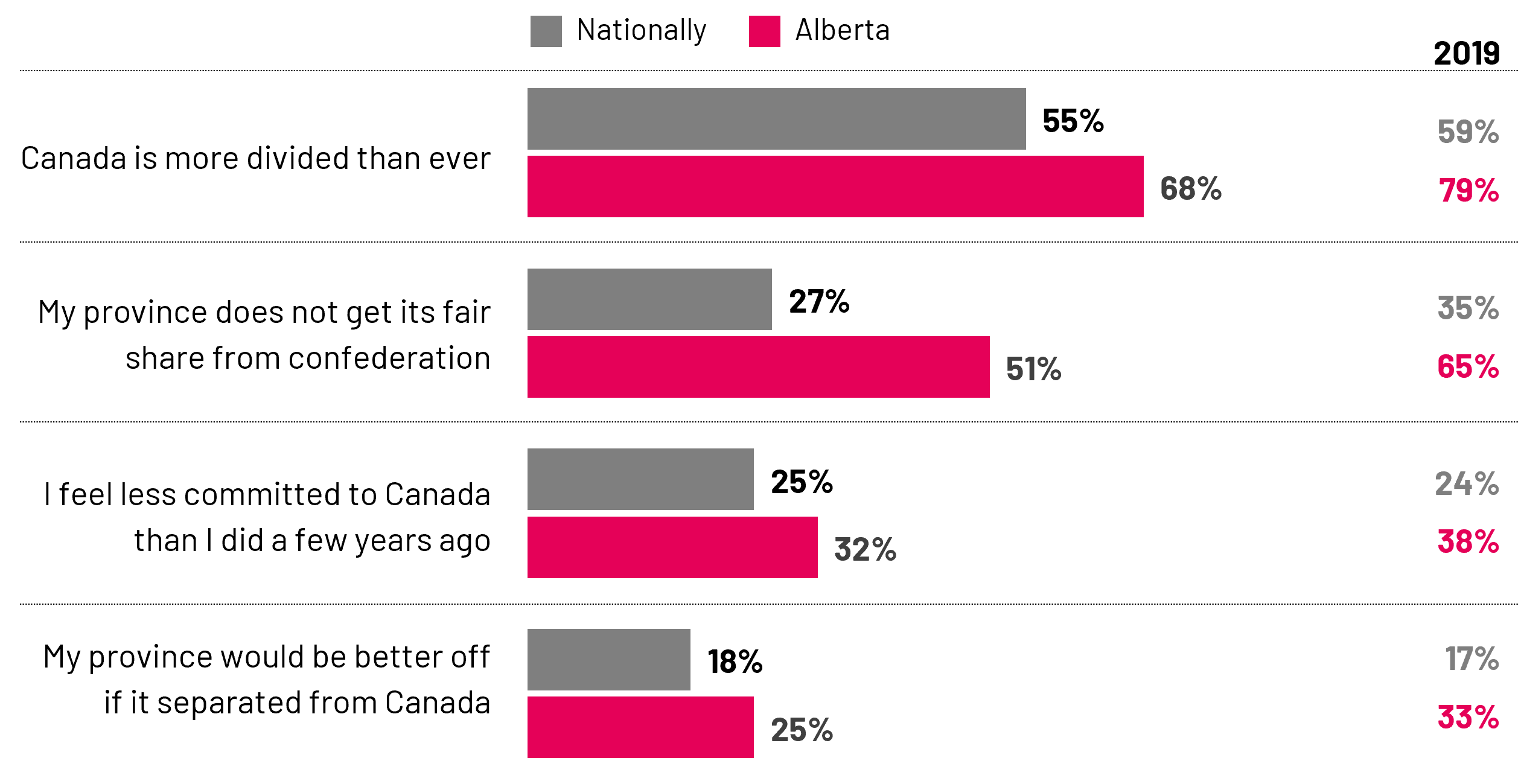
New Ipsos research finds that while half of Canadians overall agree Canada is more divided than ever, this is four points lower than it was just after the 2019 federal election. Similarly, around one-quarter nationally agree that their province does not get its fair share from confederation and that they feel less committed to Canada than they did a few years ago, eight points lower than in 2019 in the former case.
Scores across these metrics are higher in Alberta than nationally, but Albertans are also less likely now to say the country is more divided than ever, or that their province does not get its fair share. The number saying Alberta would be better off if it separated from Canada is also down, despite increased talk of separation. These findings suggest Canadians feel better about the country overall than they did just before COVID-19, when national unity was under pressure following the election of a minority Liberal government with no seats west of Manitoba.
Separatist support in Alberta in particular is actually lower today than it was then, and only a slight majority (51%) agree Alberta does not get its fair share from confederation, compared to two-thirds (65%) in 2019.

These are some of the findings of an Ipsos poll conducted between January 9 and 14, 2026, as part the Confederation Stress Test study. For this survey, a sample of n=2,000 Canadians aged 18+ was interviewed online via the Ipsos omnibus using our proprietary iSay panel. The survey includes a sample of n=500 in Alberta. Quotas and weighting were employed to balance demographics to ensure that the sample's composition reflects that of the Canadian population according to Census data and to provide results intended to approximate the sample universe. The precision of Ipsos polls which include non-probability sampling is measured using a credibility interval. In this case, the national poll is accurate to within ± 2.7 percentage points, 19 times out of 20, had all Canadians aged 18+ been polled. The Alberta sample is accurate to within ± 5.4 percentage points. The credibility interval will be wider among subsets of the population. All sample surveys and polls may be subject to other sources of error, including, but not limited to coverage error, and measurement error. Ipsos abides by the disclosure standards established by the CRIC, found here: https://canadianresearchinsightscouncil.ca/standards/
For more information on this news release, please contact:
Darrell Bricker, PhD
CEO, Ipsos Global Public Affairs
+1 416 324 2001
[email protected]

Our passionately curious research professionals, analysts and scientists have built unique multi-specialist capabilities that provide true understanding and powerful insights into the actions, opinions and motivations of citizens, consumers, patients, customers, or employees. Our 75 business solutions are based on primary data from our surveys, social media monitoring, and qualitative or observational techniques.
“Game Changers” – our tagline – summarizes our ambition to help our 5,000 clients navigate with confidence our rapidly changing world.
Founded in France in 1975, Ipsos has been listed on the Euronext Paris since July 1, 1999. The company is part of the SBF 120, Mid-60 indices, STOXX Europe 600 and is eligible for the Deferred Settlement Service (SRD).
http://www.ipsos.com/


