Canadian Sentiment Continues to Deteriorate (-6 points in October) as Ipsos Disruption Barometer now at Lowest Level since Start of Pandemic
Toronto, ON, October 17, 2020 – The Canadian Ipsos Disruption Barometer (IDB) hit an all-time low in April 2020 (-24%) due to the widespread social and economic shutdown required to slow the spread of COVID-19 across Canada. As of October, the IDB is once again moving toward that all-time low and now sits at -18%.
While the summer months offered a reprieve in the number of COVID-19 cases being identified, it did little to make Canadians more confident about the economy or their personal prospects. Confidence rebounded briefly in May, June and July as income supports kicked in and the health system avoided crisis. But by August, long before the most recent rise in COVID-19 cases, it was in sharp decline again showing that Canadians very much doubted the fundamentals of the recovery.
The Ipsos Disruption Barometer measures the sentiment of citizens and consumers in 28 countries every month. As a measure of both social and economic sentiment, it serves as a lead indicator on economic issues by identifying the context in which consumer-facing business are operating. When it remains low over a sustained period it is a harbinger of things to come, showing when the climate is ripe for social disruptions and political change.
Canadians entered 2020 on a down note (-7% in December 2019) and their social and economic confidence declined sharply with the rise of the pandemic. October’s IDB score of -18% signals a return to a tight consumer market and an unforgiving political climate as we enter the fourth quarter of 2020. Overall it looks like the recovery for those areas of the economy that are dependent on positive consumer sentiment will be on a prolonged track. If we see a K-shaped recovery we are also likely to see increased tensions between segments of the population based on age, income, sector of employment, region, home ownership, etc. Finally, the politics of the pandemic will no longer be marked by unquestioned, majority support for governments to act as they see fit to tackle the crisis. Instead we will see government actions challenged, and people will take positions based on their economic and community interests.
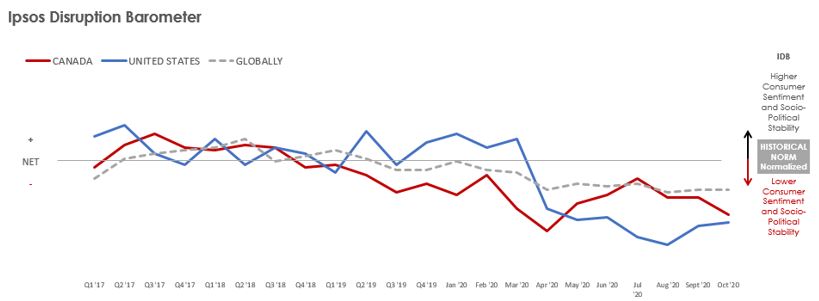 From a social cohesion perspective, the overall score hides significant cleavages that are developing across Canada, as the IDB currently ranges from a low of -26% in Ontario to a high of -7% in Saskatchewan and Manitoba. As the table below indicates, all except Ontario have made gains since their early pandemic low water mark in April. Other worrying splits include the difference between generations (+3% for Gen Z vs -23% for Boomers) and income (-40% for low income Canadians vs -6% for high income Canadians). These differences point to the potential development of regional and/or generational conflict as Canada navigates an unequal recovery from the pandemic.
 Other metrics which run in accordance with the declining confidence of the IDB include a -3pt decline (from September to October) in comfort making a major purchase and a -15pt decline in positive projections for the six-month outlook of their regional economy. Of note, there has been a +4pt increased in job security since September (still -14pts below March 2020). The public link between job security and personal economic expectations has long been severed and was evident as far back as the fourth quarter of 2018 when the IDB dipped into the negative despite near record levels of employment across Canada. From an international perspective, Canada is now close to being on par with the United States in terms of citizen/consumer confidence (-18%vs. -21% in the US). Canadians are very focussed on the US election and the spread of COVID-19 across the United States. Despite the steady stream of negative coverage and a divided electorate, Canadians demonstrate only slightly more positive sentiments than Americans.
About the Ipsos Disruption Barometer
The Ipsos Disruption Barometer (IDB) includes an element of “consumer confidence,” as well as “social” inputs and as such is a more sensitive measure than traditional consumer confidence indices. It is an index of 7 inputs (i.e., country right track, country satisfaction, national economy, personal finances, job security, etc.) and the full report and demographic analysis is available to Ipsos Context clients.
About the Study
These are some of the findings of a monthly Ipsos poll conducted between September 25 to October 9, 2020. For this survey, a sample of 1,000 Canadians aged 18+ was interviewed online. Quotas and weighting were employed to ensure that the sample’s composition reflects that of the Canadian population according to census parameters. The precision of Ipsos online polls is measured using a credibility interval. In this case, the poll is accurate to within ± 3.5 percentage points, 19 times out of 20, had all Canadians aged 18+ been polled. The credibility interval will be wider among subsets of the population. All sample surveys and polls may be subject to other sources of error, including, but not limited to coverage error, and measurement error.
For more information on this news release, please contact:
Mike Colledge
President, Ipsos Public Affairs
613-292-0253
About Ipsos
Ipsos is the world’s third largest market research company, present in 90 markets and employing more than 18,000 people.
Our passionately curious research professionals, analysts and scientists have built unique multi-specialist capabilities that provide true understanding and powerful insights into the actions, opinions and motivations of citizens, consumers, patients, customers or employees. We serve more than 5000 clients across the world with 75 business solutions.
Founded in France in 1975, Ipsos is listed on the Euronext Paris since July 1st, 1999. The company is part of the SBF 120 and the Mid-60 index and is eligible for the Deferred Settlement Service (SRD).
ISIN code FR0000073298, Reuters ISOS.PA, Bloomberg IPS:FP