
Few (6%) Canadians Think Privatization Is Best Way To Fund A Sustainable Health Care System, Preferring to Increase the Services Health Care Practitioners Provide (43%) and Focus On Prevention (22%)
Toronto, ON, October 3, 2019 — As the electoral clock ticks closer to Election Day, party leaders are vying for votes by addressing the issues that Canadians care about the most. Recent Ipsos polling on behalf of Global News has revealed that this time around is no different from previous elections when it comes to the top issue on Canadians’ minds: health care. Wait times in hospitals, affordable prescription medications, and high-quality care are all the top concerns.
One proposal that alleviates overburdened hospital waiting rooms is to introduce more privatization into the public health system. However, few (6%) Canadians believe that this is the best way to fund a sustainable health care system for the future, instead favouring solutions such as increasing the services that nurse practitioners, pharmacists, and other health care practitioners can provide (43%) and focusing on prevention and healthy lifestyles (22%). However, within this small proportion of supporters, men (8%) are more likely than women (3%) to favour privatization as the best way, as are voters who have decided to support the Conservatives or are leaning that way (10%).
It’s a Private Matter
Although more privatization comes in last among the main ways Canadians would like to sustainably fund their health care system, the private sector nonetheless has played a role providing health care in Canada, particularly when it comes to dental care, eye care, and prescription drugs. Furthermore, developments such as the 2005 Chaoulli case before the Supreme Court have in some ways protected the role that privatization has had in Canadian health care.
It is clear that Canadians feel their own health system under strain with an ageing population, and this may help explain why half (52%) agree (13% strongly/40% somewhat) that allowing the privatization of some health care services would alleviate the burden on wait times at clinics and hospitals. However, those over 55 years are the most likely to disagree with that statement (41%, 17% strongly/24% somewhat).
When asked under which conditions would Canadians be more amenable to increasing the amount of privatized health care services offered in their province, they overwhelmingly expressed support for strengthening the public system. Over 8 in 10 (84%) said they would be more tolerant of private-sector involvement in the provision of health care in their province if it meant more doctors in the public health care system in their province. A similarly high proportion (82%) would support the private sector if it meant greater sustainability in funding for their province’s health care system.
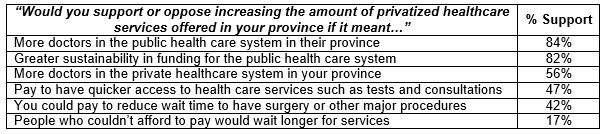 However, Canadians would be less supportive of privatized health care if it somehow had the result of harming equality of access to the system, though there are some important differences when it comes to age. Less than half (47%) say they would allow private health care if it meant that one could pay to have quicker access to services such as tests and consultations, something that Canadians aged 18-34 years support in a higher proportion (58%). A smaller percentage (42%) said they would be supportive if one could pay to reduce the waiting time to have surgery or other majority procedures, with this proportion higher among younger Canadians (51%).
Lastly, Canadians are the least supportive of the idea that private-sector involvement would mean that those who could not afford to pay would wait longer for services, as less than 2 in 10 (17%) accept that result as a knock-on effect. Younger Canadians (aged 18-34 years) are still more open to the idea (26%), whereas those Canadians over 55 years are more likely to find that prospect particularly virulent (90% disagree). It remains to be seen whether this trend is a life cycle or generational effect in the population and whether this means we will be seeing softening attitudes toward privatization in the coming years.
About the Study
These are some of the findings of an Ipsos poll conducted between September 27 and 30, 2019, on behalf of Global News. For this survey, a sample of n = 1489 Canadians aged 18+ was interviewed online via the Ipsos I-Say panel and non-panel sources. Respondents earn a nominal incentive for their participation. Quotas and weighting were employed to balance demographics to ensure that the sample's composition reflects that of the adult population according to Census data and to provide results intended to approximate the sample universe (weighting efficiency = 63.9%). The precision of Ipsos polls which include non-probability sampling is measured using a credibility interval. In this case, the poll is accurate to within ± 2.9 percentage points, 19 times out of 20, had all Canadians been polled. The credibility interval will be wider among subsets of the population. All sample surveys and polls may be subject to other sources of error, including, but not limited to coverage error, and measurement error. Ipsos abides by the disclosure standards established by the CRIC, found here: https://canadianresearchinsightscouncil.ca/standards/
© 2019, Ipsos Limited Partnership
This polling release and the data contained in it are the sole and exclusive property of Ipsos. They are NOT designed to support any election outcome or prediction model and no license to use the polling release or the data is either granted or implied by their publication. Ipsos does not endorse, and has no responsibility for the accuracy of, the result of any predictive model that incorporates this polling data. Furthermore, any use of this information to produce polling aggregations or election models without Ipsos’ written permission will be considered a violation of our intellectual property, and Ipsos reserves the right to take appropriate legal action. Detailed tabular data tables can be found here: https://ipsosintelligence.ca/canadiancontext/
For more information on this news release, please contact:
Darrell Bricker, PhD
CEO, Ipsos Global Public Affairs
416-324-2002
About Ipsos
Ipsos is the world’s third largest market research company, present in 90 markets and employing more than 18,000 people. Our passionately curious research professionals, analysts and scientists have built unique multi-specialist capabilities that provide true understanding and powerful insights into the actions, opinions and motivations of citizens, consumers, patients, customers or employees. We serve more than 5000 clients across the world with 75 business solutions. Founded in France in 1975, Ipsos is listed on the Euronext Paris since July 1st, 1999. The company is part of the SBF 120 and the Mid-60 index and is eligible for the Deferred Settlement Service (SRD). ISIN code FR0000073298, Reuters ISOS.PA, Bloomberg IPS:FP www.ipsos.com


