
Liberals (40%) Lead Conservatives (35%) Among Those Born Outside of Canada
Toronto, ON, October 8, 2019 — Canada has long had a reputation for welcoming people from all over the world and the number of foreign-born Canadians has been on the rise. Their reasons for choosing Canada are diverse – be it the attraction of high-quality jobs, a world-class education system, or a haven from war and persecution. Many fill gaps in the labour market, contribute tax revenue to the country’s social safety net, and enrich the country’s cultural tapestry. But what is on the minds of foreign-born Canadians as they prepare to vote later this month?
The latest polling figures from Ipsos reveal that among those citizens who were not born in Canada, the Liberals have a five-point advantage over the Conservatives. Furthermore, many foreign-born Canadians reside in swing ridings in British Columbia and Ontario. While this may seem like good news for the Liberals, the flip side is that these voters are more likely to have economy as a top-of-mind issue, something that traditionally favours the Conservatives.
Why Care about How Immigrants Vote?
Firstly, it is important to clarify that foreign-born Canadians do not constitute a monolithic block with a unified stance on political issues. Just as how the views of any Canadian vary based on life experiences, those of Canadian citizens who were born abroad are also diverse. However, to make meaningful comparisons between groups, we will be taking a closer look at two main groups: those who report being born in Canada and those born outside of Canada.
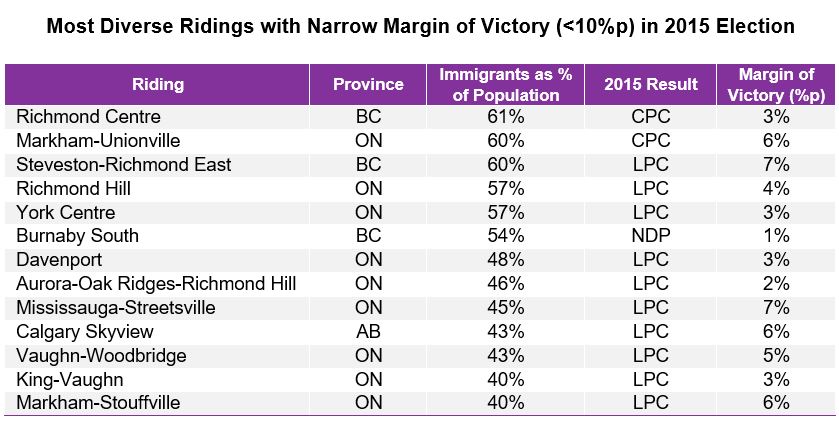
Of the top 50 ridings with the largest percentage of immigrants, 13 were won in the 2015 election by a margin of less than 10 percentage points. Of these ridings, ten were won by the Liberals, two by the Conservatives, and one by the NDP (with the latter being held by NDP leader Jagmeet Singh). Several of these ridings are also newly-created ridings from the federal electoral redistribution that took place in 2012, further highlighting the demographic growth that these areas have seen. As party leaders hit the road to court potential voters all over the country, they have plenty of reasons to pay attention to how those Canadians born outside of Canada will have their say in certain key ridings.
What Issues Do They Care About?
Born in the country or outside of it, Canadians of all origins face many of the same issues every day. Therefore, it is no surprise that birthplace does not have a significant impact on the top issues that will determine how people will vote. Health care remains the top issue, followed by climate change, affordability, taxes, and the economy. Canadians born outside of Canada share the same concerns. Health care is their top concern (35% v. 36% born in Canada), but the economy (29% v. 23% born in Canada) sneaks in before climate change (28% v. 30% born in Canada), affordability (26% v. 26% born in Canada), and taxes (25% v. 24% born in Canada).
Are there any issues where foreign-born Canadians differ from those born in Canada? Those born outside of the country are more likely to rank racism/discrimination as part of their top three issues, though this proportion remains quite small (5% v. 2%). On an issue such as immigration, where one might suspect to see some difference between these two groups, there is no statistical difference (17% foreign-born, 13% born in Canada).
How Do They Feel About Trudeau?
On a national level, Trudeau’s approval rating has veered into net negative territory over the course of the Liberal government’s mandate. In fact, the latest Ipsos polling shows that more Canadians disapprove of the government’s performance than approve of it. When looking at how Canadians born outside of Canada view the past four years, are they won over by Trudeau’s emphasis on multiculturalism and diversity?
The data reveal that those born outside of Canada are more likely than those born within Canada to approve of the Trudeau government’s performance. However, this bump for the Liberals just means that the scales are more or less evenly balanced; half (49%) of those born outside of Canada approve of the government’s performance, while the other half (51%) disapprove.
Despite this split down the middle over the Trudeau government’s record, those born outside of Canada are still more likely to say that Justin Trudeau would be best prime minister (41%) than those born in Canada (33%). When it comes to support for Andrew Scheer as the best choice for PM, there is no statistically significant difference based on place of birth, though Scheer has a slight advantage among those born in Canada in absolute terms (32% v. 30%).
How Will They Vote?
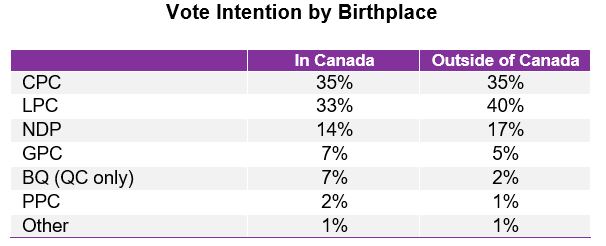
When it comes to who they intend to vote for, there are small differences between those born in Canada and those born outside of Canada. Overall, those born in Canada give a razor-thin advantage to the Conservatives (35%) over the Liberals (33%), whereas those born outside of Canada prefer the Liberals (40%) to the Conservatives (35%). The NDP is more likely to be favoured among those born outside of Canada (17%) than by those born within Canada (14%) and the Greens have a slight advantage among those who born in Canada (7%) over those who were not (5%).
Will They Show Up to Vote?
Although they may have been born in another country, Canadians with origins abroad are no less likely than those who were born in Canada to show up to vote, either on October 21 or through advance/special ballots. Six in 10 (59%) Canadians born outside of Canada say they are completely certain they will vote, roughly the same proportion as those Canadians born in Canada (63%).
About the Study
These are some of the findings of a series of Ipsos polls conducted between September 20 and October 7, 2019, on behalf of Global News. Samples of n=1500 (September 20-23), n = 1489 (September 27-30), and n = 1502 (October 4-7) Canadians aged 18+ was interviewed online via the Ipsos I-Say panel and non-panel sources. Respondents earn a nominal incentive for their participation. Quotas and weighting were employed to balance demographics to ensure that the sample's composition reflects that of the adult population according to Census data and to provide results intended to approximate the sample universe. The precision of Ipsos polls which include non-probability sampling is measured using a credibility interval. In this case, each individual poll is accurate to within ± 2.9 percentage points, 19 times out of 20, had all Canadians been polled. The credibility interval will be wider among subsets of the population. All sample surveys and polls may be subject to other sources of error, including, but not limited to coverage error, and measurement error. Ipsos abides by the disclosure standards established by the CRIC, found here: https://canadianresearchinsightscouncil.ca/standards/
© 2019, Ipsos Limited Partnership
This polling release and the data contained in it are the sole and exclusive property of Ipsos. They are NOT designed to support any election outcome or prediction model and no license to use the polling release or the data is either granted or implied by their publication. Ipsos does not endorse, and has no responsibility for the accuracy of, the result of any predictive model that incorporates this polling data. Furthermore, any use of this information to produce polling aggregations or election models without Ipsos’ written permission will be considered a violation of our intellectual property, and Ipsos reserves the right to take appropriate legal action. Detailed tabular data tables can be found here: https://ipsosintelligence.ca/canadiancontext/
For more information on this news release, please contact:
Darrell Bricker, PhD
CEO, Ipsos Global Public Affairs
416-324-2001
About Ipsos
Ipsos is the world’s third largest market research company, present in 90 markets and employing more than 18,000 people. Our passionately curious research professionals, analysts and scientists have built unique multi-specialist capabilities that provide true understanding and powerful insights into the actions, opinions and motivations of citizens, consumers, patients, customers or employees. We serve more than 5000 clients across the world with 75 business solutions. Founded in France in 1975, Ipsos is listed on the Euronext Paris since July 1st, 1999. The company is part of the SBF 120 and the Mid-60 index and is eligible for the Deferred Settlement Service (SRD). ISIN code FR0000073298, Reuters ISOS.PA, Bloomberg IPS:FP www.ipsos.com


