As 75th Anniversary of D-Day Approaches, Majority of Canadians Fail Quiz About Canada’s Involvement in Historic Day
Toronto, ON, February 19, 2019 — As the 75th anniversary of D-Day approaches, Canadians were put to the test – and failed – regarding some basic facts about Canada’s involvement in the historic day, according to a new Ipsos poll conducted on behalf of Global News in partnership with Historica Canada. Just 48% of Canadians achieved a score of three or better on the six-question quiz, while only 29% achieved a score of 4 or better.
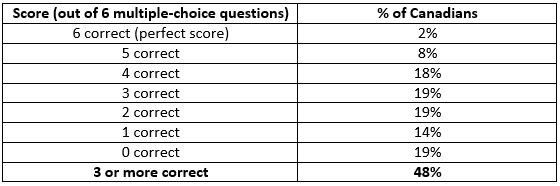 Examining whose knowledge is better than others, based on who answered at least half of the questions correctly:
- Men (54%) were more likely to get at least half correct than women (42%).
- Boomers aged 55+ were more likely to answer at least half correctly (53%) than Gen Xers (48%) or Millennials (41%).
- Those with a university degree (55%) or some post-secondary education (53%) were more likely than those with a high school diploma (42%) or no diploma (25%) to achieve a score of at least 3 out of 6.
- Atlantic Canadians (54%) were most likely to answer at least 3 correctly, followed by those living in Ontario (52%), British Columbia (51%), Saskatchewan and Manitoba (51%), Alberta (46%) and Quebec (37%).
Looking at each of the six questions individually:
- 62% correctly answered that D-Day is the date on which Allied Forces invaded northern France (Normandy) in the Second World War. Others thought it was the date on which Pearl Harbour was bombed (10%), the date on which the First World War ended (6%), Decision Day or voting day in an election campaign (4%), or the Dutch National Holiday (1%). Two in ten (17%) admitted that they did not know.
- Two thirds (68%) know that Canada participated in D-Day, while fewer know that the United States (57%) and United Kingdom (54%) also participated. Others believe that France (40%) or Spain (4%) participated, while as many as 22% don’t know enough to offer an opinion. Only 20% could correctly identify that it was Canada, the US and the UK, specifically, who participated.
- Only 34% knew that D-Day occurred in 1944. Four in ten (38%) said they didn’t know, while 28% offered some other date.
- Six in ten (58%) know that the Allies were fighting Germany on D-Day, while others believe that the Allies were fighting France (11%), England (4%), Russia (3%), or Italy (<1%). One in four (24%) admit that they are not sure who the Allies were fighting.
- Fewer than half (46%) know that Canadian forces landed on Juno Beach while more than one in three (37%) confess that they are unsure which beach Canadians landed on that day. The remaining one in five (17%) offer incorrect responses, including: Omaha (13%), Utah (2%), Gold (1%) or Sword (1%) beaches.
- Only 17% of Canadians know that 14,000 Canadians landed on Juno Beach on D-Day. Most were unable to venture a guess (53%), while others thought the Canadian troops numbered 20,000 (18%), 7,000 (7%), 2,000 (4%) or just 400 (1%).
Majority of Canadians Intend to Learn More about D-Day in Lead Up to Anniversary Commemorations
Perhaps conceding their lack of knowledge about D-Day and its significance in Canadian history, a majority (58%) of Canadians say they will seek out more information on D-Day as the 75th anniversary approaches. Moreover, half (50%) will speak with their friends or family about D-Day as the anniversary draws nearer.
Three in ten (29%) – roughly the same proportion that say they attend Remembrance Day ceremonies –plan to attend a D-Day commemoration event to mark the 75th anniversary in June, 2019. This is led by Canadians living in Atlantic Canada (45%), followed by those in Ontario (33%), Alberta (30%), British Columbia (29%), Saskatchewan and Manitoba (28%) and Quebec (18%).
Minority Believes Canadians know their History and that Students are Taught Enough in School about World Wars
Given the performance of Canadians on the quiz, it’s not surprising that only 46% agree (8% strongly/38% somewhat) that Canadians know a good deal about their history, dropping to 39% in Quebec. As a potential cause of this lack of knowledge, just 39% agree (9% strongly/30% somewhat) that students learn enough about Canada’s role in the First and Second World Wars in school – although there is disagreement among the generations: 54% of Millennials believe they learn enough, dropping to 41% of Gen Xers and 27% of Boomers who believe students learn enough in school about this topic.
In fact, just 27% agree that studying history is not as important as studying math and science, while most (73%) disagree (31% strongly/41% somewhat) with this premise, underscoring the perceived importance. Further, just 22% agree (4% strongly/18% somewhat) that Canadian history is boring, led by Millennials (33%) over Gen Xers (25%) and Boomers (12%).
The perceived deficiency isn’t contained to education, but also to the treatment of our veterans. There is a general consensus that Canada should do more to honour its veterans (89% agree – 44% strongly/45% somewhat).
A majority (52%) also agrees (10% strongly/42% somewhat) that other countries, like the United Kingdom and the United States, do a better job of preserving their D-Day legacy than Canada does.
About the Study
These are some of the findings of an Ipsos poll conducted between February 7 and 11, 2018, on behalf of Global News in partnership with Historica Canada. For this survey, a sample of 1,000 Canadians aged 18+ was interviewed online. Weighting was then employed to balance demographics to ensure that the sample's composition reflects that of the adult population according to Census data and to provide results intended to approximate the sample universe. The precision of Ipsos online polls is measured using a credibility interval. In this case, the poll is accurate to within ±3.5 percentage points, 19 times out of 20, had all Canadian adults been polled. The credibility interval will be wider among subsets of the population. All sample surveys and polls may be subject to other sources of error, including, but not limited to coverage error, and measurement error.
For more information on this news release, please contact:
Anthony Wilson-Smith
President and CEO
Historica Canada
+1 416 506 1867
Sean Simpson, Vice President
Ipsos Public Affairs, Canada
+1 416 324-2002
About Ipsos
Ipsos is an independent market research company controlled and managed by research professionals. Founded in France in 1975, Ipsos has grown into a worldwide research group with a strong presence in all key markets. Ipsos ranks fourth in the global research industry. With offices in 89 countries, Ipsos delivers insightful expertise across five research specializations: brand, advertising and media; customer loyalty; marketing; public affairs research; and survey management. Ipsos researchers assess market potential and interpret market trends. They develop and build brands. They help clients build long-term relationships with their customers. They test advertising and study audience responses to various media and they measure public opinion around the globe. Ipsos has been listed on the Paris Stock Exchange since 1999 and generated global revenues of €1,780.5 million in 2017.