Majority (55%) of Canadians – Both Women (59%) and Men (52%) – Fail True-or-False Quiz about Canadian Women’s History
Toronto, ON, October 15, 2018 — A majority (55%) of Canadians have failed a true-or-false quiz about Canadian women’s history, according to a new Ipsos poll conducted on behalf of Historica Canada. Only 45% of Canadians scored at least 6 correct responses out of 12 to pass the quiz, which covered questions relating to political history, arts and culture, and military history. More specifically, just 3% of Canadians got an “A”, answering 10 or more questions correctly. Another 5% got a “B” (9 questions correct), 9% a “C” (8 questions correct), and 27% a D.
In fact, a majority of both women (59%) and men (52%) failed the quiz. The fail rate was highest in Alberta (62%), followed by those living in British Columbia (57%), Ontario (56%), Quebec (56%), Saskatchewan and Manitoba (45%) and Atlantic Canada (45%). In Saskatchewan and Manitoba and Atlantic Canada, a majority (55%) passed the twelve-question quiz. Six in ten individuals aged 18-34 (59%) and 35-54 (61%) failed, while only 48% of Boomers aged 55+ failed.
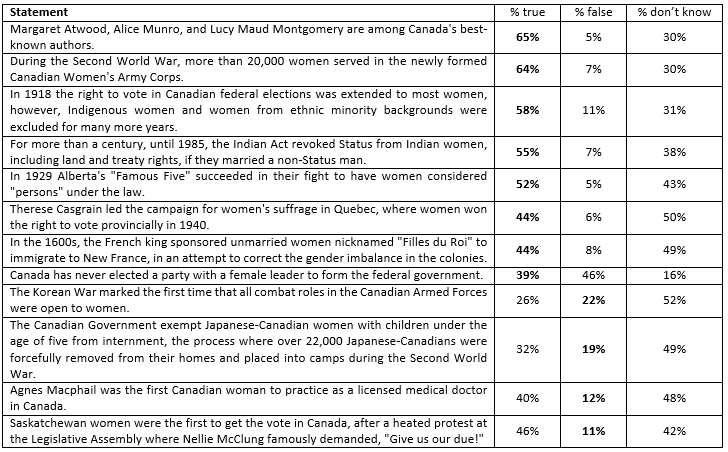
The following chart displays the statements that were posed to Canadians, along with the percentage who believed them to be true, false, or simply didn’t know and didn’t venture a guess. The correct answer is bolded, and results are displayed from the most accurate to the least accurate. While Canadians did a reasonably good job of identifying the truth in correct statements, they did not perform very well at identifying which statements were actually false.
The poll also asked Canadians which famous Canadian woman – living or dead – they would most like to have a meal with. The question was open with no provided answers. Celine Dion came back as the choice of 10% of Canadians – including 12% of women and 15% of Quebecers – making her the Canadian requiring the largest dinner table. Next on the list were Shania Twain (6%), Margaret Atwood (4%), Margaret Trudeau (2%), and Emily Carr (2%). Others receiving at least 2% of the vote are Julie Payette (2%), Anne Murray (2%), Rachel McAdams (2%), Roberta Bondar (2%), Avril Lavigne (2%) and, of course, one’s own mother (2%). Nearly two in ten (17%) Canadians, however, didn’t offer any name.
A few interesting choices:
- Men (3%) were more likely than women (1%) to name Avril Lavigne, as were Millennials (4%) more than Gen Xers (2%) and Boomers (0%).
- Women (2%) were more likely than men (0%) to pick Lucy Maud Montgomery.
- Women (2%) were more likely than men (0%) to mention Jan Arden.
- Boomers (3%) were more likely than Gen Xers (1%) and Millennials (0%) to say Roberta Bondar.
- Boomers (5%) were more likely than Gen Xers (1%) and Millennials (0%) to choose Anne Murray. She was also chosen by more BC (5%) and Atlantic Canadian (4%) residents.
- Boomers (3%) were more likely than Gen Xers (1%) and Millennials (0%) to pick Margaret Trudeau.
- Gen Xers (5%) and Boomers (4%) were more likely than Millennials (1%) to name Margaret Atwood, as were Ontarians (6%).
- Shania Twain was picked by twice as many males (8%) as females (4%). She was also more popular in Saskatchewan and Manitoba (12%), BC (9%) and Ontario (8%) than elsewhere.
- Celine Dion was picked by more women (12%) than men (7%), along with more Quebecers (15%) than elsewhere.
- British Columbians (7%) were more likely than anybody else to choose Emily Carr.
- Julie Payette was mentioned by 5% of Quebecers.
- Rachel McAdams was chosen by 4% of Albertans.
- Viola Desmond was chosen by 7% of Atlantic Canadians.
About the Study
These are some of the findings of an Ipsos poll conducted between September 27 to October 1, 2018, on behalf of Historica Canada. For this survey, a sample of 1,003 Canadians aged 18+ was interviewed online. Weighting was then employed to balance demographics to ensure that the sample's composition reflects that of the adult population according to Census data and to provide results intended to approximate the sample universe. The precision of Ipsos online polls is measured using a credibility interval. In this case, the poll is accurate to within ±3.5 percentage points, 19 times out of 20, had all Canadian adults been polled. The credibility interval will be wider among subsets of the population. All sample surveys and polls may be subject to other sources of error, including, but not limited to coverage error, and measurement error.
For more information on this news release, please contact:
Anthony Wilson-Smith, President and CEO
Historica Canada
+1 416 506 1867
[email protected]
Sean Simpson
Vice President, Canada, Public Affairs
Ipsos
+1 416 324-2002
[email protected]
About Ipsos
Ipsos is an independent market research company controlled and managed by research professionals. Founded in France in 1975, Ipsos has grown into a worldwide research group with a strong presence in all key markets. Ipsos ranks fourth in the global research industry.
With offices in 89 countries, Ipsos delivers insightful expertise across five research specializations: brand, advertising and media; customer loyalty; marketing; public affairs research; and survey management.
Ipsos researchers assess market potential and interpret market trends. They develop and build brands. They help clients build long-term relationships with their customers. They test advertising and study audience responses to various media and they measure public opinion around the globe.
Ipsos has been listed on the Paris Stock Exchange since 1999 and generated global revenues of €1,780.5 million in 2017.