
Misperceptions of How We Die: Canadians Underestimate Toll of Disease, Overestimate Death by Conflict, Terrorism and Violence
Toronto, Ontario, February 23, 2020 — Ipsos’s latest Perils of Perception study tackles a subject that many are keen to avoid: death. The study asked people in 32 countries around the world to make their best guess as to the proportion of people in their country who die from various causes each year. While patterns differ in different countries, overall on average people tend to underestimate how many deaths are caused by cancers and cardiovascular disease, and overestimate how many are caused by HIV/AIDS, transport injuries, substance misuse and violence.
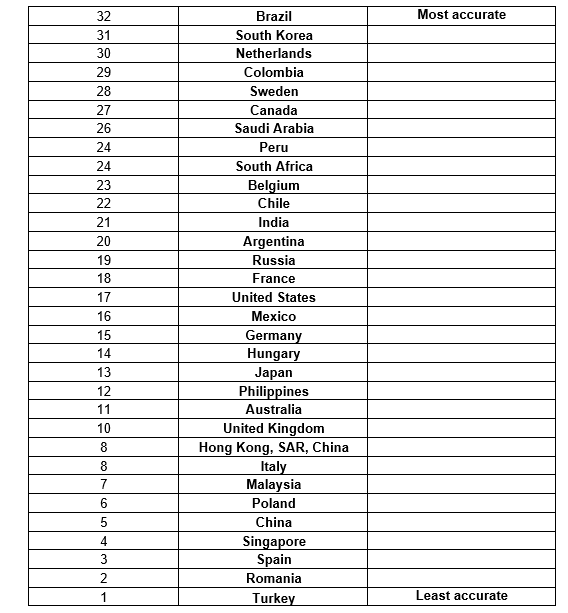
Canadians emerge as relatively successful in their estimates, with Canada ranking 27th overall, placing it among the “least wrong” countries on the Misperceptions Index., France (18th), the United States (17th), Germany (15th), the United Kingdom (10th) were all less accurate, as were many others. Brazil is the most accurate country on the Index, while Turkey holds the dubious distinction of coming in first place – making it the “most wrong” overall.
How Accurate are Canadians?
Despite their comparatively strong performance, many Canadians are well off the mark when it comes to estimating how many people in Canada die from different causes – from cardiovascular disease and cancer to substance use disorders and terrorism.
Diseases and Infections:
- Cancer: Canadians significantly underestimate the proportion of deaths caused by cancer in Canada, with an average guess of 17% compared to the actual figure of 29% - a gap of 12 points. Canada ranks among the least accurate countries, with only the Netherlands, South Korea, France, and Hong Kong being even further off the mark.
- Cardiovascular diseases such as heart disease, strokes, or heart failure: Canadians are 16 points off the mark when it comes to the proportion of deaths caused by cardiovascular disease, guessing 13% on average, compared to the actual 29%. However, Canada is still the 8th most accurate country overall – the least accurate is Romania, where more than half (56%) of deaths are from cardiovascular disease and the average guess is just 12%.
- Neurological disorders such as dementia or Parkinson’s disease: Some 11% of deaths in Canada are caused by neurological disorders. At 5%, Canadians’ average guess is 6 points off, making Canada the 8th most likely to underestimate the prevalence of this cause of death.
- HIV/AIDS or sexually transmitted infections (STIs): Most countries overestimate the prevalence of deaths caused by HIV/AIDS or other STIs, and Canada is no exception with an average guess of 3% versus the actual figure of 0.1%.
Conflict, Terrorism and Violence
- Interpersonal violence such as homicide/murder: All countries surveyed overestimate the proportion of deaths caused by homicide, with Peru the most likely to do so and the Netherlands the least likely. Canada’s average guess, at 6%, is 6 points off the actual figure of 0.2%.
- Terrorism and conflict: With the exception of Saudi Arabia, fewer than 0.5 of every 100 deaths in all countries polled are a result of terrorism and conflict. All countries overestimate the prevalence of this type of death, with Colombia leading the way at an average guess of 11%. In Canada, the average guess is 3%, making Canada the fifth most accurate overall.
Substance Use Disorders
- Substance use disorders such as drug or alcohol addiction: Media reports about overdose deaths from fentanyl and other opioids may have contributed to Canadians estimating that 8% of deaths in Canada are the results of substance abuse disorders, when in reality the figure is 1%. Canada’s guess is the 11th most accurate of the 32 countries polled, all of which overestimated their number of deaths due to substance use disorders.
Suicide
- Suicide: Canadians think that 7% of deaths in Canada are the result of suicide – the actual number is 1%. All countries polled overestimate the local suicide rate, including South Korea, where the actual rate is highest at 5% (lower than the average guess of 12%).
Transport Injuries
- Transport injuries such as road accidents: Two in every ten deaths in Canada are due to transport injuries, while Canadians’ average guess is 7%. Canada falls roughly in the middle of the pack on perceptions of transport injury-related deaths. While all countries surveyed overestimate prevalence to some extent, those in Hong Kong overestimate the most (11-point gap) while those in Russia are the most accurate (3-point gap).
Misperceptions Index
Perceptions Shaped by News Media
What people see in the news is almost certainly influencing their perceptions of how many people die from different causes. Globally, people say they see more news reports of transport injuries (38%), interpersonal violence (37%) and terrorism (35%) than for any other cause of death, which may help explain why their prevalence tends to be overestimated.
Canadians, meanwhile, also say they see transports injuries (45%) most frequently in the news, but reports about cancer (41%) are also commonplace, despite the prevalence of cancer-related death being significantly underestimated. Other frequently reported causes of death in Canada include accidental death such as drowning, fires and falls (seen by 28%), cardiovascular disease (27%), and diabetes or kidney diseases (18%).
Canadians get the bulk of their news from television (27%) or online sources (26%), followed by social media (17%), radio (13%), mobile news apps (5%).
What Affects Us Most
In line with people around the world, Canadians are most likely to have been personally affected by diabetes (63%), cardiovascular disease (61%) and cancer (54%). When it comes to perceptions of the most unpleasant way to die, Canadians tend to think of cancer (38%), transport injuries (22%), HIV/AID (21%) or accidents (21%).
Not only do Canadians think they have least control over suffering a transport injury (29%), an accident (23%) or cardiovascular disease (20%), they are more likely to see these as things that could personally happen to them. One in four Canadians (24%) think they are likely to suffer a transport injury, two in ten (18%) think they will have cardiovascular disease (18%), and 17% think they will be involved in a serious accident. Just 13% think they are likely to get cancer.
About the Study
These are the findings of the Ipsos Perils of Perception Survey 2020. 16,000 interviews were conducted between November 22 and December 6, 2019.
The survey is conducted in 32 countries around the world, via the Ipsos Online Panel system in Argentina, Australia, Belgium, Brazil, Canada, Chile, SAR China, Colombia, France, Germany, Great Britain, Hong Kong, SAR, China, Hungary, India, Italy, Japan, Malaysia, Mexico, Netherlands, Peru, Poland, Romania, Russia, Saudi Arabia, Singapore, South Africa, South Korea, Spain, Sweden, Turkey and the USA.
Approximately 1000 individuals aged 16-74 were surveyed Argentina, Australia, Belgium, Brazil, Chile, China, France, Germany, Great Britain, Italy, Japan, Mexico and Spain. Approximately 1000 individuals aged 18-74 were surveyed in the USA and Canada. Approximately 500 individuals aged 16-74 were surveyed in Argentina, Belgium, Colombia, Hong Kong, SAR, China, Hungary, India, Malaysia, Netherlands, Peru, Poland, Romania, Russia, Saudi Arabia, Singapore, South Africa, South Korea, Sweden and Turkey.
18 of the 32 countries surveyed online generate nationally representative samples in their countries (Argentina, Australia, Belgium, Canada, France, Germany, Great Britain, Hong Kong, SAR, China, Hungary, Italy, Japan, Netherlands, Poland, Singapore, South Korea, Spain, Sweden and United States).
Brazil, Chile, Colombia, SAR China, India, Malaysia, Mexico, Peru, Philippines, Romania, Russia, Saudi Arabia, South Africa, and Turkey produce a national sample that is more urban & educated, and with higher incomes than their fellow citizens. We refer to these respondents as “Upper Deck Consumer Citizens”. They are not nationally representative of their country.
The “actual” data for each question is taken from the Institute for Health Metrics and Evaluation Global Burden of Disease Study (2017). More information can be found at ghdx.healthdata.org/gbd-2017. The source for Hong Kong, SAR, China data is https://www.healthyhk.gov.hk/.
Where results do not sum to 100 or the ‘difference’ appears to be +-1 more/less than the actual, this may be due to rounding, multiple responses or the exclusion of don't knows or not stated responses.
Data are weighted to match the profile of the population.
For more information on this Factum, please contact:
Jennifer McLeod Macey
Vice President, Ipsos Public Affairs
+1 416 324 2108
[email protected]
About Ipsos
Ipsos is the world’s third largest market research company, present in 90 markets and employing more than 18,000 people.
Our passionately curious research professionals, analysts and scientists have built unique multi-specialist capabilities that provide true understanding and powerful insights into the actions, opinions and motivations of citizens, consumers, patients, customers or employees. We serve more than 5000 clients across the world with 75 business solutions.
Founded in France in 1975, Ipsos is listed on the Euronext Paris since July 1st, 1999. The company is part of the SBF 120 and the Mid-60 index and is eligible for the Deferred Settlement Service (SRD).
ISIN code FR0000073298, Reuters ISOS.PA, Bloomberg IPS:FP


