
Trudeau Moves Ahead as Canadians’ Pick for Best PM (37%, +7 pts), Scheer Trails at 30% (-2 pts)
Toronto, ON, September 18, 2019 — As the campaign for the October federal election nears the end of its first week, a recent poll conducted by Ipsos for Global News has found that Justin Trudeau remains Canadians’ favourite pick when asked which party leader would make the best prime minister. Almost 4 in 10 (37%) think that Trudeau would be best suited for the role, up significantly (+7 pts) since the previous Ipsos poll in mid-August. This is some much-needed good news for the Trudeau campaign. Improved fundamentals for the Liberal Party outlined in yesterday’s Ipsos poll may help explain the jump.
Meanwhile three in ten Canadians (30%) would pick Andrew Scheer as best suited for the top job, down 2 points. The other federal party leaders lag behind in terms of being Canadians’ top choice for prime minister: Elizabeth May (14%, -7 pts), Jagmeet Singh (10%, -3 pts), Maxime Bernier (5%), and Yves-François Blanchet (1%, -2 pts).
Although there is no difference in terms of age or gender when it comes to who believes Justin Trudeau is the best fit for the Prime Minister’s Office, Andrew Scheer finds more support among men (34%) and older Canadians (30% among those aged 35-54; 35% among those 55 and over). There is also a regional dimension to Canadians’ preferred choice for prime minister; Quebecers are more comfortable choosing Trudeau as the best potential prime minister (44%), with those in Ontario (39%) and the Atlantic Provinces (37%) not far behind. Those in Alberta (49%) and the Prairies (47%), on the other hand, are more likely to trust in Andrew Scheer.
Keeping Their Promises
Over the next month, party leaders will be trying to convince Canadians that they are the leader that will keep the promises they made on the campaign trail, but on this metric no leader has a clear advantage. Reflecting the deadlock in popular vote, Canadians are equally likely to point to Andrew Scheer and the Conservatives (29%) as they are to Prime Minister Trudeau and the Liberals (29%) as the party that is most likely to keep its promises if elected. Next in line are the Greens (17%), followed by the NDP (16%), People’s Party (6%), and the Bloc Québécois (3%).
With the exception of Canadians aged 55 and over being more likely to trust in the promises of the Conservatives (35%), there are few differences nationwide in terms of gender or age. Once again, there is a strong regional dimension to which federal party and party leader Canadians trust; Albertans tend to trust the Conservative Party led by Andrew Scheer to keep its election promises (51%), while those who tend to trust more in the Liberal Party led by Justin Trudeau are found in Quebec (36%) and the Atlantic Provinces (35%).
Up to the Challenge?
Perceptions of the Liberals’ management of the economy could be a stumbling block for the incumbent prime minister and his team. Asked how the Liberals have managed the economy over the past four years, the public verdict is split; half (49%) approve (9% strongly/40% somewhat) of the job that the Trudeau and his team have done with managing the economy and the other half (51%) disapprove (21% strongly/29% somewhat). Perceptions of the Liberals’ economic management are more positive in Quebec, where 56% approve, while disapproval is strongest in Alberta (70%).
These aren’t the only perceptions that will inform voters’ choice this October. Which party leaders do Canadians see as most up to the challenge, best suited to address a host of specific problems?
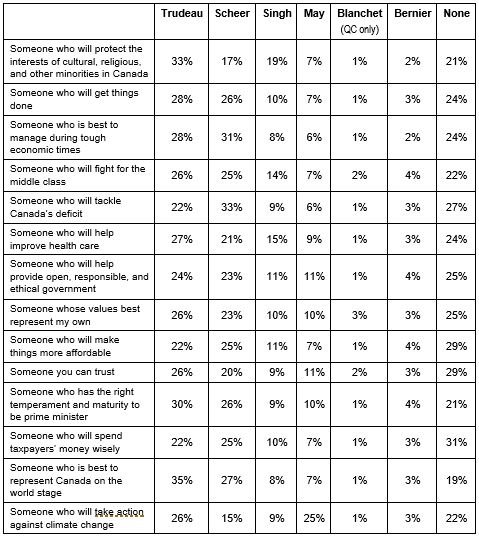
Health care is a top-of-mind issue for many Canadians and when asked which major federal party leader is best described as someone who will help improve health care, they are most likely to choose Justin Trudeau (27%), followed by Andrew Scheer (21%), then Jagmeet Singh (15%), with other party leaders receiving less than 10% of public confidence. Climate change is another top issue at this stage in the campaign: on this issue, Trudeau (26%) is statistically tied with Elizabeth May (25%) as being best described as someone who will take action against climate change. Only 15% say the same for Scheer (15%), and just 9% for Singh.
In several key areas, Trudeau appears to have an edge over Scheer, most notably when it comes to being the best person to:
- Represent Canada on the world stage (35% pick Trudeau, 27% pick Scheer)
- Have the right temperament and maturity to be PM (30% Trudeau, 26% Scheer)
Trudeau leads on protecting the interests of cultural, religious, and other minorities (33% see him as the best person to do this, compared to 17% who say the same for Scheer). By contrast, Scheer is more likely to be seen as the person best able to tackle Canada’s deficit (33%, vs. 22% who choose Trudeau) and manage during tough economic times (31%, vs. 28% for Trudeau). Similar proportions of Canadians see Trudeau (28%) and Scheer (26%) as being best described as someone who gets things done.
Also of note is the proportion of Canadians who said that none of the major federal party leaders were best suited to take up the following roles:
- Spend taxpayer money wisely (31%)
- Make things more affordable (29%)
- Be someone they can trust (29%)
- Tackle the deficit (27%)
- Provide open, responsible, and ethical government (25%)
Question: Which major federal party leader is best described by the following traits?
Whatever the outcome, almost all party leaders have a lot riding on this election in the eyes of many Canadians. Almost six in ten (57%) agree (33% strongly/24% somewhat) that Justin Trudeau should resign as party leader if the Liberals do not win a majority government, and a similar proportion believe the same about Andrew Scheer, should the Conservatives not win the most seats (55% agree). Jagmeet Singh faces less pressure if the NDP don’t win the most seats, but it should be noted that almost half of Canadians (49%) believe he should resign.
Older Canadians are the most likely to think leaders should resign if their party fails to perform well enough at the federal election. This is particularly the case toward Jagmeet Singh (60% of those aged 55 and over think he should resign if the NDP don’t win the most seats) and Andrew Scheer (61% think he should step down as party leader if the Tories don’t win the most seats).
This feeling is also in evidence among the party faithful, and nowhere more than among those who intend to vote Conservative: four in ten decided or leaning Tory voters (43%) think Scheer should resign if the party doesn’t capture the most seats. By contrast, 27% of NDP voters feel the same about Jagmeet Singh, and 29% of Liberal voters echo this opinion about Justin Trudeau if the Grits don’t win a majority government.
What Canadians Want
A majority government is indeed the preferred scenario for a majority of Canadians: about two in three (64%) agree (31% strongly/33% somewhat) they “hope somebody wins a majority government so that we don’t have another election for a while.” By contrast, only four in ten (39%) agree (10% strongly strongly/29% somewhat) they “would be happy with a minority government as a result of this election.”
The overwhelming majority of Canadians (84%) claim they will vote with their hearts, voting for a candidate they believe in, with few (24%) being prepared to back a winning candidate who is not their first choice. Most (62%) agree (23% strongly/39% somewhat) it’s important to them that their MP is a member of the party that forms the government after the election, though 21% disagree and 18% aren’t sure. Ultimately, voter disenchantment risks being a source of apathy on election day: as many as one in three Canadians (36%) agree (11% strongly/25% somewhat) they don’t really like any of the parties in this election – a feeling that is shared by 41% of 18-34 year olds, and 48% of those who say they don’t plan to vote.
The Quebec Question
Given Quebec’s importance in helping to determine the outcome of the election, La Presse and Global News teamed up to conduct an oversample of Quebec voters, yielding a sample of 1,004 Quebecers with which to analyze the province’s unique dynamics during the campaign.
At this stage in the campaign, Justin Trudeau and the Liberals enjoy a large amount of support in Quebec, perhaps a sign that the SNC-Lavalin affair has not damaged support for the prime minister or his party in the province. The incumbent Liberal government enjoys its highest approval level in Quebec (52%), peaking at 66% on the Island of Montreal. Almost half of Quebecers (47%) believe that the Trudeau Government has done a good job and deserves re-election, rising to 62% on the Island of Montreal.
It is also clear that Quebecers prefer Justin Trudeau to all the other federal party leaders: four in ten Quebecers (44%) believe Trudeau is the leader who would make the best prime minister, compared to 23% for Andrew Scheer, 9% for Elizabeth May, 8% for Maxime Bernier, 6% for Jagmeet Singh and 6% for Yves-François Blanchet. Trudeau’s advantage climbs to 59% among those living on the Island of Montreal.
About the Study
These are some of the findings of an Ipsos poll conducted between September 11 and 13, on behalf of Global News and La Presse. For this survey, a sample of n = 2562 Canadians aged 18+ was interviewed. A sample of n = 2062 was interviewed online, via the Ipsos I-Say panel and non-panel sources, and respondents earn a nominal incentive for their participation. A sample of n = 500 Canadians aged 18+ was interviewed by live-interview telephone interviewers by landline and cellphone, using random-digit dialing. Quotas and weighting were employed to balance demographics to ensure that the sample's composition reflects that of the adult population according to Census data and to provide results intended to approximate the sample universe (weighting efficiency = 62.9%). The precision of Ipsos polls which include non-probability sampling is measured using a credibility interval. In this case, the poll is accurate to within ± 2.2 percentage points, 19 times out of 20, had all Canadians been polled. The credibility interval will be wider among subsets of the population. All sample surveys and polls may be subject to other sources of error, including, but not limited to coverage error, and measurement error. Ipsos abides by the disclosure standards established by the CRIC, found here: https://canadianresearchinsightscouncil.ca/standards/
© 2019, Ipsos Limited Partnership
This polling release and the data contained in it are the sole and exclusive property of Ipsos. They are NOT designed to support any election outcome or prediction model and no license to use the polling release or the data is either granted or implied by their publication. Ipsos does not endorse, and has no responsibility for the accuracy of, the result of any predictive model that incorporates this polling data. Furthermore, any use of this information to produce polling aggregations or election models without Ipsos’ written permission will be considered a violation of our intellectual property, and Ipsos reserves the right to take appropriate legal action. Detailed tabular data tables can be found here: https://ipsosintelligence.ca/canadiancontext/
For more information on this news release, please contact:
Darrell Bricker, PhD
CEO, Ipsos Global Public Affairs
416-324-2002
About Ipsos
Ipsos is the world’s third largest market research company, present in 90 markets and employing more than 18,000 people. Our passionately curious research professionals, analysts and scientists have built unique multi-specialist capabilities that provide true understanding and powerful insights into the actions, opinions and motivations of citizens, consumers, patients, customers or employees. We serve more than 5000 clients across the world with 75 business solutions. Founded in France in 1975, Ipsos is listed on the Euronext Paris since July 1st, 1999. The company is part of the SBF 120 and the Mid-60 index and is eligible for the Deferred Settlement Service (SRD). ISIN code FR0000073298, Reuters ISOS.PA, Bloomberg IPS:FP www.ipsos.com


